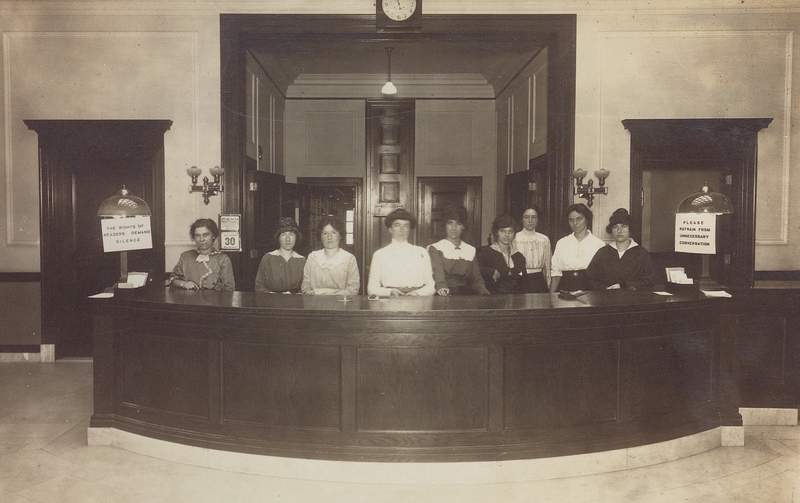
The Tuberculin Test: We would like to call your attention to the fact that everywhere in the United States, doctors and health officers are working very hard to stop the spread of tuberculosis. In our own city Miss Hopkins, Dr. Gumprecht, and Dr. Fellows, the heads of the Anti-Tuberculosis Association in Bangor, are doing their utmost to prevent tuberculosis. However, because of the lack of cooperation on the part of school children, these people can not make much progress. Everyone can help very much by taking the tuberculin test. In a few weeks the freshmen will be asked to take it, so let's cooperate by having 100% of the freshman class taking this harmless test.
Magazine Honors for the Oracle Repeated in 1936: The Oracle in receiving First Class Honors in the Sixteenth All-American Critical Service for Scholastic Magazines, conducted by the National Scholastic Press association, scored eight hundred and ninety-five out of a possible one thousand points. In attaining this recognition the Oracle was in competition with sixteen magazines representing schools from various parts of the United States, with student enrollments ranging from nine hundred to sixteen hundred. The entries in all classes totalled one hundred and fifty-one.
Another American Tragedy by John Lewis: Tragedy again blots the souls of American people people in one of its most fearsome ways. The unfortunate people dwelling in the valley districts of Southern New England, up-state New York, and especially in Pennsylvania, are harrassed by uncontrollable waters. Verdant acres of fertile farmlands are ruined by yellowed waters of once serene rivers. Farm-houses and barns with stock still in them are swept swiftly to destruction. Thriving villages and cities are destroyed by turbulent waters. Comfortable homes of striving laborers are whirled away or ruined. Thousands are driven from their homes, forced to leave most of their possessions behind them to be claimed by angry waters. At the latest report, one hundred fifty-five are dead, and hundreds more missing.
Attitude Toward School: Today's attitude toward school has changed, for the most part, considerably from that of years gone past. If, by chance, it has not, then it should change as soon as possible. In our grandparents' time and even as late as the time when our parents went to school, this institution of learning was much different. They were taught under many disadvantages. The school house in itself was a great hindrance to the teacher and pupil. Also books and facilities inside the school building were not too great a help to the pupil. Thus, with the improvement of school buildings and books, the attitude of a pupil should change to a great extent. These were not the only drawbacks, however. A student of grandpa's time was not made to feel that the school was his, and not being made to feel this, it was necessary for the teacher to watch the pupil every minute. The students were not given any responsibility and therefore could not show their worth. Pupils, however, should be and are, to some extent, given a chance to be responsible for the function of school life. This can be done through cooperation of both the teacher and the pupil.
A Balanced School Life: Do we, as a group, receive benefits in proportion to our labors? Or, and, perhaps, what is more important, do we expend efforts that make us worthy of receiving any reward? Some of us, in less than four short months, will start counting up the profits of our four years at Bangor High School. What will the totals tell? A's, B's, and C's don't count as much as that feeling which tells us we have done our best, indeed, our utmost, to attain respectable rank and to really learn what we set out to learn. Some of us will continue our education further.
Our Understudies: The Oracle wishes to take this opportunity to congratulate the faculties and students of the Mary Snow and Abraham Lincoln Schools for their effort and interest in the publishing of a school newspaper. The three editions of the "Palm Breeze" edited by the pupils of Abraham Lincoln School, last year, met with such enthusiastic approval that the maintenance of the publication for this year was assured... The Mary Snow School prints "Snow Flurries" under a similar plan.
A Student Looks at the Teachers' Convention: Three days not ordinary days, but days of leisure. A half-week's vacation because the teachers are going to hold a "meeting." The foregoing is probably what the student first thinks in regard to the Teachers' Convention. Let's follow it along and see what happens next. These days, and the convention held during them, serve a special purpose. These days are used in improving teaching methods. All this is done evidently upon the theory that better methods of attack--yes, attack upon ignorance--will make up many times over for the few hours lost.
Foreword: The Oracle Board takes pleasure in printing in this number a history of Bangor High School from 1835-1935. The Centennial celebration of our high school is of special interest this year, coming at a time when the whole country is joining with the citizens of Boston in celebrating the three hundredth anniversary of the Boston Latin School, the establishment of which was the beginning of free education in this country.
Scholarship by Isabel Cumming: Professor Brown's purpose in coming to Bangor was to present the high school with a cup won by Andrew Cox, Edward Curran, and Frederick Newman, for scholarship at Bowdoin college. But the cup was not engraved, and Professor Brown was forced to carry on without it. After a glowing tribute to the winning three, of whom Bangor High is justly proud, Professor Brown announced his topic--scholarship.
Debate Club: With its season in full swing, the Debate Club is living up to its reputation for doing things. The Bowdoin league debates found Corinne Adams and Ernest Andrews representing Bangor, with Myer Alpert as alternate. Miss Coffin and Mr. Prescott accompanied the debaters, who left for Brunswick the Friday afternoon before the forum, returning Saturday night after participating in the debates with Edward Little, Jordan, South Portland, Portland, Deering, Gardiner, Foxcroft Academy, and Oxford. Bangor placed third, being three points behind Deering on a basis of 600, Edward Little having won the tournament. Mr. Prescott expressed himself as thoroughly satisfied with the work of Adams and Andrews, saying, "We have won in times past with cases not so good, and we have lost with better. It's all in the game. One judge gave us first place, but the other two didn't see it that way."
Don’t You Love a Parade? Carnivalites on Parade Dec. 7 & 8!! Today and tomorrow, at four P. M. a big parade will march through town and announce that big attraction the carnival, which will take place both before and after the play. The parade will be led by our six cheer leaders, Dot Kamen, Evelyn Nickerson, Barbara Freese, Eleanor Winchell, Marion Small, and Virginia Bemis. Dressed in their red sweaters and white skirts, they will add plenty of color and pep in the line. Directly following them, will be 'the old Ford' newly polished and dressed in festive colors for the occasion.
Student Activities: All the activities are in full swing now. They are positively humming--getting in that state which resembles popping corn. As the enthusiasm waxes the activities begin to pop.
Foreword: In the past fifty years, progress has become increasingly important as the keynote of our civilization. And so it is that today our eyes are directed not toward the past with its great achievements, but toward the future with its far greater possibilities. Our progress, as seniors, has carried through high school, and, as pictured in the cut before the senior division in this ORACLE, the road to success lies ahead. As one of the senior essays says, many will not reach the objective, but the beckoning goal is always in front of us.
Illustrations: When you run through a magazine, naturally the first things that meet your eye are the illustrations. Have you ever stopped to notice the different kinds of illustrations, how some seem clearer than others, how some seem just black and white, while others are shaded? Take, for example, the issue of the Oracle you have in your hands now. There are three differert types of illustrations in this magazine: linoleum cuts, line etch-ings, and half-tones.
Activities of the Dabate Club: The Bangor High School Debate Club has started another season off with a bang, with two of its star debaters, Andrew Cox and Bernice Braidy, winning the first and one of the most important debates of the season the Bowdoin League. This is really a great honor for Bangor High, as they have beaten the champ debaters of the outstanding high-schools and academies of the state.
Parades: October 18 marked the debut of the R. O. T. C.'s public appearance and it was for a worthy cause indeed Bangor's official N. R. A. Day. Taking into consideration the comparatively short time in which this organization had had to become well organized and well versed--especially the sophomores--in the soldier's manual, Bangor High may be well proud of the impressive showing made by Uncle Sam's "Reserve Officers."
The Blue Eagle: The N. R. A. under the sign of the great Blue Eagle is an emergency measure which was initiated by President Roosevelt to put people to work and to get the wheels of industry and business started again. The plan, in brief, puts pressure on one spoke of the wheel in order to set the whole cycle in motion. The purpose is to maintain a definite and constant balance between capital, labor, and consumption. No one of these three essential factors is to get out of proportion; that is, we must have neither too much nor too little of any one factor. Thus, under the N. R. A., the employers put more men to work. These men, in turn, spend their wages for the things they need. The factories, with business booming because of restored buying power, increase production, money begins to circulate freely and we have prosperity again.
Foreword: The many and diversified classes of oracles in ancient Greece acted as intermediates between gods and mortals. Thus Pythia, priestess of the oracle at Delphi--most famous of old oracles--gave responses after being thrown into an ecstacy by a cold vapor issuing from a cleft in the mountain side; this "ecstacy" partially explains the very ambiguous revelations given to the votary. However, all oracular responses were so worded that whatever the outcome of events, the oracles preserved their prestige. A representation of the entrance to an ancient oracle as it may have appeared in former times with its marble walls, tripod, and smoking crevice, appears on the cover. Snakes, which in ancient pictures are many times seen entwined about the temple tripods, and eagles perched on either side of the oracle were regarded with awe. The Sybil, or prophetess, at Cumae sat at the entrance of a cave, wrote messages on leaves and tossed them forth, while the wind gently wafted them about until they became fixed in crannies whence they could be dislodged only with difficulty. The seers decreed that the prophecy was annulled if the order of the leaves was disturbed. Just as the Cumaean oracle, pictured at the beginning of the literary section, tossed forth inscribed leaves to be read by those who would be wise, so seven printed leaves of this ORACLE bring their message to knowledge-seekers. As the oracles of old brought to seekers both fact and fancy, so this ORACLE of today hopes that it has published for the students during the last year a little of the sense and nonsense of school life.
From A Far Land: Bob Cumming will be remembered by his many associates in B. H. S. as a gentleman, as an orator of no mean ability, and as one of our highest ranking scholars. But he will best be remembered as one of the truest friends a fellow can have. Bob's wide grin and his friendly clap on the shoulder are known throughout the class of '33. This year Bob's father is teaching in the American School of Oriental Research in Jerusalem, and Bob is with him, taking classes in the school, and studying hard, he assures us. An important part of the work of the school takes the form of trips to excavations in Palestine, Egypt, and Syria. He is much too busy to write an article for us, he says, but some of us are fortunate in having an occasional letter from him.
Junior Exhibition: On the evening of the issue of this Oracle, March 24, ten juniors, five boys and five girls, will compete in a contest of oratory. The high school orchestra will render several selections during the program, and one hundred and twenty-five juniors, picked from the Festival Chorus, and the Glee Clubs, will sing two choral numbers, Pretty Primrose and Gypsy Lullaby. The speakers are the finalists in a competition in which all juniors are required to participate.
Bangor High School Publications Before 1892: So far as it can be discovered, there were about five different papers published by Bangor High School before 1892, the year in which the Oracle first appeared. These publications, all put out by the students of the school, were newspapers with the exception of a few, of which one was the Mustard Seed. The Mustard Seed and its contemporaries were in manuscript form and were published sometime before the Civil War; the Mustard Seed came out in 1858.
The Journalistic Conference of Kappa Gamma Phi: Eleven years ago, there was founded at the University of Maine, an honorary journalistic fraternity--Kappa Gamma Phi. One of its purposes is to help journalists of secondary publications with their problems. Since the beginning of the fraternity, it has been customary for a yearly journalistic conference to meet in the spring. This year, however, it was thought that the conference would carry more benefit to the participants, if it were held in the fall, since the delegates would then have the rest of the year to apply their ideas. Therefore, the eleventh annual conference of Kappa Gamma Phi met November eighteenth and nineteenth.