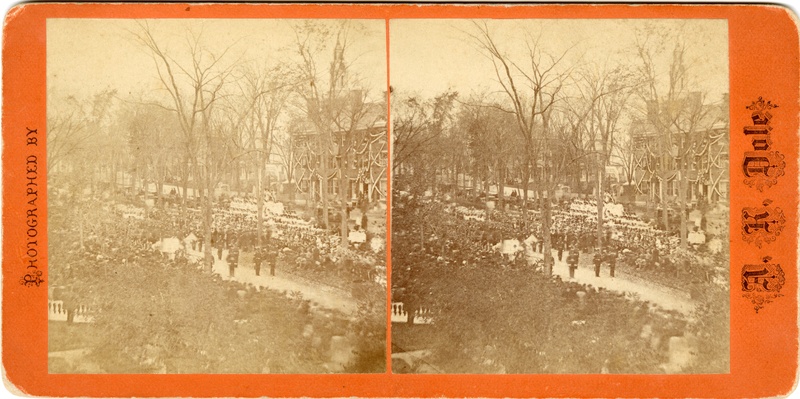
President Ulysses S. Grant arrived with an entourage laden with the influential Maine men in late 1871 in a visit to open the railroad connecting Maine to Canada and thence a steamer line to Europe. The railroad was a significant undertaking, much lauded and full of great expectations in spite of its $4.5 million cost. Grant made several small stops at receptions along the rail line to Bangor, and once he arrived, there were enormous crowds waiting to greet him. This photograph shows the assembled schoolchildren of Bangor waiting along the parade route on Broadway to serenade the President, the Mayor, the Governor General of Canada, and the president of the rail line, who rode together in a carriage. The children sung a song and presented bouquets; one, at the top of the podium, is arrayed as an allegorical Justice. The parade involved all of the Maine regiments, who later passed in review before the President, although the exercise had to be cut short when night fell. Newspapers recorded that several men, mostly Civil War veterans, broke through the barriers along the parade route in order to shake hands with the President, who responded with grace.
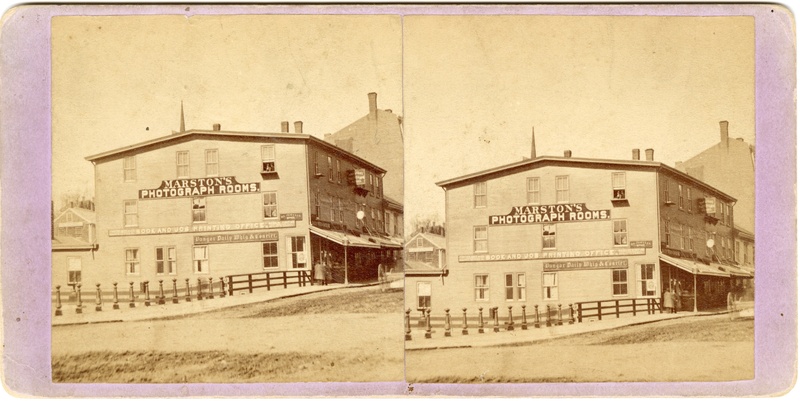
A stereograph showing Marston's Photograph Rooms and office of the Bangor Daily Whig & Courier, 3 Bowman's Block, at the east end of Kenduskeag Bridge.
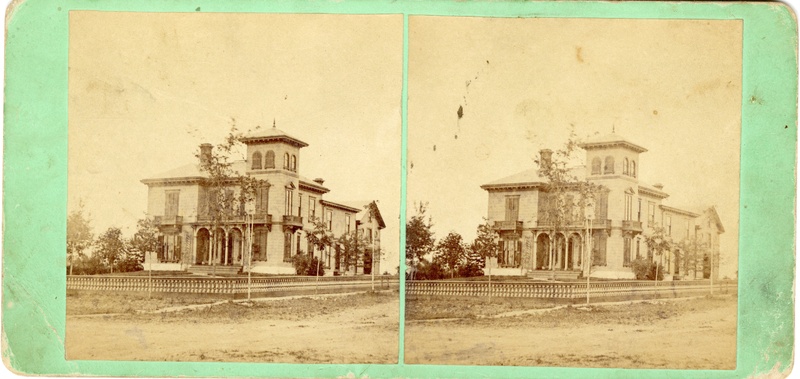
Known as Elmbank, the Henry E. Prentiss House was first owned by Thornton McGaw. It was known as Weed House when it was built in 1835. Details about this earlier house are scarce. Prentiss bought the property and began remodeling it in 1868. He added the mansard roof, which created a full third story, as well as the angled portico, Italianate trim, and a gazebo (not visible in photograph). The house still stands at 31 Kenduskeag Avenue.
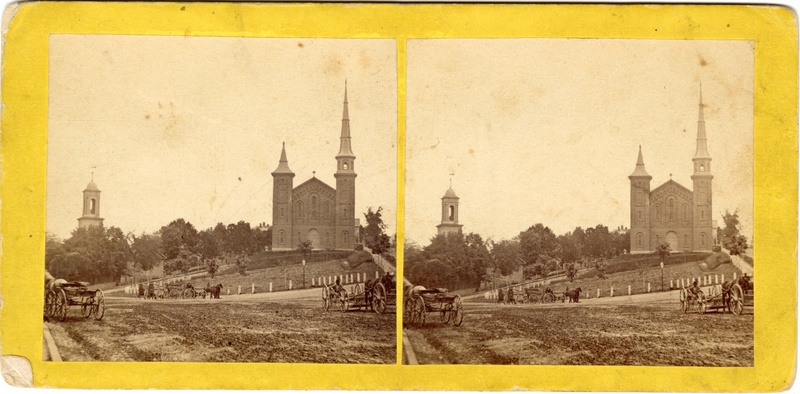
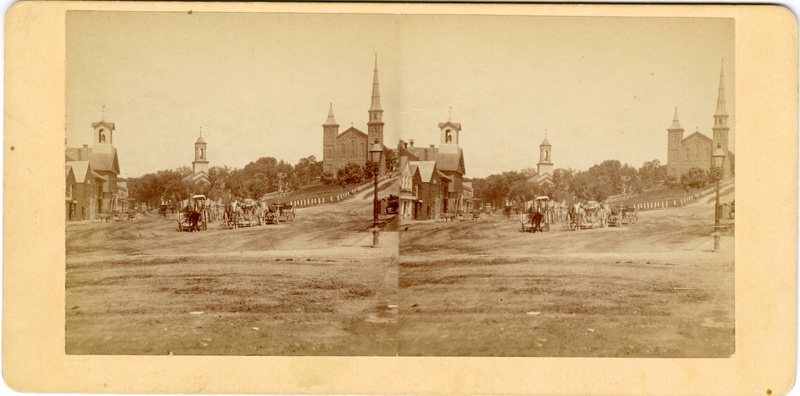
Stereograph showing Bangor's East Market Square bustling with horse-drawn carts and carriages in front of Center Park. In the background are the Universalist Church with its double steeples designed by Harvey Graves and built in 1860-1862; and the First Baptist Church, 1828-1829, probably designed and built by Charles G. Bryant.
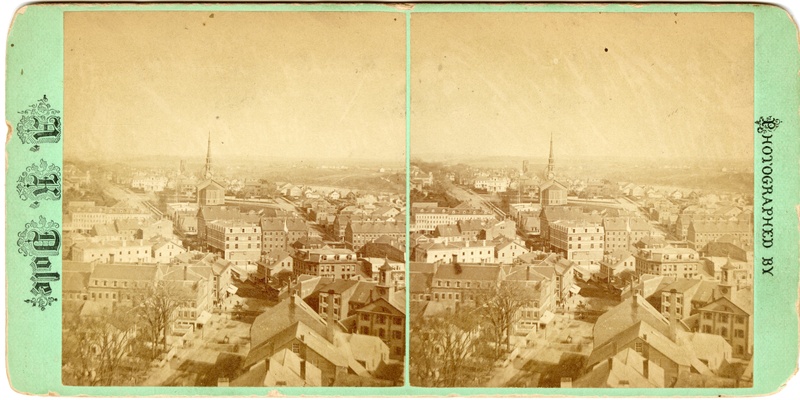
Stereograph showing a broad view of Bangor and the Penobscot River. This photograph was taken from the belfry of the Hammond Street Congregational Church and shows the dense clusters of buildings in downtown Bangor. Crossing the Penbscot is the old covered toll bridge to Brewer, with the Egyptian style entrance arch on the Bangor side.
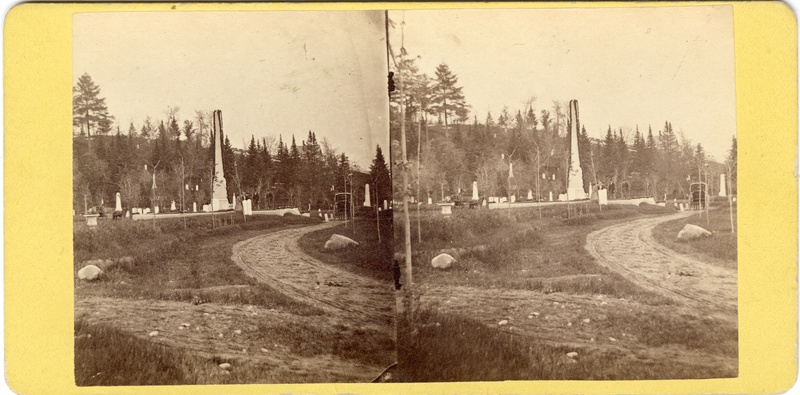
Soldiers Monument, a 20-foot high obelisk near the entrance of the Mount Hope Cemetery, may be the oldest Civil War monument in the United States. It was dedicated in 1864, when the body of Bangor native Stephen Decatur Carpenter was laid to rest. Although his body was moved to a family plot at their request in 1881, those killed in action as well as veterans filled the plot, and in 1907 the Grand Army of the Republic fort and monument was dedicated, followed in 1960 by the 2nd Maine Regiment memorial near the gates of the cemetery. Mount Hope Cemetery was itself something of a trend-setter; inspired by the Mount Auburn Cemetery in Massachusetts, it became the second-oldest garden cemetery in the nation when it was consecrated in 1836, covering one hundred acres.
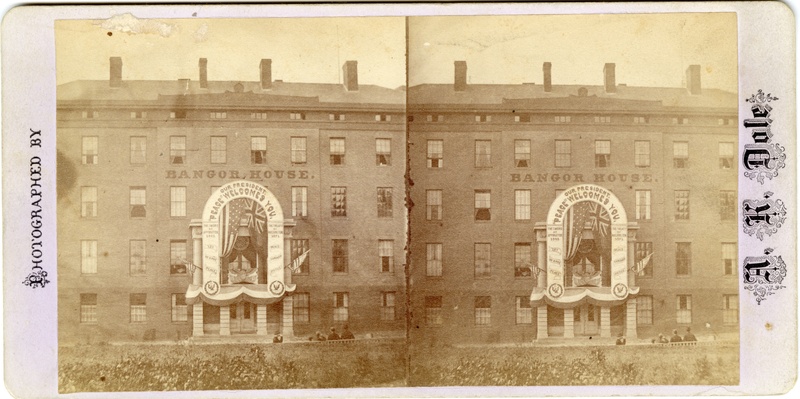
The Bangor House decorated for the visit of President Grant in October, 1871. Grant, his entourage, and the Governor General of Canada stayed overnight in the best rooms of the Bangor House, which is elaborately decorated with bunting, flags, and mottoes. Grant made a brief speech from the balcony as well as several other public remarks at receptions in his honor. Bangor was so thoroughly decorated that bunting had to be rented from Boston, and British flags borrowed from Canada. Businesses and private homes eagerly tried to out-do each other, and the celebrations were to culminate with an elaborate illumination along the streets--unfortunately, rain descended to douse lights, but not enthusiasm.
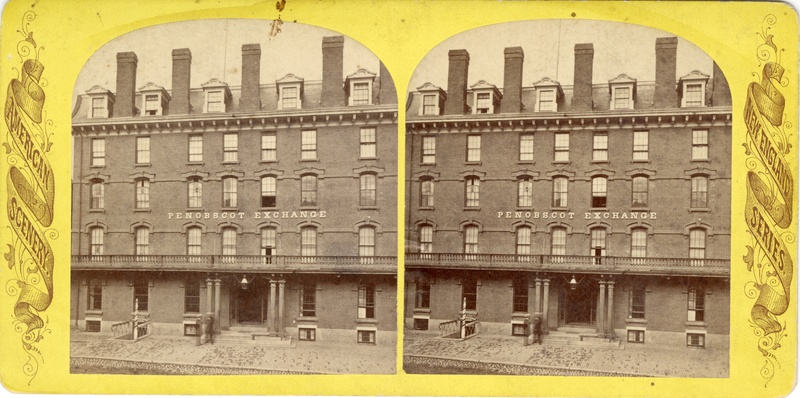
Built in 1827 by Zadock French, the Penobscot Hotel (originally French House) was so big that it was known locally as 'French's Folly.' In 1828, the Penobscot Exchange Coffee House, named after Boston's Exchange Coffee House, opened. The building is made of brick, four and a half stories, gabled roof and eight chimneys. The Queen Anne balustrade balcony was added later. The mansard roof was added in 1859, along with two extended wings, possibly the work of Benjamin S. Deane and Edwin Lee Brown. Additions and revisions were a constant theme, and the character of the building continued to shift. In 1908 a city ordinance required that all downtown buildings have a flat roof to alleviate danger from ice and snow, so the building was expanded to a full five stories with an Italianate cornice, as well as modern bathrooms and an elevator. In the mid-twentieth century, the building was briefly a dormitory for Husson College, but was eventually razed in the Urban Renewal program of the 1960s.
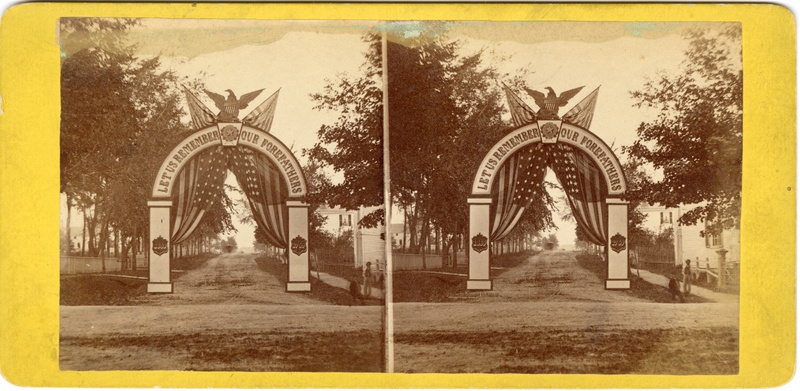
Bangor celebtrated its centennial on September 30th, 1869. Among the events to commemorate the day was a lengthy procession of dignitaries, which passed by the arch in this photograph. Bearing the motto "Let us Remember our Forefathers 1869 1769," the arch was erected at the corner of Lime Street and State Street.
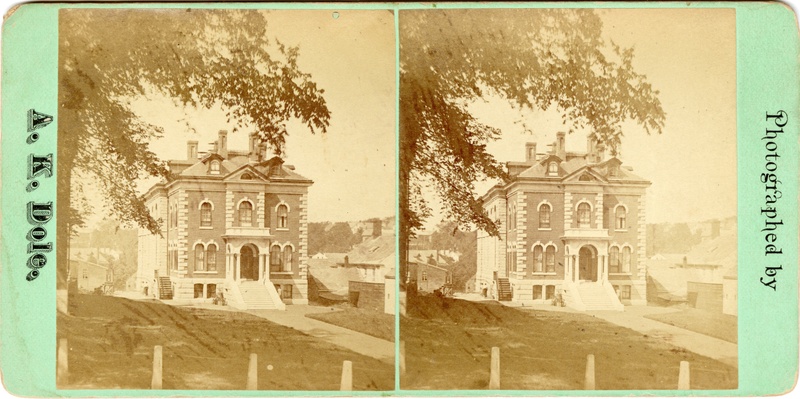
The Penobscot County Jail was designed in 1869 when the previous prison, built in the 1830s, proved inadequate. Designed by Gridley J. F. Bryant, the jail has somewhat of a dual personality. The gracious front in the Italianate style, housed the jail keeper and allowed the building to blend into the stylish and handsome neighborhood of downtown Bangor and Hammond Street. As can just be seen in this photograph, the longer rear section was more severely modeled in granite and housed the prisoners.
This broad view of East Market Square seems greatly underdeveloped to the modern eye. Although the Universalist church still stands on the hill, it lacks the distinctive asymmetric tower that was lost to the fire of 1911. Likewise lost was the Baptist church in the center of the photo, which was replaced by the re-built High School, and, ironically, the Harlow Street (Center) Fire House; the tower to the left. The sloping hill of Center Park is today the site of the Bangor Public Library, and the unpaved streets team with cars.
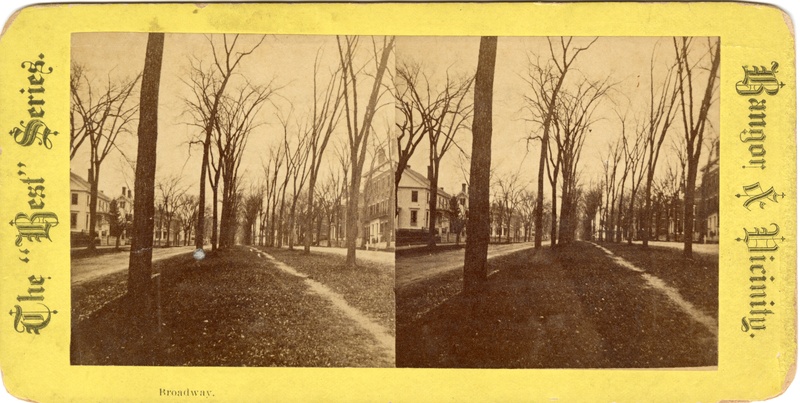
Stereograph showing Broadway and a footpath as it runs along some of the fine houses of this section of Bangor. Taken some time between 1881 and 1890, rows of elm trees are silhouetted without their leaves.
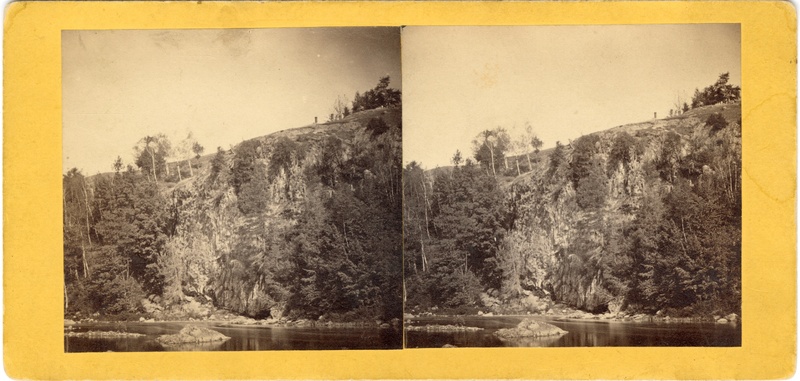
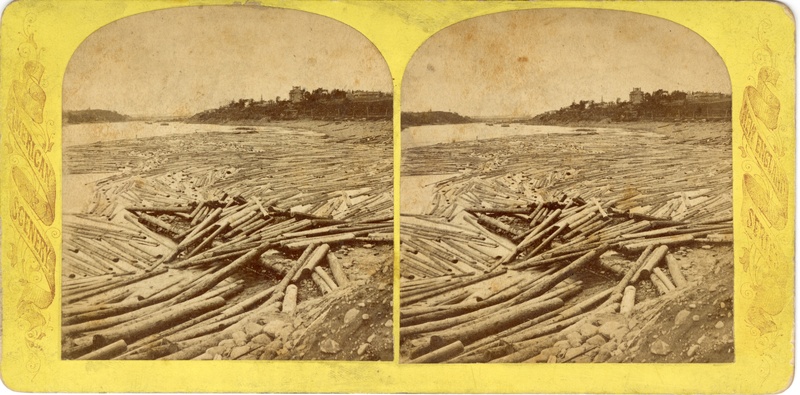
After logs were cut and floated down the Penobscot, they were drawn up short by the boom streched across the river. Here, the logs were identified by the hallmarks cut into them at lumber camps, and separated by owners. In this picture, the ebbing tide has tumbled logs against each other along the bank. The pylons of the boom can be seen in the background in the middle of the river; a chain reached between them to halt the logs.
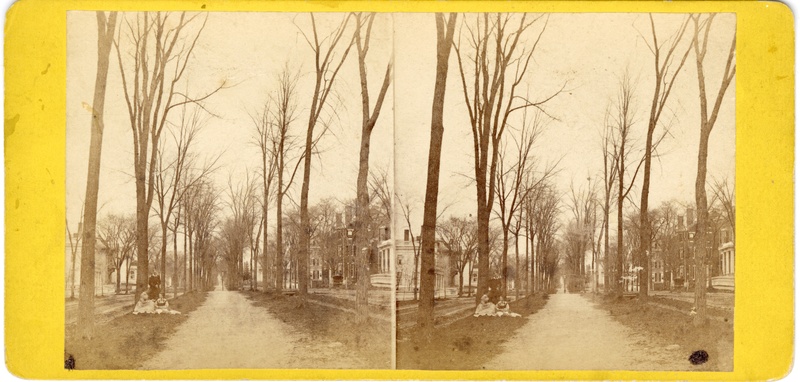
This view of Broadway from State Street, taken sometime between 1869 and 1871 and distributed by Trask and Dole, showcases Bangor's fine rows of elm trees--as well as its unpaved roads, which were fearsome in the Spring 'Mud Season." Three women pose in the weak sunlight next to a melting snowbank.
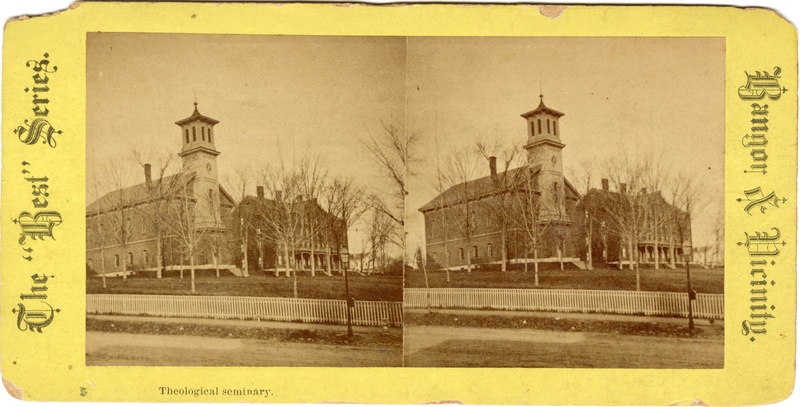
The chapel of the Bangor Theological Seminary was built in 1858 by the architect William G. Morse. To the right of the chapel is Maine Hall, designed by Charles H. Pond. Maine Hall, begun in 1833, was designed as a sober, traditional building, modeled after similar structures at Andover Seminary and Harvard University, so its simple Federal facade is plain except for a simple doric portico.
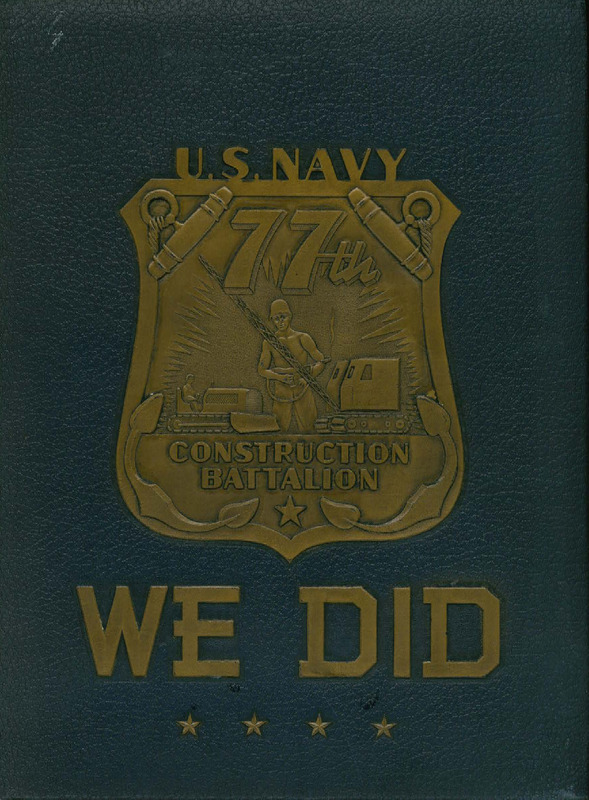
"Here is our story -- to the everlasting memory of associations with men of courage, ability and determination in time of our greatest national emergency, a job well done." --Robert E. Fonger, Lt. Col. C.E., Commanding
6-7 January 1945: We made the most of our opportunity to get acquainted with the French. Phrase book in hand we went determinedly after the population, and soon large clusters of Gls were seen around tolerantly amused little kids, asking any sort of question they could think of. For the most part the kids waited until the boys were just about talked out, and then asked for ''Chocolate, chewing gum, or cigarette pour papa." Others didn't wait for them to talk themselves out. No matter how the conversation started, it always ended with the request for cigarettes and chocolate. In an alley down the street a still was found that transformed apple juice into a product for which many uses were found, including lighter fluid . And the "Vive Ia France!" sentiment gained in intensity. Our vocabulary was soon increased by such valuable terms as "Cognac, Calvados, No compree, Couchez avec moi, etc."
From the unofficial introduction: "And Seabee ingenuity, what of that? We made bull fiddles out of oil drums, violins out of native mahogany on Guadalcanal, sight-seeing boats out of sunken barges; drove piles without pile drivers, built bridges before our equipment could get to us. On Bougainville, although bombed 60 times by the Japs, Seabees on their own time rigged up an ice cream factory which supplied 30 gallons of the world's best ice cream to these fighting builders. Perhaps these examples seem trivial in the light of the substantial contributions to total victory which the Seabees have made, but they reveal the spirit of the men. How are you going to discount men who can go through 60 bombings and come out making ice cream? We are famous now, this group begun so few years ago--famous for our work, famous for our fights, famous for our ability to make something out of nothing, but we are famous for other things, too, not the least of which is our chow. Many are the Marines and soldiers who have come to Seabee mess halls for a hot meal. The 77th never sat down to a meal without at least one guest. Some of these were famous, many more were just GI's on the line who could do with something hot inside. The 77th Welcome Mat was always out, not one meal chit was ever issued to one of these guests. So it went for four long arduous years, move up, move in, build up, roll down, clear out, haul dirt, tamp strips, lay mats, move out, start again. The pattern has been set, the die cast. The Seabees are in, in to stay, in as a part of the fighting team of the United States. Construction men in uniform, trained to build by years of experience, trained to fight by Uncle Sam, ready to turn Can Do into We Did whenever and wherever the need for construction engineers is greatest. And now for the story of the 77th, one of the best of the many which fought and built in World War II."
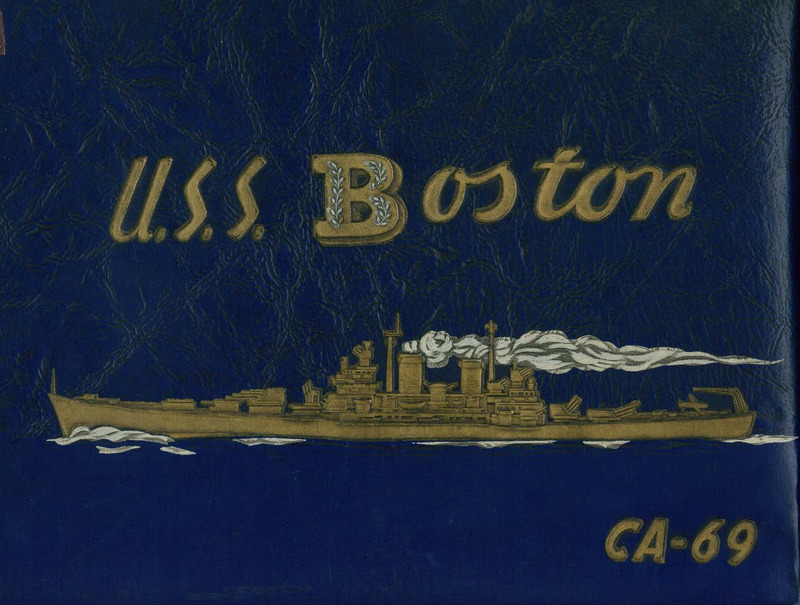
From "The Story of the U.S.S. Boston" by Henry G. Leader, SP (X) 3/C: Built for speed, maneuverability and tremendous fire power, the USS Boston is the second ship of the Baltimore class. Ordered July 1, 1940 prior to the outbreak of the war, her keel was laid June 30, 1941 in the Fore river yard, Quincy, Massachusetts by the Bethlehem Steel Company. On August 26, 1942 Mrs. Maurice J. Tobin, wife of the Honorable Maurice J. Tobin, Governor of the Commonwealth of Massachusetts, sponsored the launching, and on June 30th of the following year, the ship's ensign fluttered in a gentle breeze as she was officially commissioned and accepted by her first commanding officer, Captain John H. Carson, USN. Slipping smoothly through Atlantic waters, the Boston began her maiden voyage on August 13, 1943 en route to the Gulf of Paria, between Trinidad and Venezuela, for the shakedown cruise designed to accustom her crew to the sea and enable officers to detect any possible wrinkles in her makeup. A month later the Boston returned to her home port. a fighting ship with her crew well trained to fight the enemy. On the record of her engineering trial, she was established as one of the fastest heavy ships in the fleet; on the record of her gunnery exercises she was established as a good gunnery ship. After a few more weeks in the port of Boston and some trial runs off Rockland, Maine, the USS Boston set out on November 18 to fulfill the job for which she was designed and built-the defeat of this country's enemy in the Pacific. After passing through the Panama Canal, followed by a two day lay-over in San Francisco, she arrived at Pearl Harbor on the eve of the second anniversary of the Japanese sneak attack. Six weeks were spent in Pearl Harbor waters engaging in more of the exercises that are so essential to the maintenance of the fighting qualities of a First Class Warship.
It was World War II that brought to women their first opportunity to serve as an integral part of the Corps. The challenge came on February 13, 1943, with the announcement that the Marines had once more opened their ranks to women and now offered them full membership, including the chance for promotion to non-commissioned and commissioned grades and the privilege of serving in a wide variety of posts. Thus, scientific developments in war-making equipment, the global proportions of World War II, and the desperate need for a never-before-dreamed-of number of Marines, had made women's role in the Corps the most vital and important in history. In response to the challenging ''Free a Marine to Fight'' women began to flock to the procurement offices. Mrs. Ruth Cheney Streeter, of Morristown, New Jersey was appointed director of the new Women's Reserve and commissioned a major in the Marine Corps. Long active in public affairs, a member of the New Jersey State Relief Council, New Jersey Commission on Interstate Cooperation, and New Jersey Board of Children's Guardians, as well as former chairman of the Fort Dix, New Jersey, Citizens' Committee for Army and Navy, she was eminently qualified to take up her new tasks.
From the Introduction: Before leaving Saipan a number of men with the 73rd Wing and its units expressed a hope that some sort of a history of our organization would be published and made available to all Wing personnel. The Wing historical officer seemed the logical person to do this since he had handled the official history of the Wing which is now on file in Washington. In response to this demand, as well as to other requests received since returning to the States, this volume is prepared. While material in the book is partly borrowed from the official history, it is mostly written and collected now after a few months in the States have mellowed our memories of the Marianas. The 73rd Wing, as a whole, was a homogeneous, hard-working organization. Its personnel were cooperative with one another and did a tremendous piece of work on and from Saipan. The Wing was not only the first 20th Air Force organization to hit Tokyo but it also dropped the largest number of bombs on the Japanese Empire and flew the most missions of any of the 20th's five wings. To the 15,000 men who went through the months on Saipan, those months were long and hard. While these men may not have actually been in the front lines, the Wing's casualty list of both men and airplanes show that we were a fighting organization. Also our living conditions were far from comfortable most of the time. Our food was sometimes inferior and our quarters were not too good. We were subject to Japanese raids during the early part of the period. Nevertheless, our memories of Saipan will always be close to us. While this volume is written primarily from the point of view of the Wing Headquarters itself it should be of interest to all personnel of the Wing's organizations. After all, the Wing did operate as a single unit from Saipan and the groups never did operate independently. The statistics and figures included have to do with the Wing operation as a whole rather than any particular organization. This history will necessarily lack the personal touch that the story of a smaller unit might have. Personalities are pretty much lost in the over-all picture. These 73rd Wing organizations included the four tactical groups-the 497th, the 498th, the 499th and the 500th Bombardment Groups. Also there were the four Air Service Groups--the 65th, 91st, 303rd and 330th. Without these maintenance and engineering specialists and the Service Centers they manned, the Wing would surely have failed.
December 21st, 1943 marked the day of activation of the 716th Railway Operating Battalion. The outfit, sponsored by the Southern Pacific-Railroad, began its life at Fort Sam Houston (San Antonio), Texas with officer personnel drawn chiefly from the sponsor and a cadre made up of "veterans" of the 726th, the unit that had recently completed its technical training on the Santa Fe at Clovis, New Mexico. For the most part, both the officer personnel and the cadre were former railroad men.
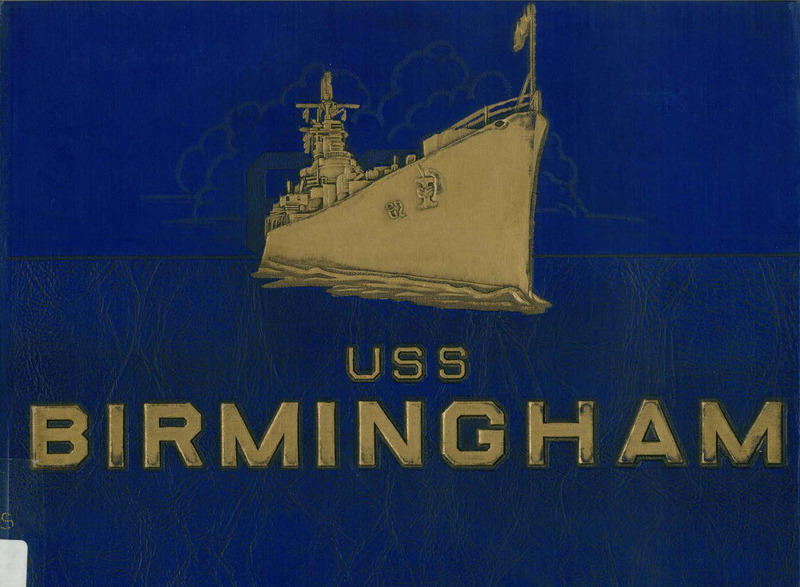
Foreword: It was my good fortune and high honor to be entrusted with the command of the Birmingham from 11 August, 1943 to 22 November, 1944. Those were months filled with action, excitement, and high adventure. The trials and triumphs which we shared together; the knowledge that the success of the ship and the safety of all depended upon the devotion to duty of each; the understanding that the team was more important than the individual; the mutual respect and affection amongst us all; all these things made us "shipmates" in the finest sense of the word. In the face of exhaustion, danger, and grimmest tragedy there was no grumbling, no shirking, and no flinching. Young America need concede nothing in fortitude to other races or other generations. Our steel ships, too, are served by iron men. Never in history had a Captain the good fortune to command a finer crew. --Rear Admiral Thomas B. Inglis