"This is a pictorial review of the overseas activities of the men who helped deliver the goods for the Navy. This may be interpreted as the story of your own Bill or Joe or Eddie, for within these covers we have endeavored to display the living story, in pictures, of individual personalities. How better could a Seabee Battalion be defined than " ... a sizeable group of individuals, each of whom possesses a knowledge of some specific trade or profession, is able to think for himself, to perform his duties under pressure, working together as a highly synchronized unit and willing to fight together if need be to preserve the freedom and personal right for which our great country stands."
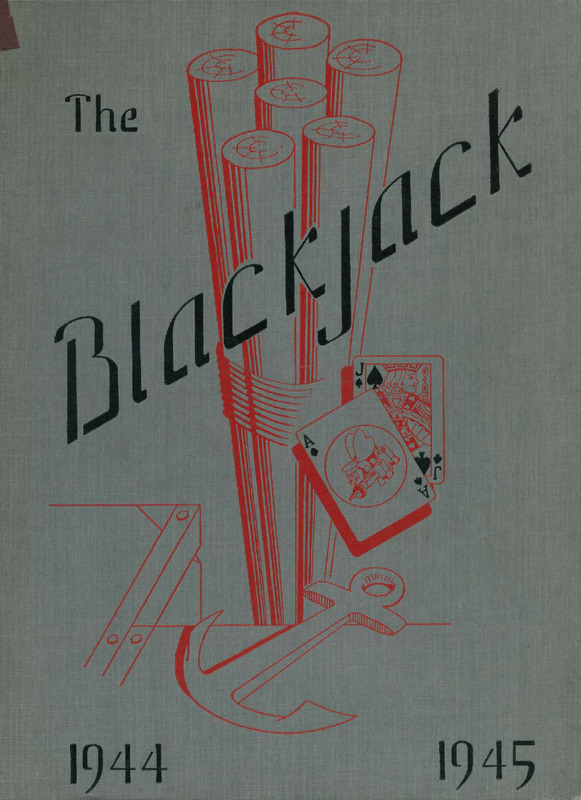
Foreword: For three years these men have adjusted their individual characters, their own ways of doing things, their very natures to that vague method of procedure called "The Navy Way." It is at once the most efficient and most bungling method of getting things done. It is a conglomerate of logical procedure mixed with hopeless muddling, sound economy with profligate waste, rank incompetency with expert performance, nonsensical methods of operation with excellent results. Men exposed to the Navy Way for three years have drunk the dregs of despair and tasted the wine of life at its fullest. They have seen life at its worst and at its best. Men so exposed will never be the same. Such are the men of the Twenty-First. This is our story. This is the story of the 21st U. S. Naval Construction Battalion, the 21st Seabees, the Blackjacks--one of those groups of a thousand-odd men who helped to build and fight the way to the defeat of Japan. We were just one battalion, and thousands of battalions and millions of men and women made up our armed forces. Maybe our part was small in the whole history of the war, but we saw to it that this part was done with a let's-get-it-over-with-quickly, "Can Do" energy. These words and pictures are mostly about our second tour of overseas duty--our work in the Central and Western Pacific. Before this came our first "cruise" in the Aleutians.
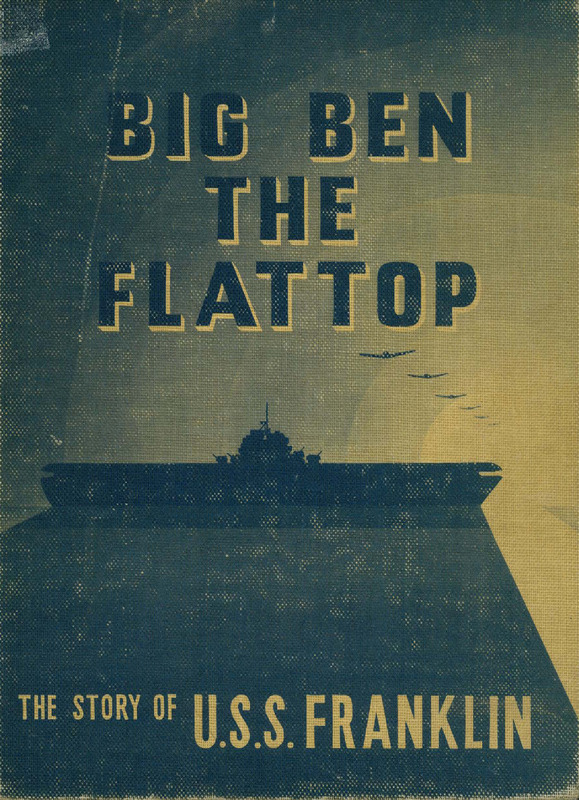
This book is as nearly as possible an authentic history of the U.S.S. Franklin. The data was assembled from official action reports, ship's records, the history of Air Group Thirteen, and from conversations with crew members. The story was prepared by Lt. Marvin K. Bowman, U. S. N., with the advice and assistance of Mr. Paul Warrick, of Atlanta, Ga. ... All pictures are official U. S. Navy photographs. Credit for many of them is due Chief Photographer's Mate Luke J. Durante, who was killed in action 19 March, 1945. The art work, including the cover design, was prepared by Thomas Leo, Seaman First Class, U.S.N. R. Attempts to achieve accuracy of detail, especially in connection with individual's names, have been handicapped to a certain extent by meager records, separation of personnel from the service and partial destruction of photographic files and records during the action of 19 March, 1945. It is sincerely hoped that no grave omissions have occurred.
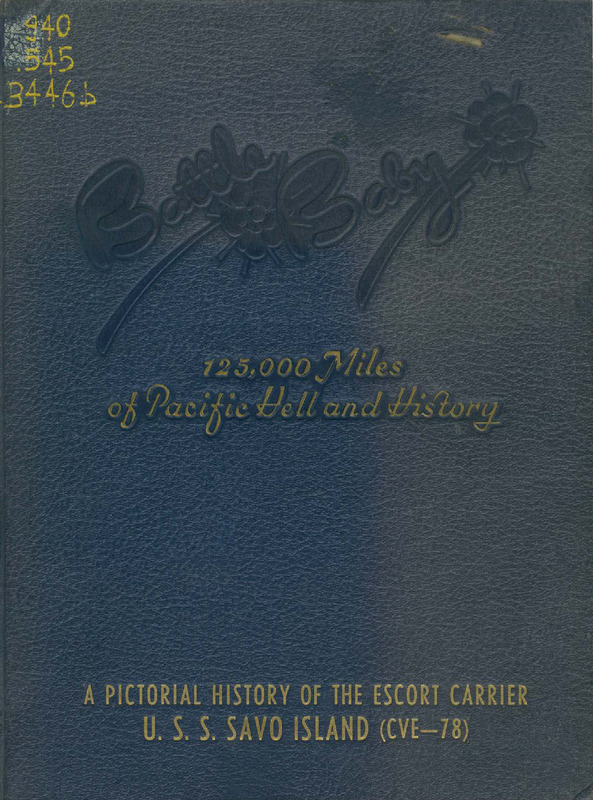
The ship was named after two naval battles which were fought near Savo in August and in October, 1942. In the first of these battles our forces were surprised, mistakes were made. and four cruisers were lost. It was a hard lesson, well learned. A few months later, one of our cruiser divisions intercepted a Jap task force near Savo and sank at least six vessels, cruisers, and destroyers. No great damage was done to our ships. The enemy was surprised, one of his cruisers was sunk before her guns were even trained out, and he was out-fought in every phase of the battle. As a result, this body of water, Purvis Bay. is known as "Iron-Bottom Bay." Savo Island is located in Sky Lark Channel between the Western extremities of Florida and Guadalcanal Islands. It is a product of volcanic upheavals, is only four miles in diameter, and consists of extinct volcanic peaks. Ships now anchor in waters that cover a village which subsided years ago as a result of an earthquake. Even today, there may be an occasional tremor. A few natives live on the island, and you will find very small villages and a mission station there.
Opening paragraphs: Bairoko Harbor is a small inlet on the North coast of New Georgia, one of the Solomon Islands. A Spanish navigator, coming upon these islands in 1567, and hopefully believing he had finally touched on the fabled and wealthy lands of the Indies named the group "Ilas de Solomon." Subsequent English explorers claimed part of the group for Britain, and at the outbreak of the war New Georgia was under the English flag. During the early part of 1942, in their effort to cut the Allied supply line to Australia, the Japanese seized the Solomons and began the construction of a series of air fields throughout the islands--at Vila on Kolombangara, at Munda on New Georgia, and on Guadalcanal. Vila and Munda were mutually supporting fields. Bairoko Harbor lay between these two airfields and was the port of supply for Munda. By the spring of 1943 Guadalcanal was secure and we had sufficient men and material to open the offensive against New Georgia. On June 30, 1943, Rendova Island was seized and Munda then placed under artillery fire. Marines and Infantry landed on New Georgia. In the heat and muck of the tropical jungle they met a bitter Nip foe enraged at the loss of Guadalcanal. Resistance was particularly strong near Bairoko Harbor. After six weeks of desperate jungle fighting the Munda airstrip was overrun, but Bairoko Harbor did not fall until August 25th. Its seizure marked the end of the fifty-seven day campaign for New Georgia. Bairoko signified the end of this early Pacific campaign--so the name of our ship is a symbol for that final victory which came during her shakedown cruise.
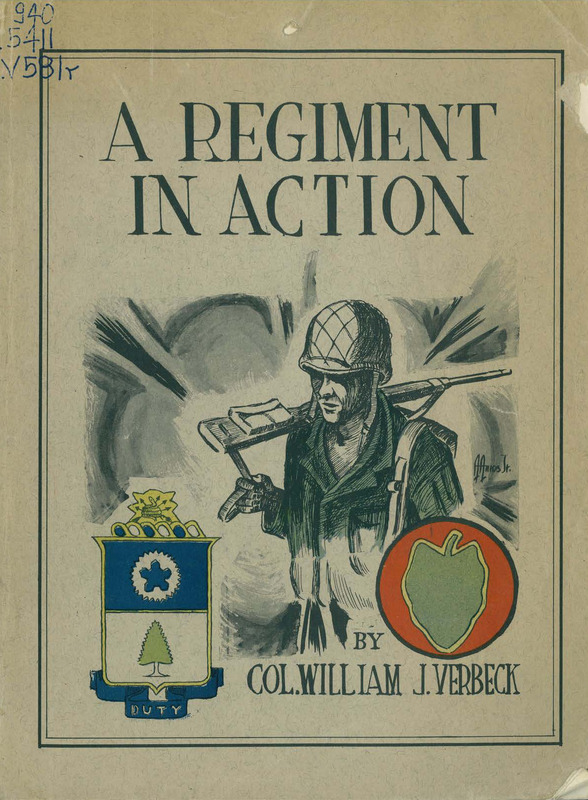
"The work which follows is by no means a thorough or complete history of the Twenty First Infantry Regiment in World War II. To my knowledge no such history has yet been written. I have, however, a number of official accounts of some of our actions. These I have edited and put together with whatever other information available in order to have at least some form of published record. I am publishing this work in response to numerous requests from members and former members of the 21st Infantry as a chronicle of our days together in combat. Most of the description concerning the Hollandia Operation was submitted by Lieut. Colonel Roy W. Marcy. The sketches after Page 37 and Page 52 were drawn by Mr. Lawrence E. Hickman another former 21st Infantryman. Great thanks are due to Lieut. Colonel Judson MacIvor Smith for the material on Pages 3, 4, 5 and 6 which were taken from his book "The Story of a Regiment"--a history of the 21st Infantry. Thanks are also due to Mr. Arthur Amos, Jr. for the cover, Miss Ruth Middleton for typing the manuscript and to Mr. T. L. Tuggle for supervising the multilith operations of reproduction. I would be glad to receive information from anyone who can furnish more complete data for inclusion in a future, more complete work. Also any corrections or suggested changes will be very welcome."--William J. Verbeck, Colonel, Infantry, Commanding Officer of Troops, U.S.M.A., West Point, N.Y.
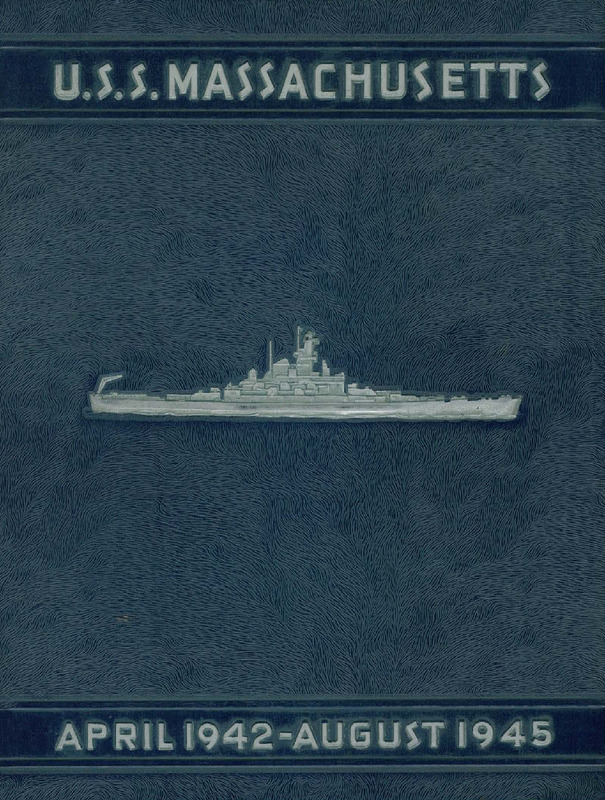
The Log Tossing the first sixteen-inch shell to open the European offensive and firing the last big naval bullet in the Pacific campaign--these are the outstanding mileposts in the 39-month fighting career of the U. S. S. Massachusetts. The Japs have capitulated; details for carrying out the formal surrender ceremonies have been arranged for the official end of World War II. The stories that make the war history can now be released and "Big Mamie" has one of her own. It may not be spectacular, but it reveals a ship manned by resolute and efficient officers and men who turned in a workmanlike job and who more than once received "well done" from the Admirals. It wasn't always easy going and the grind was monotonous but ... here's our story. When peace came to the Pacific, Mamie could look back on a long and action-packed career. From the time of commissioning on May 12, 1942, until the end of the war in mid-August, 1945, she had logged over 225,000 nautical miles, her journeyings taking her all the way from Casablanca to Tokyo and the China coast. She had taken part in some thirty-five engagements with the enemy. She had sunk or damaged five ships, including the mighty French battleship, Jean Bart. She had taken part in nine bombardments of enemy territory, three of which were directed at the Japanese home islands. She had destroyed or assisted in the destruction of at least eighteen Japanese aircraft. Her scout Kingfisher planes had rescued seven aviators downed by enemy fire, often performing the rescues within sight and range of Jap guns. Thanks to her fire-power and speed, she had lent invaluable support to the fast carrier task forces as they carried out their mission of crippling Japanese air-power and seizing control of Pacific skies. Our ship has been a workhorse of the Fleet. She was always in there pitching when there was fighting to be done. She went about her tasks without ostentation and with a high degree of competence and skill gained from long hours of practice and of combat.
Two Years of Preparation: The 334th Infantry Regiment was activated 15 October 1942 at Camp Howze, Texas. For a regiment which was later to grind its way through the Siegfried Line, disorganize three of Germany's finest divisions in the Ardennes, and spearhead the Ninth Army's drive across the Roer and into the German heartland, the beginnings were not sensational. In 1942 Selective Service began to look more carefully into the manpower pool, and the Army began to develop a reservoir of Infantry. Many original men of the regiment had been classified 4F by lenient draft boards who subsequently reclassified them when the quotas were made more stringent. In October 1942 the War was nine months old, and while many men were convinced it should be fought, few were volunteering for the Army, and fewer for the Infantry. The Air Forces were called the Air Corps, a place for gentlemen and adventurers, and the Infantry was coolie labor, a tutored mob. The first men to join the regiment had a "raw deal" they told themselves around the beer tables in the PX. First, they didn't like the Army; second, they weren't physically fit; third, their talents were not being used. As the men looked around and listened, they invented a satisfying rumor, compensation for their "raw deal," a rumor that was going to last until we heard the first sounds of Long Toms and 240's outside Gulpen and Waalwiller, Holland: "We're a replacement outfit. The 334th isn't going anywhere. If it does, we're Army of Occupation. Man, they can't send this outfit into combat!"
At the Naval Construction Training Center, Camp Peary, Williamsburg, Virginia, on the first day of June, 1943, E. H. Honnen, then a Lieutenant Commander, on orders from the base Executive Officer, set up headquarters in Area B-8, and began the formation of the 96th Naval Construction Battalion. In a few days, officers and drafts of men, most of them recently out of basic training, began arriving in the area. Those were busy days.
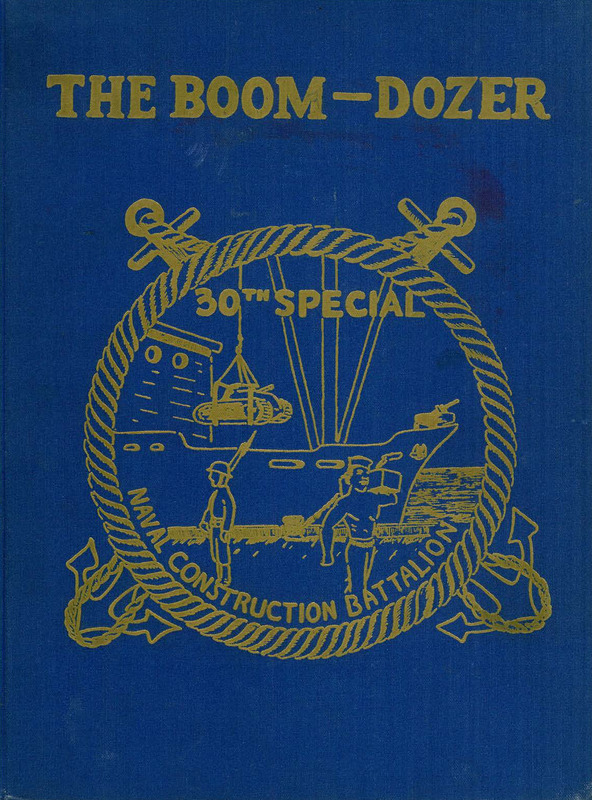
The 90th U. S. Naval Construction Battalion was born at Camp Peary, Virginia on the twenty-fifth day of July, nineteen hundred forty-three, in the blistering hot sun, as those who were there will well remember. As an indication of what was to come later the sun, in all its glory, was appropriate; for the battalion, on its tour of duty in the Asiatic-Pacific Theatre, has scarcely ever found the smallest amount of shade! From Peary to lwo Jima and V-J Day our stirring saga runs. The inevitable triumph of Allied arms found us deep within the shattered inner perimeter of the Land of the Setting Sun. This, The History and Achievements of the 90th United States Naval Construction Battalion, is our LOG.
From the Introduction: Activitated 15 December 1941 at Fort Belvoir, Virginia, the 649th Engineer Battalion was assigned to the First Army and placed under the technical direction of the Chief of Engineers. In an Army the size of ours the activation of a battalion causes only the slightest ripple on the pool of available manpower. It's just another battalion with a number and that's as far as it goes. But this book isn't about numbers; you can find numbers in an arithmetic book. This is the story of a group of men and we'd like to tell you from whence they came. At its inception, the battalion comprised three companies, viz: Headquarters and Service, including Photomapping; B, the Reproduction company; A, the Survey company ... Though the majority of us came from New York, New Jersey or Pennsylvania, all sections of the country are represented in our ranks, and practically all the states. What better beginning can a battalion in this man's army have?
One of the war's famed Engineer Light Ponton Companies was born on paper in Washington, D. C. on 14 January 1943, a full five months before its first soldier opened the door of the orderly room at Camp Hood, Texas. Never then realizing what a great part he would play in World War II the 549th Engineer knocked the dirt from his spikes and got ready for the great race across the States and half way 'round the world. It was indeed to be history · and now the curtain opens on the big show ...
It is with the hope that your book will aid you in appreciating the part played by the 42nd General Hospital in this War that it is presented to you. A scarcely less important purpose is that of familiarizing each section with the work of other sections and of the unit as a whole. In after years, its value will increase to each one of us, and it will come to form a tangible link with the comradeship we shared in working toward a common end--the alleviation of suffering. Wherever possible, the record is presented pictorially. If some group or department feels itself slighted, the editors can only plead pressure of time and the shortage of film and photographic service, trusting that any shortcomings will be graciously overlooked. To all those whose kind cooperation made your book possible, we extend our sincere thanks, and to the Signal Corps of the United States Army we are indebted both for many of the pictures and much of the general photographic work.--The Editors. The Staff: Major Theodore A. Schwartz, Major Walter E. Karfgin, Sgt. Clarence G. Luther, Sgt. Charles E. Church, Pvt. 1Cl. Julius Goldstein, Pvt. Burton V. Doyle.
From the Introduction: That is the purpose of this book--to tell a story, the story of the men of the 233d Engineer Combat Battalion ... their combat experiences, the story they want to be told. It comprises the better part of the history, and in its writing it is fully realized that at its best this book will be only a brief summary of the full story. Each act of heroism or determination, each recording of skill and self-sacrifice, and each feat of bravery depicted will be only one of many. Throughout the entire writing of this book I have had to be content with the telling of a few incidents with the full certainty of neglecting many. The only records of many acts of courage are still being held in the hearts of the doers, and only because they were seen by someone else did those related here become known. For it was the spirit of the Battalion that to sacrifice, to go beyond the call of duty and to accomplish the job at any cost was merely doing the job well. If this book tells the story they want told, if it brings a feeling of pride to the members of the Battalion, if it brings enjoyment to its readers, it will have fulfilled its purpose, and it is further hoped that in its recording I have brought forth the spirit of undying cooperation that so successfully carried the 233d Engineers across the many beaches in the Pacific Theater and made the accomplishment of their every mission possible.--Victor E. Weaver, 2nd Lt, 233rd Engineer Combat Battalion, Adjutant
"From February to December 1945, the 102nd Construction Battalion was engaged in the building of the Submarine Base, Subic Bay, Philippine Islands. Their nucleus planning group came in with the assault in February and immediately started work at the selected site which at that time was mostly rice paddies, swamps, and bare hillside. Under great difficulties of lack of adequate personneL materials and equipment, together with adverse weather conditions, the Battalion cheerfully and efficiently improvised and established essential elements of the base which were extremely useful to our submarines in fighting the last few months of the Jap war. Although uncompleted at the termination of hostilities, many members of the Battalion voluntarily stayed on long after with the avowed intention of completing the base which they had started. For their future memories, the members of the 102nd Construction Battalion have left a monument to themselves which will serve their Navy and their Nation for many years to come. It is a base which we did not have before World War II started and which is now available to us should any future aggressor nation decide to to interfere with our rights and liberties. I salute the 102nd Construction Battalion for their excellent spirit and achievements." James Fife, Rear Admiral U.S. Navy, Commander Submarines, Philippine Sea Frontier
Foreword: The battalion arrived at Pearl Harbor on March 29, 1943. "Remember Pearl Harbor" had become a battle cry for all Americans in the Pacific War. Our Marines had turned the tide of the Japanese offensive at Guadalcanal and the enemy had begun to feel the blows struck from Henderson Field built by the Seabees. The Navy was beginning to marshal her fast growing forces at Pearl Harbor. Men, material, and ships required new barracks, warehouses and ship-repair facilities. The 62nd Battalion was the first to take over work from the contractors at Pearl Harbor and our officers and men carried through their jobs with the true Seabee spirit and ingenuity. Among the vital and urgent projects completed were the Submarine Base Extension, the Waipio Point Amphibious repair facilities and housing at the Advance Base Reshipment Depot. As the Pacific War moved in to full scale offensive, our battalion was assigned to the Western Pacific on the assault eschelon at lwo Jima. Our battalion arrived on " Bloody lwo" soon after the Marines and started to work immediately on the Southern Airfield. As soon as the Southern Field was operational, the 62nd Battalion was ordered to the Central Airfield. Both jobs were started under enemy mortar and sniper fire and the courage and the spirit of the battalion can never be forgotten. This book is a history of your battalion, a battalion in which you can take well-earned pride. It is a record of your experiences, both the hardships and pleasures which have made up your part in the winning of the war in the Pacific.--F.B. Campbell, Comdr. USNR (CEC), Commanding Officer
"On July 15th, 1946, the U.S.S. Hancock was officially awarded the Navy Unit Commendation for outstanding heroism in action ... Today she is one of many proud ships moored along the thousand-mile shore-line of Puget Sound, a memorial to the men who trod her decks in the hope of providing a just and lasting peace. At dusk as the sun dips behind the snow-capped Olympic Mountains to the westward it sets upon a nation which has yet to know a conqueror's tread. The price of that freedom is so great that if the lowering of colors each evening were a tribute to a single fallen hero of World War II it would take a year to honor the Hannah's own casualties and more than eight centuries would elapse ere homage were paid in full. May we build no earthly monuments to those who lie beneath the far Pacific, or on some foreign shore, save the monument of a lasting peace for posterity--should we falter in our course may those ghostly ships, rising and falling on the eternal tide, serve as a reminder of our obligation to them."
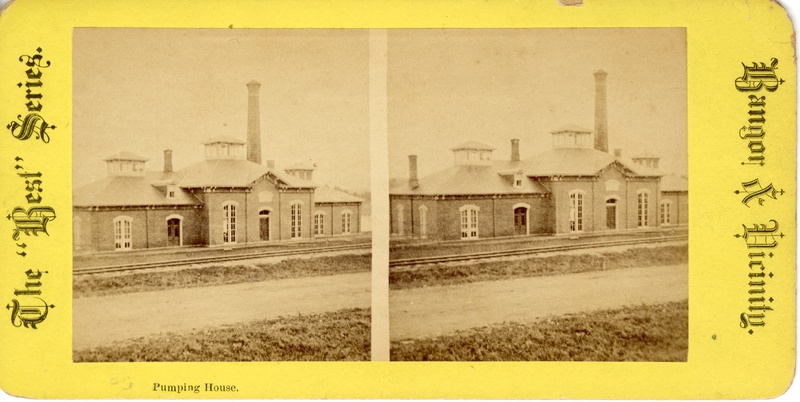
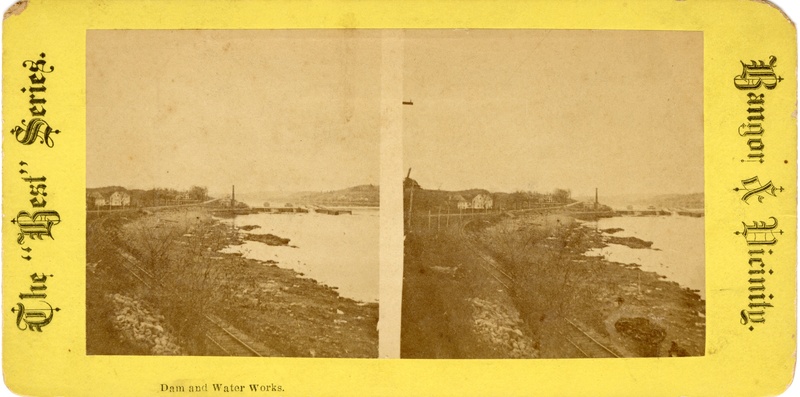
The Bangor Water Works were built in 1875-1876 following a State act to supply Bangor with a reliable source of clear water and confront the constant problem of sewage. The Water Works, which also contained a dam, was designed as a source of power and transportation as much as of drinking water, and the $154,000 project included a wheelhouse, sluice, and fishway. The pumping house in the photograph was designed by the Holly Manufacturing Company of Lockport, New York, and shows a four-story tall steam stack in the background.
The Bangor Water Works were built in 1875-1876 following a State act to supply Bangor with a reliable source of clear water and confront the constant problem of sewage. Shown here are the Penobscot River and the area of the dam.
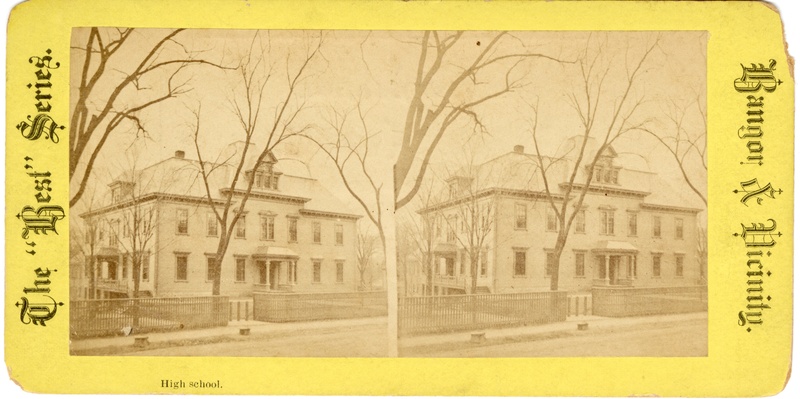
Stereograph showing an intermediary stage in the progression of Bangor's High School. Following the destruction of the original high school in a fire in 1882, the opportunity was taken to greatly improve the building. Wilfred E. Mansur, a graduate of the previous high school and later architect of many buildings in Bangor, followed much of the existing design but with enlargements and modifications. In 1903 a back wing was added to house the Manual Training School, and the entire building perished in the Great Fire of 1911.
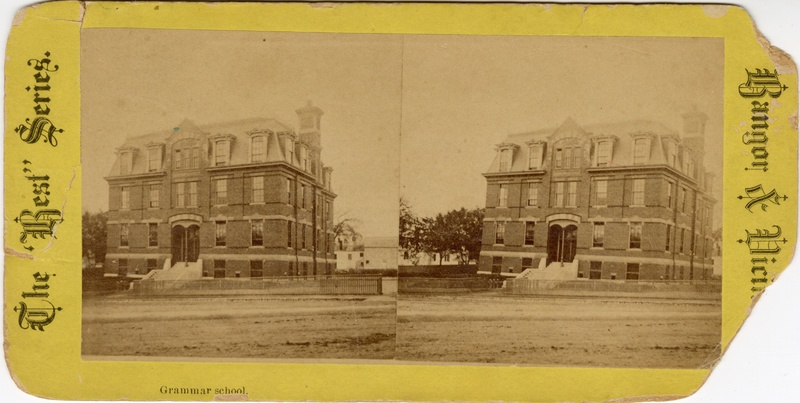
Dedicated in 1875 by B. C. Kenway, the Union Street Grammar School was one of a new wave of schools designed as imposing edifices to the potential of youth. The three-story building held eight schoolrooms, three playrooms in the basement, and a coal furnace, and was outfitted with the then-new combined desk and chair, described as "superior to any other" for "the health and comfort of the pupils."
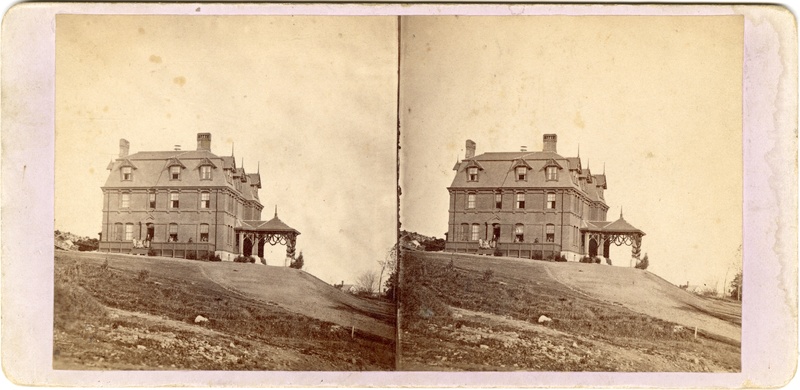
The Bangor Children's Home was completed in 1869 following the design of Henry W. Hartwell. It was designed in memory of Sarah, the late wife of Franklin W. Pitcher, and built with $25,000 which he donated. Although it derived from the Bangor Female Orphan Asylum, chartered in 1839, the state legislature granted a new charter as the home was under construction allowing the admission of boys. The back of the building is shown below the rise of Thomas Hill. Samuel Prentiss donated the land next to the Home to serve as a playground. Located on Ohio Street, the Home was added to the National Register of Historic Places in 1975.
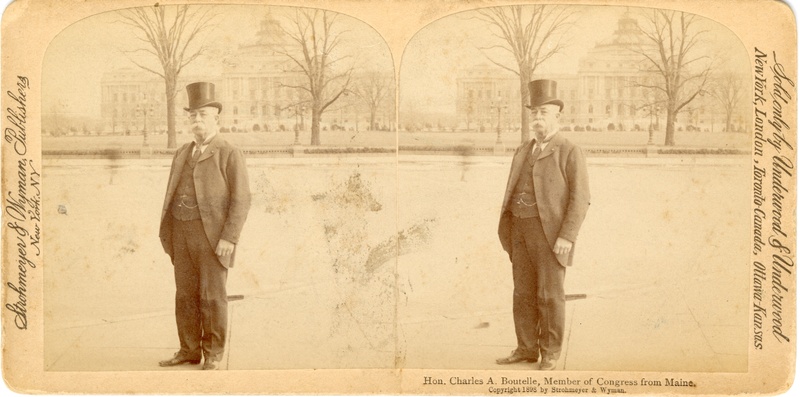
Charles A. Boutelle (1839-1901), poses in front of the U.S. Capitol in 1898 when he was serving in the U.S. House of Representatives. Boutelle was elected to the House in 1882 and became the second longest-serving Maine Representative. Boutelle was so popular that, when he suffered a seizure in late 1899 and was removed to a mental institution in Massachusetts for the rest of his life, he was nonetheless re-elected. He was a popular figure; using his naval background he was instrumental in modernizing the American navy and in the rise to prominence of the Bath Iron Works. A charismatic writer and speaker, he was noted for speeches defending the foreign policy of President Cleveland. He resigned from Congress before the session commenced, and, when he was left in financial distress, Congress appointed him to the Naval List, enabling him to draw half-pay for the rest of his life. Boutelle had been a seaman, served in the Union Navy during the Civil War, and in 1870 became the editor of the conservative Bangor paper, the Bangor Daily Whig and Courier. He bought the paper in 1874. He was married to Elizabeth Hodsdon.
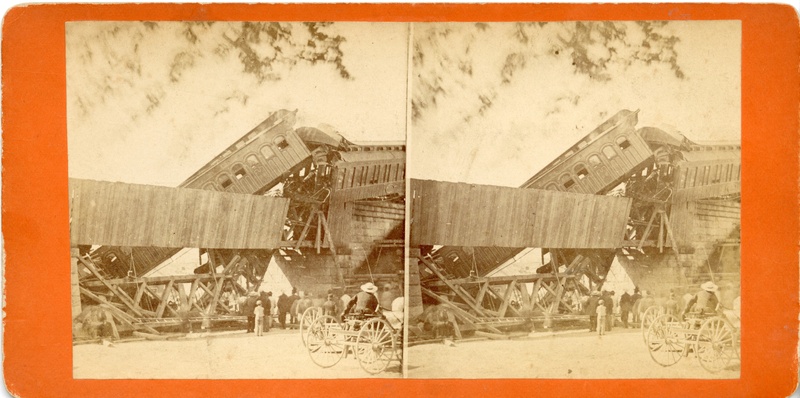
When the mail train to Bangor hit the Tin Bridge on the evening of August 9, 1871 running fast, the old bridge--later found riddled with dry rot--collapsed. Five cars were sent off the tracks and down the embankment, and two people were killed. The next day, thousands of spectators began to arrive at the scene. This picture shows the back of the bridge, the fallen truss lying on the ground and the back of a carriage ripped open, as well as a selection of spectators.