
Items
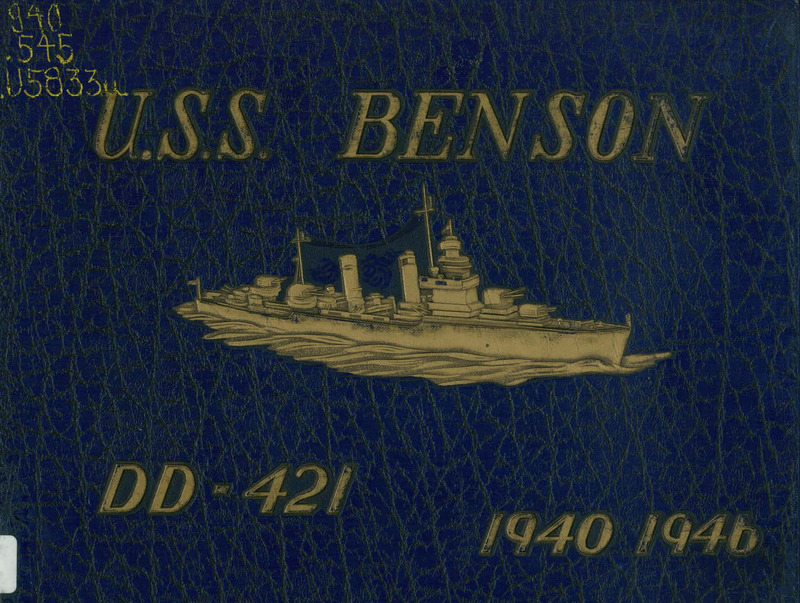
U.S.S. Benson DD-421 : 1940-1946
From The Log of the U.S.S. Benson DD-421: The U.S.S. Benson (DD-421), is one a class of thirty-two destroyers, known as "Benson Class of 1937-1940." The Benson is one of thirty destroyers built to Bethlehem-prepared plans. The Benson is named for Admiral William S. Benson, U.S.N., and was built at the Bethlehem Steel Company Plant, Quincy, Massachusetts--authorized March 27, 1934; keel laid May 16, 1938; launched November 15, 1939 and first commissioned July 25, 1940. Some of the characteristics of the Benson class are: square funnel caps and bases; uneven height of stacks. Destroyers of this class are ten tons lighter and eight inches narrower than destroyers of a later class, known as the "Livermore" type; otherwise they are similar. Both classes have four high-pressure boilers, geared turbines and twin screws. Cruising range exceeds 9,000 miles at 15 knots. The "Benson " class, DD-421 to DD-428 were originally armed with five 5-inch-38's, and ten tubes. A few still carry ten tubes. Light armor protects bridges and controls in all newer destroyers. Little has been written of the part that destroyers played in World War II, where they were called on to fulfill such a variety of missions that they were multi-purpose ships, engaging in any form of combat. Because we lacked suitable escort ships, destroyers were used to protect convoys, as well as to guard our combatant Task Forces. Destroyers were used to bombard enemy shore positions, and to carry bombs and aviation gasoline, and stores to Guadalcanal during the lean weeks, early in the campaign in those far-distant seas. By nature as well as by name, the purpose of the destroyer is wholly offensive Bantamweights in comparison with the great battlewagons, they pack a punch out of proportion to their size. They are triple-threat weapons, built to strike at the enemy on or over or under the sea. They are the "fightingest things afloat."
Tour of Duty: 103 Naval Construction Battalion, 1943-1945
Introduction: Naval Construction Battalion 103 was not among the first to go to war. World War II had been raging perilously for twenty-one months before our men mustered into boot camp. Yet this did not mean we were lax in responding to the battle call. For it was logical that the nation count on many of our kind to first build the industrial might by which we armed ourselves and our allies. Aircraft plants and planes, munitions plants and guns, shipyards and ships had to be built. Those who remained behind us had to be taught a multitude of artisan trades only the construction men could perform. Then, with the industrial potential leaping ahead, we put down our tools and tasks: We said goodbye to our families, children and friends, and solemnly shoved off for boot camp. By average, the men in this battalion, and those who followed, are older in years of experience. When we entered boot camp a new system of military training, based on modern battlefield conditions, awaited us. When we took aboard our gear for the big overseas job, we found it to be the best equipment man could make. This is a far different story than of our Construction Brothers who had gone on before. Ill-prepared, those men threw themselves before the yellow tide in the Pacific-and stopped it cold. Only a few bull dozers, a minimum of military training, and an amazing amount of guts did the trick. They diked up that yellow tide. Held it until we and others, well trained and well equipped, could move out into this war theater to secure and make ready the great offensive now launched from all quarters against the enemy. Naval Construction Battalion 103, to date, has seen only the backwash of war: Marine casualties returned from tough campaigns; a handful of enemy flushed out, like sewer bugs from dank and odorous caves; a city and villages blasted to rubble and ruin; natives carrying life-time scars of torture. These sights have a profound effect upon all of us. Impulsively we want to drop the hammer and saw, take up the carbine and press on to actual combat. That chance may yet come. We are on this tour of duty to build. We are here to construct the facilities by which the war progresses toward the unconditional surrender of the enemy. And we are bound to do these duties well for the sake of every man who came out here to fight and to build, but who will never see, with mortal eyes, his home again. The Seabees were conceived at a ghastly, agonizing hour in our history shortly after Pearl Harbor, 7 December 1941. They emerged as a surprise force, the one BIG NEW element in the waging of a surprise war, and have proven to be neither strictly sea goin', in the Navy sense, nor landlubbers. Rather their ranks boast of men of the sea and men of the soil alike. They have brought their pontoon causeways through rough surf and shellfire to establish beachheads; they have tilled the soil of these far off lands to raise crops for desolated natives. Yet their main task has been to construct forward bases from which a mighty Navy and Army press home the attack. Construction Battalion 103 is doing just that. And in this pictorial review of our tour of duty thus far, you will see a battalion of American men at work-and at play, too. For it is an American premise to see the lighter side, to fraternize with friendly people, to indulge in horse-play during those all too few hours of liberty.
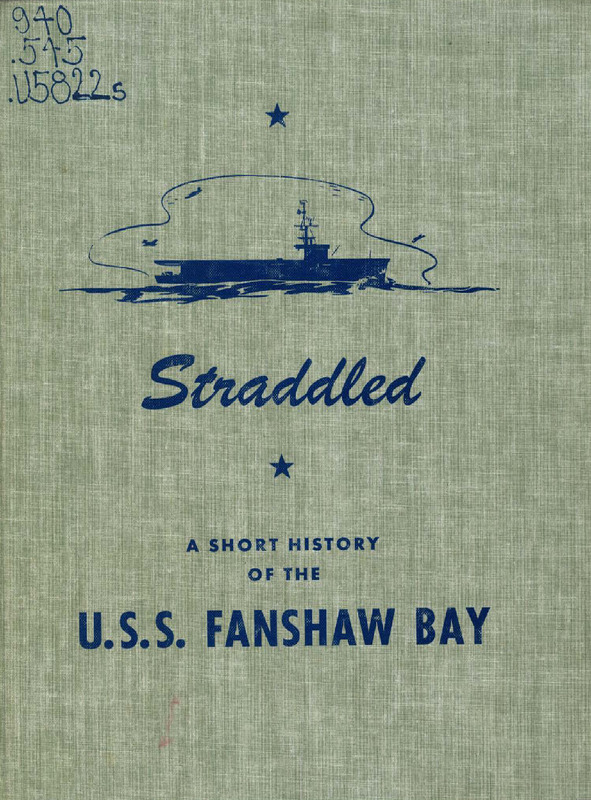
Straddled: A Short History of the U.S.S. Fanshaw Bay
The U.S.S. Fanshaw Bay (CVE 70) was commissioned December 9, 1943, at Astoria, Oregon, less than seven months after the keel was laid by Kaiser Company in Vancouver, Washington. Named for a bay in Southeastern Alaska, she is the first Naval vessel to bear that name. Like other Casablanca class escort carriers, the Fanshaw Bay was built from designs never intended for a combat vessel, yet she carried her crew through the longest operational period sustained by any escort carrier. Dedication Wherever the Fanshaw Bay shall sail again in the reminiscences of her old crew, she will carry with her the memory of those gallant men who have answered their last call to flight quarters. To the twenty-four men killed in action and to the fourteen missing airmen this history of the Fannie Bee is humbly dedicated.
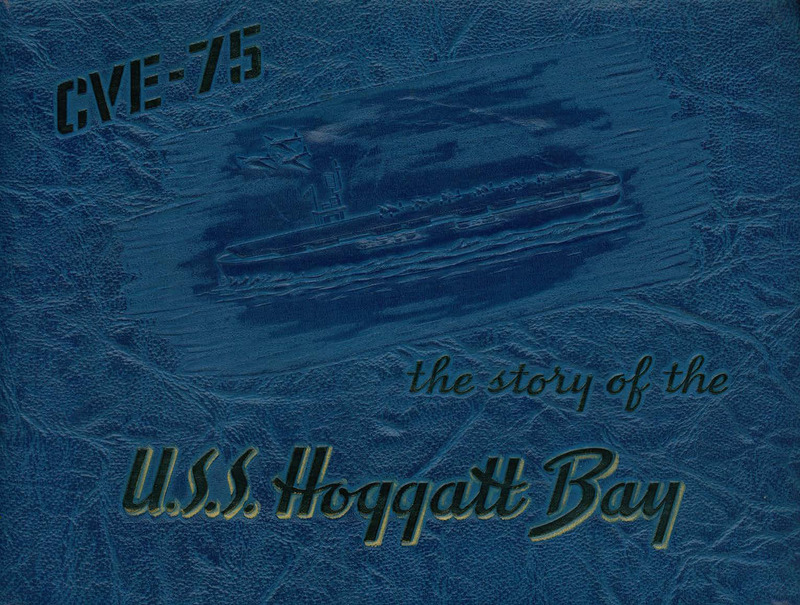
Story of U.S.S. Hoggatt Bay
Dedication: The purpose of this book is to tell a story--not just an ordinary story, a fictional creation of one man's mind, but a living, dynamic story. It is living and dynamic because it is the story of a life. In word and picture it depicts the life of her whom we affectionately call "Queen of the CVES"--the U.S.S. Hoggatt Bay, CVE 75. It is the story of the men who transformed her from an inanimate bulk of steel into personality endowed with life and feeling and courage, of the men who guided her through perilous waters, of the men who manned her guns to ward off the enemy, of the pilots who soared from her flight deck to search out and destroy the same enemy. In short, it is the story of the officers and men of the Hoggatt Bay who have lived, and fought--and died--that others might live in peace. To all of them, those still aboard, thos who have left us, and especially those pilots and aircrewmen, heroes all, who took off from her flight deck never to return again, this book is proudly and affectionately dedicated.
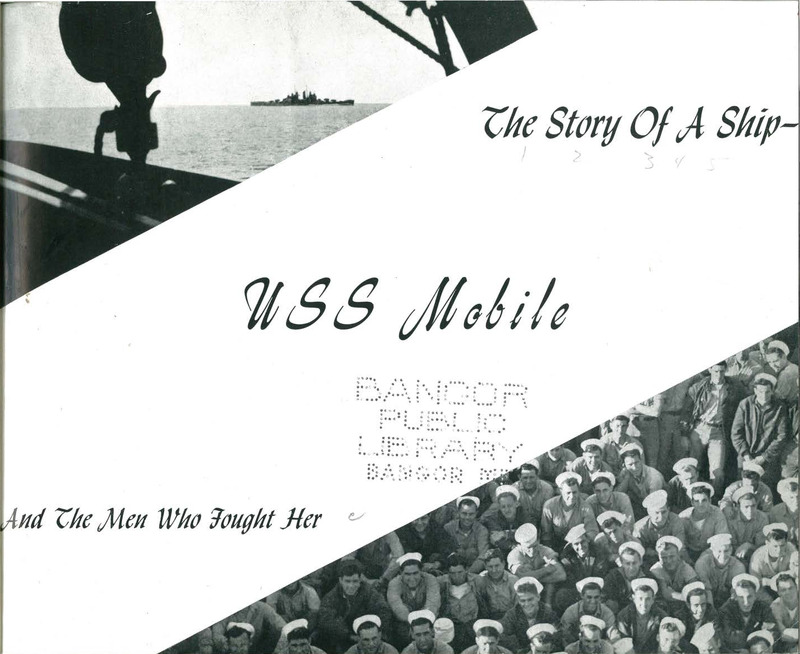
Story of a Ship--USS Mobile, and Men Who Fought Her
The U.S.S. Mobile, CL-63 Authorized at a time when hostilities in Europe were arousing keen concern over our own naval shortcomings, the story of the Mobile corresponds closely with the development of our naval strength in the Pacific. Only one other ship has borne the name: she was a small warship operating under the Union colors with Admiral Farragut's fleet during the Civil War. The keel of the new Mobile was laid on April 14, 1941 at the Newport News Shipbuilding and Drydock Company and on May 15 of the following year the hull of CL 63 slid down the ways. The sponsor was Mrs. Harry T. Hartwell, wife of the president of Mobile's city commission. On March 24, 1943 the commission pennant was raised with appropriate ceremony and Captain C. Julian Wheeler took command. After a short period of training in the Chesapeake Bay and a brief visit to Casco Bay, Maine, the Mobile turned toward the Pacific, leaving the Canal a stern on the 20th of June. With eleven "Battle Star" operations to her credit the story of the "Mighty Mo" is told by the record of her achievements, by the accomplishments of the fleets in which she worked, and, in part, by the pictures which follow.
Service Record of the 145th Naval Construction Battalion, 1943-1944-1945
Introduction: As the sunrise dispersed the chill early morning mists from over Camp Peary, Virginia, on the morning of 15 November, 1943, a momentous event was in the making. Old Doc Stork circled thru B-10 area, hopped into Replacement, dipped thru Ship's Company area, and laboriously dumped his mountainous load with a resounding thud into Area A-7. The 145th Naval Construction Battalion was born. Little did the infant suspect the experiences on the long rough road ahead of it ... a journey that would occupy two years and would take it to Japan's front door and back. And so it was with a naive and strictly Gl "Here Sir" that we answered our first muster at Camp Peary. It was with the enthusiasm of the uninitiated that we marched to the trains in tempo with a band, and set out on November 20, 1943.
Odyssey of 411 Engineer Base Shop Battalion, 1943-1944
Foreword: This book was prepared for the members of the 411th Engineer Base Shop Battalion, as a pictorial record of its achievements in "The Land Down Under" during the period from 1943 to 1944 in the war against Japan. Although the book deals principally with the construction of power barges, the powerful influence of Australia is strongly felt in the background. During the early stages of the war against Japan, when port facilities in the South-West Pacific Area were practically non-existant, and the problem of supplying troops in forward coastal areas of New Guinea posed a critical problem, the Engineer Amphibian Command was formed at Camp Ed wards, Mass. One of the organizations in this command was the 411th Engineer Base Shop Battalion. Although the members of the 411th were selected for particular technical skills, further specialized training occupied the rest of the year. Some of the men were sent to various schools and industrial plants, principally in New England and the Middle West. In the fall of 1942 Company A was ordered to Caribelle, Florida, for training, and Companies B and C were sent to New Orleans, La., for a period of intensive training at the Higgins plant. By December of 1942 all the companies of the 411th had made the trip to the Pacific coast and were located at Ford Ord, California, awaiting orders to proceed overseas. Company C had the distinction of preceding the remainder of the Battalion to service overseas; but on January 7, 1943, the 411th passed under the Golden Gate aboard the Dutch ship "Tabinta." Irresistably the great ship plunged into the gathering darkness, symbolic of the uncertainty; but confidence which we felt. Now we were told. We were bound for the mysterious Island Continent of Australia, and our new home was to be at Cairns, in the tropical north. Our job was to build the LCV landing barge. Let us see just what happened.
Manus Review
"In the course of 20 months overseas the 20th handled every conceivable type of cargo from eggs to two-ton bombs. By late July 1945, the battalion had handled well over one-half million tons of cargo. For their continual good work under adverse conditions, the 20th Special received numerous commendations from high ranking Naval Officials. Following the end of the war, an increasing number of men of the battalion began the long-awaited trip to the United States. On October, 22, 1945, the battalion received the welcome orders to begin inactivation. On November 3, 1945, the battalion was officially decommissioned. To help recall the days on Manus the battalion is publishing this book. On this and following pages you will find many pictures which record far better than words, the humor, thrills and boredom shared by all during duty with the 20th Special Battalion. Every effort has been made to minimize the amount of copy and captions, in order that each man may relate his own personal story for every picture. So, proceed, Mr. Civilian, the history of the 20th Special U. S. N. C. B. lies in your hands."
Log of the U.S.S. Richard P. Leary
At 1500 February 23, 1944, the U.S.S. Richard P. Leary (DD-664) was placed in commission by Captain R. C. Grady, USN (Ret.), in Navy Yard, Boston, Massachusetts. Commander Frederic S. Habecker, USN assumed command. This vessel was named for the late Rear Admiral Richard P. Leary, USN and was built at the Navy Yard, Boston Massachusetts, the keel having been laid on 4 July 1943. The launching took place on 6 October 1943.
Log of the U.S.S. Oglethorpe
The U.S.S. Oglethorpe (AKA-100), was built by the Federal Shipbuilding and Dry Dock Company, Kearny, New Jersey, for the U. S. Maritime Service, and converted to the U. S. Naval Service under current emergency war acts. The keel of the vessel was laid on December 26, 1944, and the ship was launched April 15, 1945. Mrs. Ellsworth Buck, wife of Representative Buck of New York, sponsored the ship at launching. The ship is named for Oglethorpe County, Georgia, which in turn, was named in honor of James Oglethorpe, founder of the State of Georgia. The vessel was completed on June 4, 1945, made its trial runs on 4 and 5 June, 1945, was accepted by the U. S. Navy on June 5, 1945, and commissioned for duty on June 6, 1945, at Pier "J", Berth 15, U.S. Navy Yard, Brooklyn, New York. The ship's company was on board at the time of commissioning.
Log of the U.S.S. General Leroy Eltinge (AP-154)
From The Ship and Her Travels On February 21st, 1945, the General Leroy Eltinge was comissioned at San Francisco. When we fell in on top of Hatch No. 5 for the ceremony, the band was playing and visitors were gathered in the 20mm. gun tubs. The ship was presented to Captain Wakefield and he replied with a short speech of thanks. After the chaplain gave the benediction, the commissioning pennant was run up. We were through with ceremony and ready for work. There was plenty of that--we went across the bay and loaded stores for 48 backbreaking hours in an all hands evolution. During the days that followed there was much to be done to get things "squared away" in readiness for the shakedown cruise. At last, on March 4th, we got underway for San Pedro. On the way down we held speed runs, gunnery exercises, and dozens of other tests to find out everything we could about our new ship. And everything went well. After we reached San Pedro we went out for more gunnery exercises and for simulated strafing attacks and things still went well. We were ready for sea.
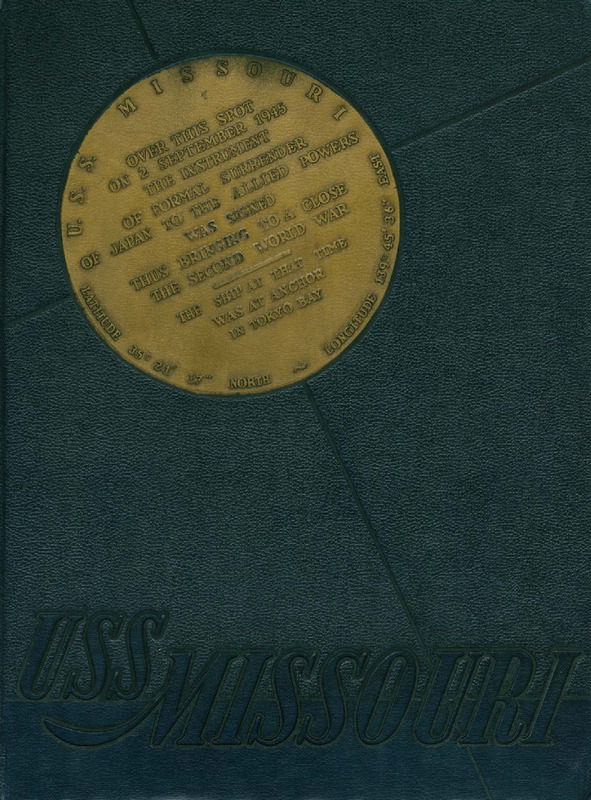
History of USS Missouri
"U.S.S. Missouri. Over this spot on 2 September 1945 the instrument of formal surrender of Japan to the Allied Powers was signed, thus bringing to a close the second World War. The ship at that time was at anchor in Tokyo Bay. Latitude 35° 21' 17" North -- Longitude 139° 45' 36" East"--Cover
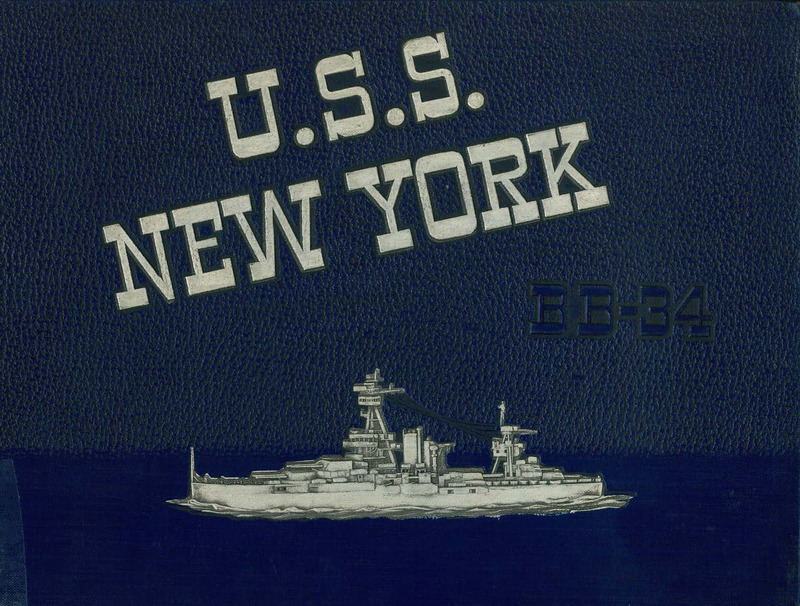
History of U.S.S. New York, BB-34
The U.S.S. New York, whose career spans a thirty-one year period embracing a volume of tradition which might well be the envy of any ship of the Fleet and whose name has been borne of six vessels of the United States Navy through 170 years of naval history, has the unique distinction of having played a noteworthy role in two world wars.
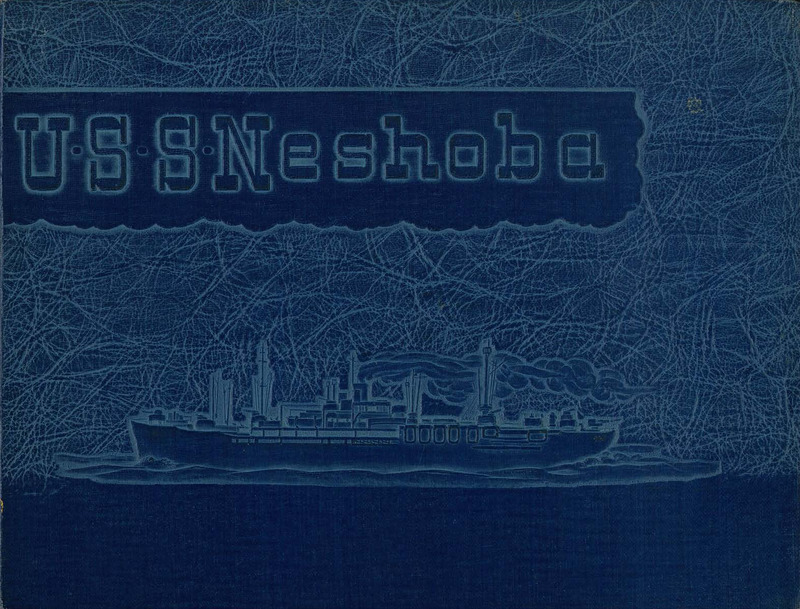
History of U.S.S. Neshoba
Her name, the U.S.S. Neshoba. Like most of her sister Attack Transports, she was named for a county in the United States. Neshoba county is located in the state of Mississippi, but the ship was built many miles away from there. One of the 130 ships of her class, the Neshoba was built by the Permanente Metals Corporation of Richmond, California, and launched on 7th of October, 1944. She was commissioned as a ship of the United States Navy on November 16th, 1944, being sponsored by Mrs. Wendall E. Adams of Berkeley, California, and placed in command of Commander Martin J. Drury, USN Commander Drury was later promoted to the rank of Captain. The conversion to an attack transport was made at Hunter's Point Ship Yard in San Francisco. The conversion consisted of installing Navy Radio and Radar equipment, armament, adding welin-davits for landing craft, and the landing craft. At the conclusion of this conversion, the Neshoba was a fullfledged, ready to APA. From time immemorial, every Navy ship has had its shakedown cruise. The Neshoba was no exception. Her shakedown brought her from San Francisco to San Diego. It was during this coastal run that she attained her top speed of 19 knots. At San Diego, she was committed to Amphibious Training at which time the new boat crews got a feel of their craft. She acted as flagship, for Transport Squadron Thirteen whose commanding officer at that time was Commodore John G. Moyer, USN. The training was supposed to last a period of two weeks, but sudden changes in the Pacific Fleet organization made the Neshoba's entrance on the scene of action very imperative and the training was cut short. She proceeded to San Pedro, California, where final repairs and checkups took place.
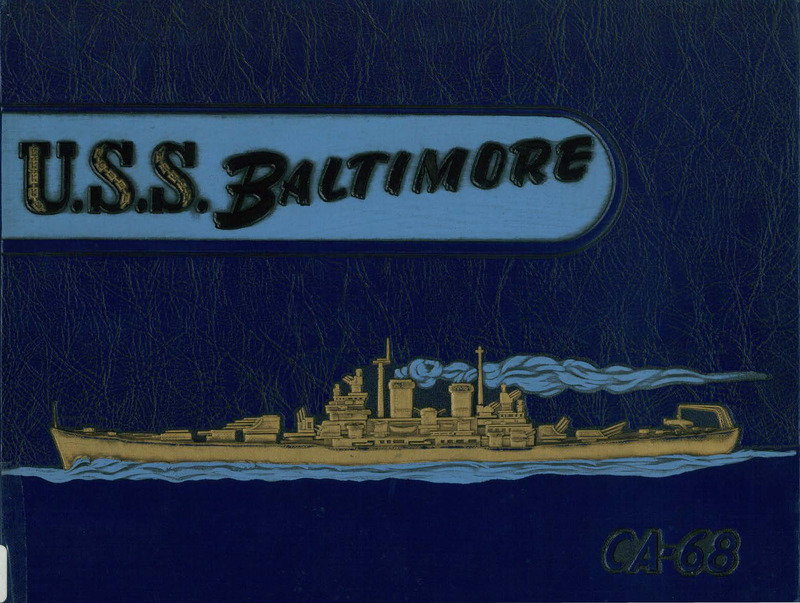
History of U.S.S. Baltimore, CA-68
Beginning of The Baltimore Story: Now at Wars' End the Story of the Heavy Cruiser U.S.S. Baltimore Can Be Told! Like other battle seasoned and scarred heavy cruisers, the USS Baltimore has lived a full war life, sampled its first battle with a bombardment of Makin island, stormed through the Gilbert, Marshall, and Marianas campaigns, leveled the synchronized fury of its nine protruding eight-inch rifles on Satawan island in the Caroline group; but unlike many less fortunate cruisers, the Baltimore had run the gamut unscathed. Some of her actions and deeds--like carrying the late President Roosevelt to his historic triumvirate at Pearl Harbor with five-star Admiral Nimitz and General MacArthur-were tagged as "top secret", thus remained untold 'til war's end. But probably the main reason for her silent satirically and smothered blackout was that in doing a thorough workmanlike job for over two years, the Baltimore's skippers (Captains Calhoun and Fink), officers, and crew had clearly defied, coldly thwarted, and precisely out maneuvered every Nip attempt to register a single hit on its six hundred and seventy feet of armored deck and superstructure.Not once did she wear a hurt, martyred look, or limp into the news as a battle casualty--not a man did she lose through enemy action. But the Baltimore was always there, as her crew so loudly and proudly echoes: "They don't wear service stars for nothing!"
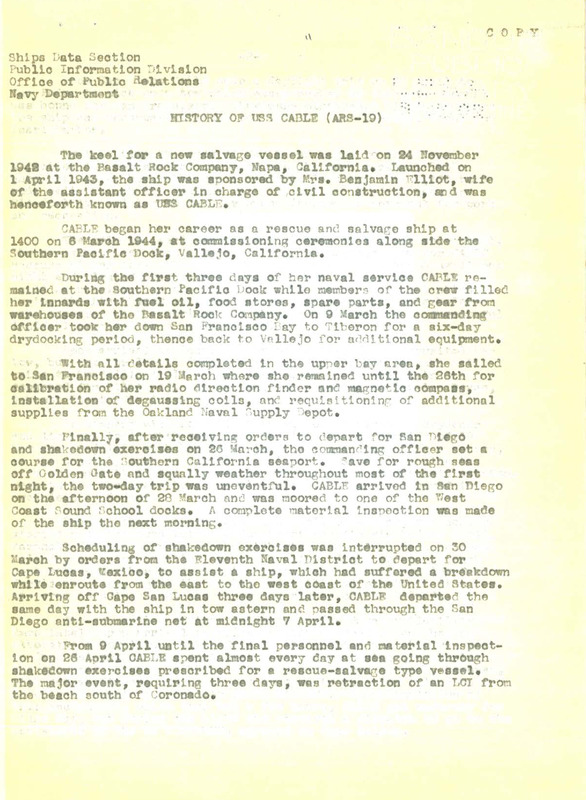
History of the USS Cable (ARS-19)
The keel for a new salvage vessel was laid on 24 November 1948 at the Basalt Rock Company, Napa, California. Launched on 1 April 1943, the ship was sponsored by Mrs. Benjamin Elliot, wife of the assistant officer in charge of civil construction, and was henceforth known as USS CABLE. CABLE began her career as a rescue and salvage ship at 1400 on 6 March 1944, at commissioning ceremonies along side the Southern Pacific Dock, Vallejo, California.
First Anniversary, U.S. Naval Construction Battalion Maintenance Unit No. 597: First March 1945
"... The accomplishments of the Seabees have been one of the outstanding features of the war. In the Pacific, where the distances are great and the expeditious construction of bases is frequently of vital importance, the construction accomplished by the Seabees has been of invaluable assistance. Furthermore, the Seabees have participated in practically every amphibious operation undertaken thus far, landing with the first waves of assault troops to bring equipment ashore and set up temporary bases of operation. In the Solomon Islands campaign the Seabees demonstrated their ability to outbuild the Japs and to repair airfields and build new bases, regardless of conditions of weather. There can be no doubt that the Seabees constitute an invaluable component of our Navy." From the official report by Admiral Ernest J. King, Commander in Chief, United States Fleet, and Chief of Naval Operations

Fighting Fox: U.S.S. George Elliott
Foreword: A ship is only as great as the men who sail her . . . This the story of a great ship ... U. S. S. George F. Elliott Auxiliary Passenger Number 105, affectionately and aptly known to her men as . . . "The Fighting Fox"
Eighty-Second U.S. Naval Construction Battalion, 1943-1945
Foreword: The primary purpose of our book is to provide a pictorial record in time sequence of the journey of conquest, work projects, and related activities of our battalion in the Pacific Ocean Area. In no other way is it possible for us to have a true and compiled portrayal of our proud accomplishments, notable achievements, and fine associates. The past two years have cost immeasurable energy. We have forgone many civilian pleasures and activities. Accordingly, all this has greatly delayed the progress of our life's planned work. It is our sincere hope that this record be as complete and accurate as possible. We trust that it will give you many fine, complete, and proud recollections of true and sincere fellowship. With this goes a great satisfaction. The contributions of our battalion have enabled the armed forces to successfully travel the road to complete victory. We cannot measure our accomplishments in personal sacrifices or monetary gains or losses, great as they might have been. Rather it is for each of us to accept proudly the responsibility of our work and be humble in our acceptance of the glory in a great achievement. Let us proceed to use wisely the long and costly victory.
Earthmover: A Chronicle of 87th Seabee Battalion in World War II
This book is divided into two parts to accommodate quicker download speed. Foreword This volume is essentially the overall story, in log form, of the 87th U. S. Naval Construction Battalion--a hard-working Seabee outfit, which did everything asked and expected of it from the Solomons through war's sudden end on Okinawa. It is, of course, no better or worse than the approximately 1,300 officers and men who carved out its multiple achievements with their sweat, blood and, at times, even tears. This trip book has been designed to cover the period between 20 February 1943 and 9 October 1945--a span of approximately 31 1/2 months. Unfortunately, no pictures were taken between 9 October and 7 November when the remaining 361 men finally embarked for the States in their twenty-seventh month overseas. The photographer and assisants had all gone home. The story of the tour has been purposely kept vague or general so that each man might be free to relate his version of the sequence of events as he saw them. This publication has been prepared for the men of the 87th, their families and friends and is not intended for general publication or circulation. Moreover, the opinions expressed in this volume are those of the editors and their staff and are not intended to reflect those of the Navy Department or the service at large. Every reasonable effort has been made to keep the written portions of this trip book as objective as possible. And an honest effort has been exerted throughout to make the book as factually accurate as existing facilities for assembling and checking information would permit. However, conceived and launched just prior to leaving New Caledonia and finished in foxholes and amid post-war confusion on Okinawa, the job, a spare-time project until 12 August 1945 , was accomplished under just the worst circumstances imaginable. At its best, THE EARTHMOVER could never hope to depict the overall impact inflicted on each man during the several years spent on these far-flung Pacific islands. but the editors herewith submit it as a fair resume of the 87th's role in World War II.
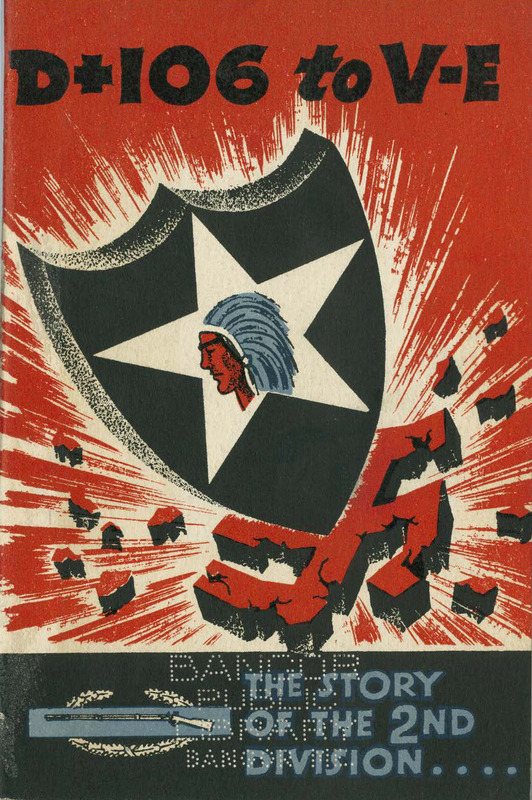
D + 106 to V-E: The Story of the 2nd Division
From the Introduction: "This booklet is designed to give a general picture of the Second Infantry Division in its operations from the time it reached the Siegfried Line in Germany on October 4, 1944, until it arrived in Pilsen, Czechoslovakia, its location on V-E Day, May 8, 1945. A preceding booklet told how the Second, which was activated in France in 1917 and which probably gained more renown in World War I than any other division, opened its campaign in World War II when it came ashore on Omaha Beach in France, D plus 1, June 7. The story described the manner in which the wearers of the Indianhead patch fought their way through Treviers, Cerisy La Foret, and then, in one mighty effort, crushed the powerful Nazi defenses on Hill 192, grassy slope holding up the advance on St. Lo. In the speedy breakthrough South that followed, the Second stepped out in front and pushed through St. Jean des Baisants, Vire, and Tinchebray in victorious but hard fighting. It was next ordered along with two other divisions to take Brest, heavily defended seaport which the Germans had used as a submarine base. After a bitter four-week struggle, in which the Nazis fought desperately to prevent the port from passing into U. S. hands, the garrison formally surrendered to Major General Walter M. Robertson, Division Commander, from Nelson County, Virginia, on September 18, 1944. The division then moved by truck and train across France and Belgium to the Siegfried Line, where this story begins.

Contrast: The Story of the the Fifth Special Naval Construction Battalion
This is the story of a Seabee Special Battalion, a rigger or stevedoring battalion, whose principal function in the Navy of World War II was the working of the vital cargo and materiel necessary for the prosecution of the War. Special battalions were not permanently employed on Stateside duty; that was a job for civilians. Like all Seabee units, the Specials were rigidly trained and indoctrinated for overseas duty and the inevitable hazards of war. They became the life blood, the dominating force of the supply lines, radiating from Allied ports of loading to the front lines of the farthest theaters of war. Participating in actual invasions, they helped conquer new territory for their supply line, then maintained those extensions as our forces pushed forward toward the enemies' homelands. Ships and craft of every size and denomination, flying the flags of every Allied nation, were worked by the Seabee stevedores, the Special battalions. This, then, is the story of one of those stevedoring battalions, and it chronicles its wanderings from its birthplace in Virginia across the United States; its duty in the frozen wastelands of the Aleutian Islands and the farthest Arctic outpost at Point Barrow; its return to the States for rehabilitation and re-assignment; and finally, its tour of duty in the South and Central Pacific. From Point Barrow to New Guinea, from Virginia to the Philippines-thousands of miles, months that stretched into years, are written into this history, a story not only of the battalion but of the men, the individuals themselves, who loaned that part of their lives to the service of their country that this history might be written. It is to them, then, the men of the Fifth Special Naval Construction Battalion, that this history of their outfit is dedicated. Frank L. Holland, Lieutenant-Commander, USNR, Officer-in-Charge
Cargo Soundings Album: April 1944 to November 1945
Prologue: Soon after the treacherous attack on Pearl Harbor, the idea was conceived by the Navy Department of forming construction units which would do all construction work overseas that would arise from the exigencies of war. Less than a year later a bottle-neck developed in the unloading of ships which made it obvious that the Navy needed not only experienced builders but capable stevedores, as well. Hurriedly the "Special" Battalions were formed. Their personnel consisting of some life-long stevedores, but in great part, of men who had never before been on a dock for a purpose other than boarding a ship or fishing. These battalions came through in the best traditions of the Seabees and the U.S. Naval Service. From Port Hueneme, California, to the Philippines, from Davisville, R. I., to Burma. The "Steve-bees" have, in full battalions, detachments and units, performed miracles in speed of loading and unloading supply ships. The 28th Special Naval Construction Battalion is typical of the fast-working, efficient, stevedoring outfits that have done so much to facilitate the logistic angle of the war effort. At Pearl Harbor it received commendations for its speed and capability, for its record-breaking handling of all possible manner of cargo. In the Philippines it continued its excellent work. Soon after V-J Day the battalion moved to Japan, where it was decommissioned. When the 28th Special landed at the Philippine Islands, it found nothing in the form of living quarters waiting for them. A camp had to be built from scratch and there was no one around to do it but the stevedores themselves. The men fell to the job with a vengeance, determined to prove their versatility. Following in the footsteps of a Construction Battalion, they built a camp that was generally conceded to be among the best on the island. It is to these men who have sweated on the docks through all hours of the day and night; who have outdone themselves in an unaccustomed construction job that this book, the story of their lives in the 28th SI'ecial, is respectfully dedicated.
Can Do: The Story of the 571th Naval Construction Battalion Maintenance Unit
The story of an outfit is often a story of the individual experiences of its men, but this narrative is a chronology of the collective achievements and adventures of men working in unison, primarily the men who formed the original complement of Construction Battalion Maintenance Unit 571. The charter members of this Seabee crew hailed from all walks of life and went on to carve out a bright record of attainment on lonely tropical islands unheard of and unimportant until war made their possession and exploitation necessary. The final, complete story of CBMU 571 is not over, because CBMU 571 is, at this writing, still commissioned, still doing a job, still adding to a record. But to the men who formed it, who carried the knowledge, the brawn, the guts, and the equipment into the islands of the Pacific, this chapter of their careers as Seabees is completed. These men may go on to other naval organizations or they may already be civilians again, but their first love as servicemen will be CBMU 571.