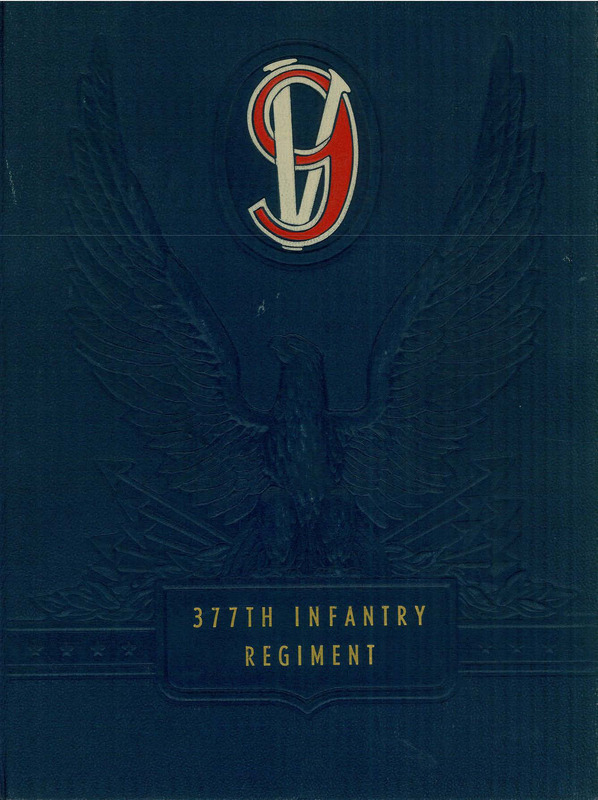
This is a history made by the men of the 377th Infantry Regiment. It's a story of men who served their country and served it well. Men who underwent the toughest, most rigorous, most backbreaking training that the Army could hand out. And men who, after two hard years of this training, went across to the field of battle in Europe, met the enemy, and defeated him at his own game--war. It all began on the sandy flat of the recreational area at Camp Swift, Texas, a typical Army camp located about 30 miles from Austin, with the usual training-center panorama of red-and-white water towers, white wooden barracks, and green recruits. There, under the blazing hot sun of July 15, 1942, the 377th Infantry Regiment was activated, along with the rest of the 95th Infantry Division.
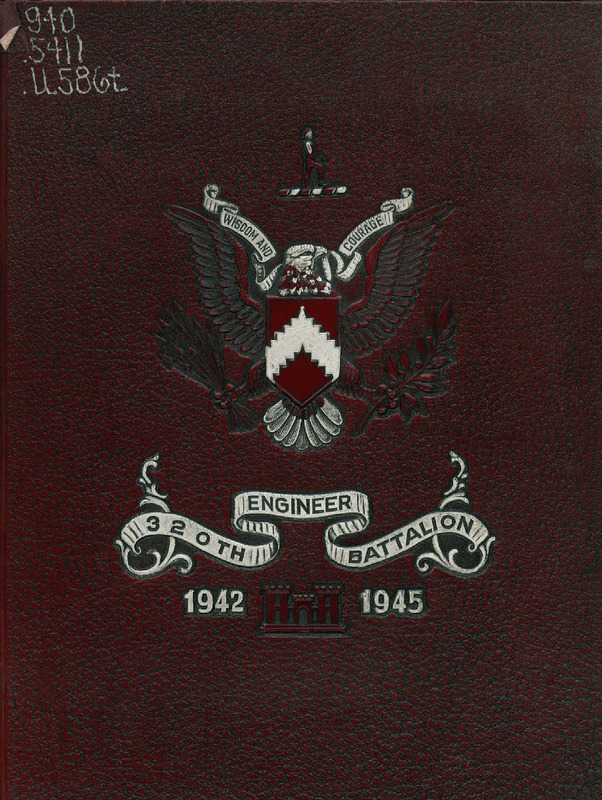
The 320th Engineer Battalion was activated as part of the 95th Infantry Division on July 15, 1942, at Camp Swift, Texas. The enlisted cadre for the Division was furnished by the 7th Infantry Division. The officer cadre had been drawn from many organizations and received refresher courses before reporting to the Division. Additional officers were received direct from Officer Candidate Schools. Maj. Gen. Harry L. Twaddle came from the War Department G-3 to take command of the Division. Lt. Col. Leland B. Kuhre came from the St. Louis Engineer District to command the 320th Engineer Battalion.
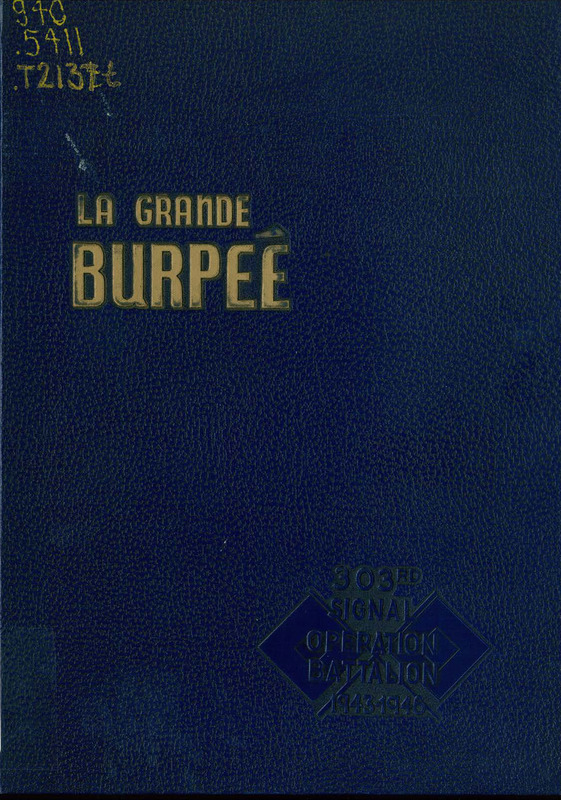
April 17, 1943 was officially activation day for the 303rd at Camp Crowder, Missouri. Shortly before that, Lt. Clyde Burch had herded a wild and wooly cadre crew northward from the 17th Sig. Opn. Bn., which was then on 2nd Army maneuvers in Tennessee. Officers then began to trickle in, more cadre men, and the inevitable lesson plans and course outlines started to take shape. The bulk of the "fillers" arrived around the first of June, and training took hold with vigor, if not with a great deal of vim. Basic training, hikes, calisthenics (TC-87!) and rain, rain, rain occupied our days, always under the fierce scrutiny of Col. Rinaldo Coe who ruled the 2d Army detachment at Crowder with the aid of Capt. Cohen and an assorted staff,guaranteed to give trouble. Col. Coe was a real soldier, and though we groaned under him, later we were damned proud of our state of training. He was aided in his inspections by his dog, which the men fervently believed came up to inspect our training on his own, and then scampered back to report our deficiencies to his master.
I am sure that in future years when looking through this book it will be a never ending source of pleasure in recalling memories of your friends and the pleasures and hardships you went through together. I am equally as sure that when this war has been fought to a successful conclustion that you will be proud to look through these pages and know that you were a member of the finest fighting organization in the Army--the SEVENTEENTH AIRBOURNE DIVISION. --W. M. Miley, Major General, U. S. A., Commanding
Few military organizations in the United States can trace their history as far back as pre-Revolutionary War days. One such organization is the 156th Field Artillery Battalion whose Battery A many believe to be the oldest military unit in the United States. A Kingston outfit of the New York National Guard, it dates back to 1658.
Book is divided into two parts. From the introduction: "This is the history of the 13th Armored Division, a story of three long years in training and battle--a story written not in the bone-dry dust of the historian, but rather with the sweat and blood and honest fear of the infantryman, the tanker, and the cannoneer. These men worked together, lived together, and some of them died together--died in the filth and rubble of the war-ravaged Ruhr or in the rivers and forests of Bavaria. But, most of the men lived--and fought, and captured towns, liberated prisoners of war, killed Germans--and helped win the war. This, then, is the story of these men, living and dead. The war was young, andnot going at all to our liking, when we descended upon Camp Beale, California in 1942 to begin the long training grind that was to lead us to the battlefields of Germany. And we were young, too, and cocky--"Get that cap on the left side of your head, soldier. You're in the Armored Force now' we barked. We trained and learned the arts of battle the hard way--toughening up with basic training, and problems staged with the realism of combat. "California's Own" they called us--and the Governor of the state christened our tanks. That was in the summer of 1943. For two years we toughened up at Beale and Camp Bowie, Texas, and we were plenty rugged when they put us on that boat for the ETO."
Foreword: In editing this, the history of the 13th Airborne Division, we hope that we have not committed the grievous error of considering our commission as merely a personal honor. We feel that the honor and the high responsibility entailed therewith allows us an opportunity to render a real service to our comrades and to our beloved Division. It is our most sincere hope that in the years to come, when the memory of recent days fade, you may take this book in your lap and recall memories of friends--of trials and triumphs--of days we spent together in the 13th Airborne Division. The Editorial and Management Board
The history of the 1288th Engineer Combat Battalion has been well recorded on film. It is not a story of heroic deeds and battles but it is never-the-less a very interesting one because of the many historic and picturesque places that were either occupied or visited by the personnel of the Battalion. The history of some of the scenes and buildings pictured on the following pages dates back to the Medieval and even Roman eras while in others you see the settings so familiar as the backdrops for the greatest epic of all times, World War II, in which you, the members of the 1288th, had a hand in the making of history.
From Division Briefs: "11th Airborne Division: activated February 25, 1943, at Camp Mackall, North Carolina ... Composed of paratroopers and glidermen who have been through the toughest kind of training, including full portions of double time hikes, guerrilla exercises, and bivouacs."
In November of 1940 the War Department, after two years of experimenting in search of a highly mobile ground reconnaissance force, selected seven national guard and two regular army cavalry regiments to be reorganized as "Horse-Mechanized Cavalry." With a new national emergency in sight, and mobilization already under way, the 102nd (Essex Troop) Cavalry was honored by being selected as one of these. The new regiment consisted of a rifle squadron (horse), reconnaissance squadron (mechanized), a headquarters troop and service troop, the latter embodying portee equipment for the horse squadron. From a peacetime strength of about 500 men, the organization jumped to a mobilization table of some 1,500 and active recruiting was started immediately.
Foreword: It has been regretted for some time that, because of Wartime restrictions, personally owned cameras are not allowed on board, and it has been impractical for the Photo Lab to attempt to furnish all hands with pictures of the places we have visited and of the many interesting, thrilling, exciting and even hair-raising experiences that we have had during this, our first year as an integral, fighting part of our Fleet. Considerable thought also has been given to devising some means whereby the memories of our many experiences, and our everyday life aboard, might be preserved in a definite and concrete form, because, regardless of how anxious we are to get back to our families, and regardless of how arduous, trying, and nerve racking our experiences have been, when the time comes for us to leave the Lunga Point, it is confidently believed that our happiness in returning to our families will be mingled with a genuine feeling of regret in having to leave the many friends we have made on board, not to mention the regret we shall feel in leaving the Lunga Point, which has, after all, been our home for many months now. We feel that we can say without fear of contradiction that the Lunga Point and those who have served in her will have a very warm spot in the heart of every Officer and man who has been privileged to fight her, and that place in our hearts will ever increase as the years roll by. .... Every officer and man should, therefore, receive due credit for the part he played, and for that reason, the name, rank or rate, and home address of every member of our Ship's Company will appear in this book, except for some few who have been transferred without leaving their addresses. In the above paragraphs, this book has its genesis. It is not a perfect book by any means. There have been many obstacles, some of which it was impossible to surmount, but it has been our earnest endeavor, as nearly as possible, to completely and faithfully chronicle our first year for you. If this book achieves its purpose of preserving those friendships and memories of the past year, we will have been well rewarded for our efforts, because, as your Editor, we will have that deep sense of personal satisfaction that can come only from the knowledge of a job well done. It's been a grand cruise, Shipmates. Au revoir! And God Bless you all. --S. Linton Smith, Lieut., USNR
"You'll be sorry!" With those ominous words ringing in their ears, 1082 embryo Seabees, destined to become the 119th Naval Construction Battalion, passed from civilian life into the receiving center at Camp Peary on a prophetic torrid day in July of 1943. "You're in the Navy, Mac. Wipe that grin off your face and line up as your name is called." Men who had been welders, electricians, machinists, carpenters, plumbers, shipfitters, and skilled workers in every trade and profession found themselves on a threshold of a new life. At 5:30 in the early darkness of the next day, the raucous blare of the bugle--their first reveille--awakened them. Sleepy and confused, they were mustered and lined up. They scarcely realized then that for the rest of their service lives they would "sweat out" endless lines for every occasion.
This is the story of one regiment; or rather, it is the story of the men of one regiment. Undoubtedly, the world took little note of the 254th Infantry. To them we were merely a number, a small unit which lost itself in a multitude of small units, a forgotten integer in headlines which screamed only of corps and armies and theaters of war. But to those of us who fought in the regiment, it was the army, the theater, the war. When our casualties were high, the war was a tough one; when we moved rapidly and the land fell to us like wheat before a reaper, the war was going well.
This is the military history of the 179th Regimental Combat Team. As a component of the "fighting 45th" Infantry Division, its story is a revealing one. Through its history can be seen a major portion of the Sicilian and Italian Campaigns, much of the French and German Campaigns--in other words, the war in Europe. Through its history weave the gallantries of the men who made the Regiment; yet by changing names and dates and places, this becomes the story of any combat infantry regiment. Thus, through its history must inevitably flow the life blood of the American soldier.
The 493rd Armored Field Artillery Battalion was activated on 15 September 1942 at Camp Campbell, Kentucky as a part of the 12th Armored Division. Major General Brewer was designated as Division Commander and Major Barry D. Browne the Battalion Commander. Edited by Paul H. Shepard Jr. Written and photographed by officers and men of the battalion
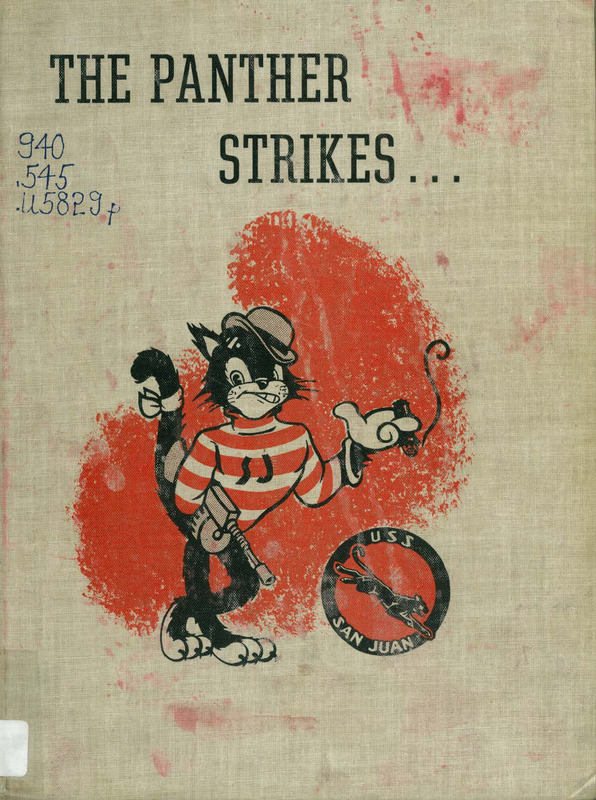
The story of the United States cruiser San Juan is, in reality, the chronicle of a relatively small group of men, and of ships, bound together in allegiance to a common flag--the colors of a free nation whose peacetime borders boast no fortifications, save the guns of a salt water fleet. It is the story of a Navy which arose from staggering defeat to "bring the fleets of two aggressor nations to their knees, receiving their surrender within four months of each other." It is the saga of a sleek anti-aircraft cruiser whose graceful lines and latent power won for it the affectionate nickname "Panther"--a nickname which matured, as the San Juan itself matured, through fifteen major engagements against an enemy victorious in every war since 1596. The sobriquet gained material being by way of a signalman's sewing cunning and under Captain J. E. Maher, U.S.N., the San Juan's first commanding officer, the "Panther Flag" gained recognition as a battle flag and from that time on flew from the foretruck during the "Panther's" strikes against Japan. E.G. Hines, USNR
Like all other commands, the IX Air Force Service Command is made up of people--people whose jobs began long before the invasion, endured right up to H-hour and beyond. There were glider pilots, engineers, clerks, mechanics, cooks, doctors, truck drivers; in fact, every conceivable job necessary for victory was filled by an expert who was willing to subordinate everything to the goal ahead. Take the transport pilots, for instance. Red-eyed, flying seemingly endless hours, they operated on a two-way schedule that carried everything from gasoline and guns and bombs to blood plasma and sulfa drugs into Normandy, then carried wounded men back to England on knock-down cots which made ambulances of the Douglas Skytrains. And they did this on schedules which sent ten planes across the Channel every hour. The achievements of the IX Air Force Service Command are many and varied-it is virtually impossible to enumerate all of them. Perhaps it would be better simply to say that it is the "good right arm" of the Ninth Air Force. And when "service" is wanted by the Ninth, it is the Service Command which provides it as quickly as possible.
From the Foreword, written by Arnold T. Johnson, Col. A.C., Group Commander: This book has been prepared and published in the belief that every member of the 497th Bomb Group will want to have its glorious combat history preserved and that every member will desire to have a copy. It is hoped, as you browse through this book in future years, it will serve to remind you of your many friends and team-mates with whom you served. It is hoped, as you glance through the "Roll of Honor", it will keep alive your memory of our brave friends who did not return, and of the great sacrifices a war exacts. Because these gallant men made the supreme sacrifice, we are living to enjoy the "Four Freedoms" for which this war was fought. As I think back to those days on Saipan, where we lived, worked and fought together, I think of the smoothest functioning team it has ever been my pleasure to serve with. I think of every man performing his duties with loyalty and cooperation and to the best of his ability. Men in the kitchens, on the maintenance line, in the offices, on board the airplanes; each seemed to take pride in making every mission a little better than the last; each knew that his efforts brought the war to a close just a little sooner. Every-man who fought with the 497th Bomb Group deserves the highest praise and commendation. To each of you I extend my sincere appreciation and congratulations for the job you did so well. Preparation of this book did not begin until five months after the group had returned to the States. The group was then stationed at MacDill Field, Tampa, Florida. Very few of the enlisted personnel had returned, many of the officers had returned but there were also many new ones assigned. Many staff positions were filled by personnel who were new to the group. The records of the group, including the squadron records, arrived home in a thoroughly disorganized fashion and a considerable amount of the records were never found. These facts together with the difficulties in obtaining the correct status of missing personnel and present locations of all former personnel have made the task of preparing this book very difficult. It is desired to acknowledge that this book will contain many imperfections and perhaps many errors. The errors are regrettable but everything has been done to avoid them, insofar as has been possible. In spite of this, it is believed that this book is well worth while and will be thoroughly enjoyable to all former personnel of the group.
Headquarters and Headquarters Battery 108th Antiaircraft Artillery Group, a new organization in the annals of United States military history, has had a rich and important part in the successful prosecution of this Second Great War just ended. Activated 1 March 1942 at Camp Davis, North Carolina, as Headquarters and Headquarters Battery 514th Coast Artillery (Antiaircraft) the Group had had the responsibility for providing demonstration, instruction and maintenance personnel for the Antiaircraft School and Antiaircraft Board until October 1943.
In this book of words and pictures is a compilation of the work, accomplishments, and activities of the Twenty-Sixth United States Naval Construction Battalion (Second Section) which on July 15, 1945, was redesignated Construction Battalion Maintenance Unit Six Hundred Thirty-Five. It is dedicated to each officer and man who gave his' best for the one and only cause, and each can be justly proud of the part he played. The Staff wishes to extend its appreciation to each and every member of this Battalion who helped in procuring and compiling the necessary information, for without your moral support. interest. and actual aid this book would have been impossible. We sincerely hope that in years to come you will refer to this book often in remembrance of the part you and your comrades played in the achievement of the final victory.
The enlistment centers throughout the country were opened to volunteers for the Seabee branch in the latter part of December, 1941, just after the Pearl Harbor incident. In order to induce skilled construction workers to give up highly paid civilian jobs and volunteer for Seabee service, Navy rates were offered. From the ranks of some sixty different building trades, men began to answer the call. The age range was wide, seventeen to fifty years, and the preponderance of older men, many of them veterans of the last war, soon caused the Bees to become known as "grandpops" among the men of the regular Navy.
As uncertainty marks the course of world events and Democracy stands on a threshold of unrest and threats of aggressor nations, citizen soldiers of the 246th Coast Artillery again have calmly adjusted themselves to another unlimited national emergency. While many of the great nations of the world are in a state of undeclared war and their peoples enslaved to a dictatorial tyranny, guardians of the Mother State--many of them reminiscent of their 1917-18 struggle to save the freedom handed down to them from courageous ancestors--are preparing for any eventuality that may threaten the American way of life. Just as the first European government crumbled under the heel of a monstrous conqueror in this World War lI--the Army of the United States signaled for strength. We, of the 246th Coast Artillery (Harbor Defense), are proud to be a part of this vast bulwark between a free, peace-loving nation and a force so destructive that the entire world fears for its safety.
This is the story of an artillery outfit in World War II. Most of it had to be written after that war was over and the outfit scattered over the land. It very likely has as many "bugs" in it as the post-war auto. Only two sources of information were available from which to piece this story together. One was the official history of the 91st Division Artillery which bristled with facts and figures, but told little about men and their lives. Whatever was missing, I tried to supply from my memory.
An account of the 10th Mountain Division in the Italian campaign; edited by Theodore Lockwood with the assistance of other members of the division. "It was Washington, D.C., July 15, 1943. At the War Department it was noted that a new division was being activated as of that date--the 1Oth Light Division. Out in Colorado the usual afternoon cloudburst broke loose as the journal clerk recorded the fact that the division had been officially activated. A month later there was a formal occasion; Pando, Colorado witnessed the parade and ceremonies honoring the birth of the Tenth. Major General Lloyd E. Jones reviewed the troops."