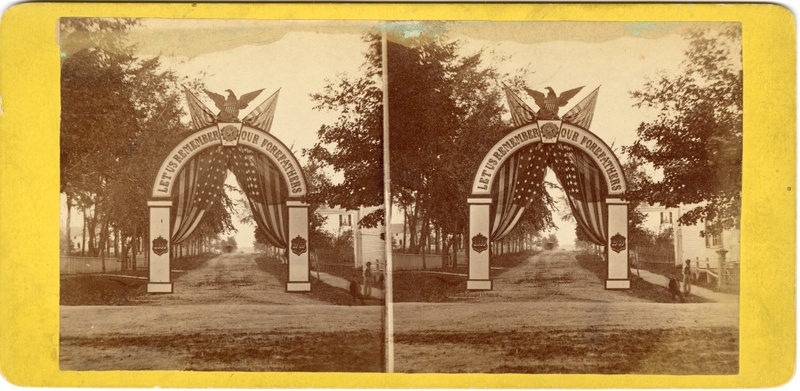
Bangor celebtrated its centennial on September 30th, 1869. Among the events to commemorate the day was a lengthy procession of dignitaries, which passed by the arch in this photograph. Bearing the motto "Let us Remember our Forefathers 1869 1769," the arch was erected at the corner of Lime Street and State Street.
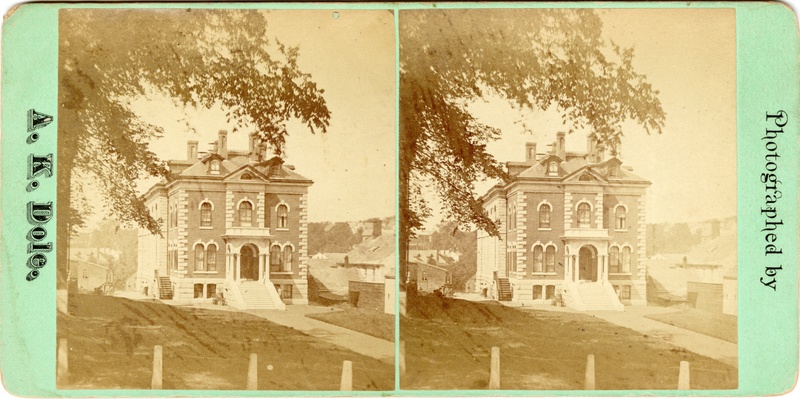
The Penobscot County Jail was designed in 1869 when the previous prison, built in the 1830s, proved inadequate. Designed by Gridley J. F. Bryant, the jail has somewhat of a dual personality. The gracious front in the Italianate style, housed the jail keeper and allowed the building to blend into the stylish and handsome neighborhood of downtown Bangor and Hammond Street. As can just be seen in this photograph, the longer rear section was more severely modeled in granite and housed the prisoners.
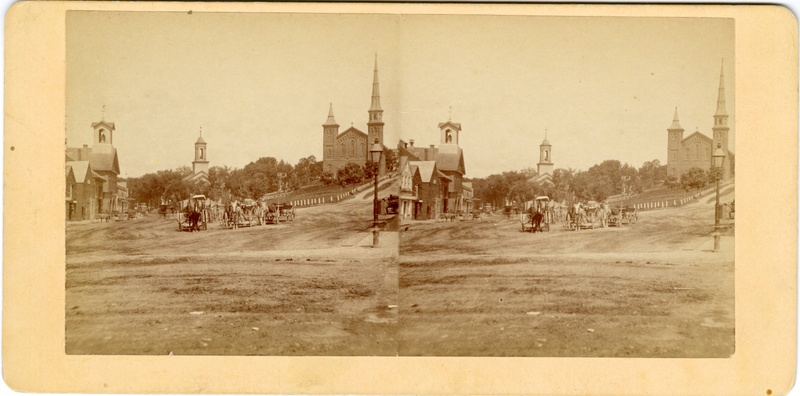
This broad view of East Market Square seems greatly underdeveloped to the modern eye. Although the Universalist church still stands on the hill, it lacks the distinctive asymmetric tower that was lost to the fire of 1911. Likewise lost was the Baptist church in the center of the photo, which was replaced by the re-built High School, and, ironically, the Harlow Street (Center) Fire House; the tower to the left. The sloping hill of Center Park is today the site of the Bangor Public Library, and the unpaved streets team with cars.
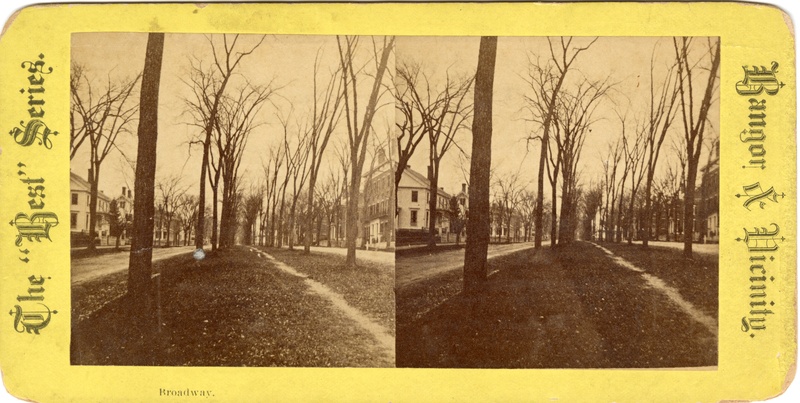
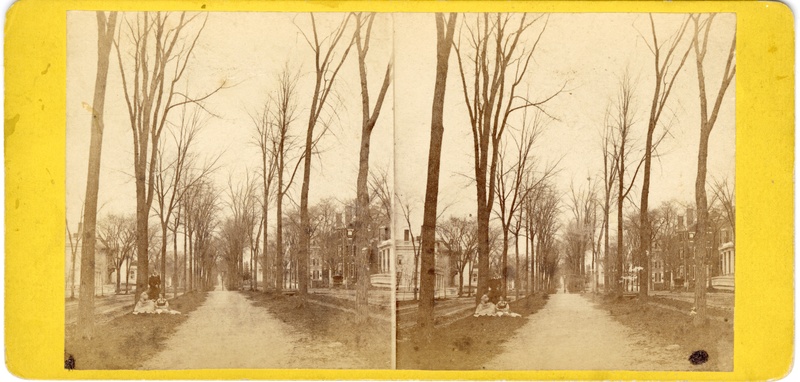
Stereograph showing Broadway and a footpath as it runs along some of the fine houses of this section of Bangor. Taken some time between 1881 and 1890, rows of elm trees are silhouetted without their leaves.
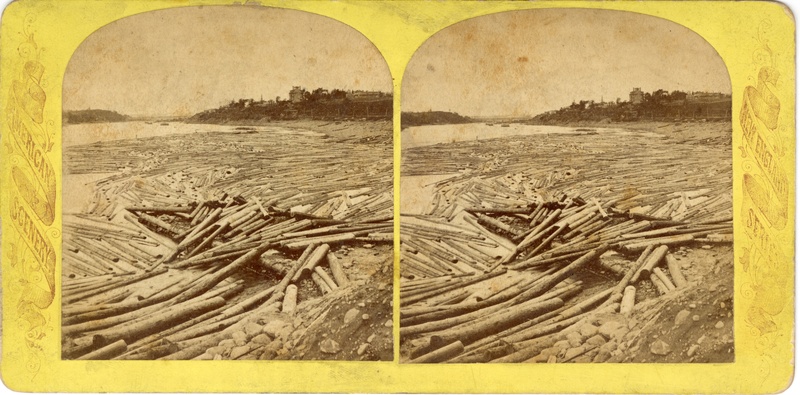
After logs were cut and floated down the Penobscot, they were drawn up short by the boom streched across the river. Here, the logs were identified by the hallmarks cut into them at lumber camps, and separated by owners. In this picture, the ebbing tide has tumbled logs against each other along the bank. The pylons of the boom can be seen in the background in the middle of the river; a chain reached between them to halt the logs.
This view of Broadway from State Street, taken sometime between 1869 and 1871 and distributed by Trask and Dole, showcases Bangor's fine rows of elm trees--as well as its unpaved roads, which were fearsome in the Spring 'Mud Season." Three women pose in the weak sunlight next to a melting snowbank.
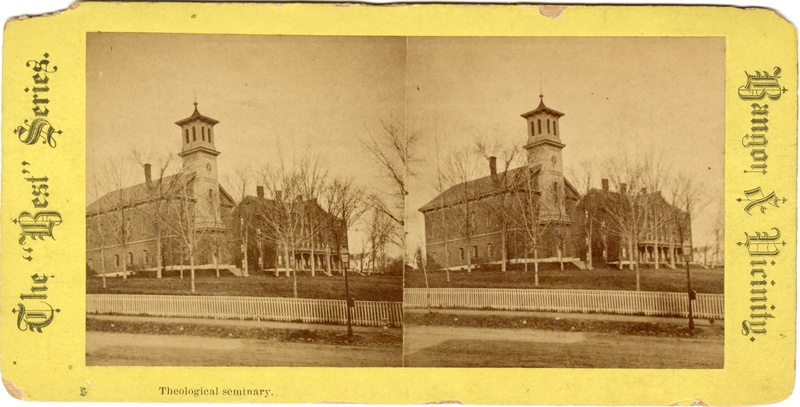
The chapel of the Bangor Theological Seminary was built in 1858 by the architect William G. Morse. To the right of the chapel is Maine Hall, designed by Charles H. Pond. Maine Hall, begun in 1833, was designed as a sober, traditional building, modeled after similar structures at Andover Seminary and Harvard University, so its simple Federal facade is plain except for a simple doric portico.
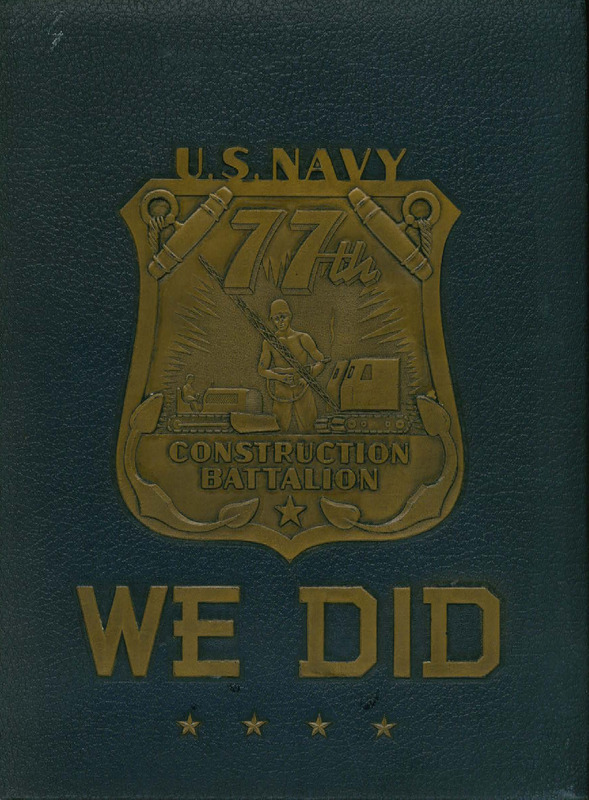
"Here is our story -- to the everlasting memory of associations with men of courage, ability and determination in time of our greatest national emergency, a job well done." --Robert E. Fonger, Lt. Col. C.E., Commanding
6-7 January 1945: We made the most of our opportunity to get acquainted with the French. Phrase book in hand we went determinedly after the population, and soon large clusters of Gls were seen around tolerantly amused little kids, asking any sort of question they could think of. For the most part the kids waited until the boys were just about talked out, and then asked for ''Chocolate, chewing gum, or cigarette pour papa." Others didn't wait for them to talk themselves out. No matter how the conversation started, it always ended with the request for cigarettes and chocolate. In an alley down the street a still was found that transformed apple juice into a product for which many uses were found, including lighter fluid . And the "Vive Ia France!" sentiment gained in intensity. Our vocabulary was soon increased by such valuable terms as "Cognac, Calvados, No compree, Couchez avec moi, etc."
From the unofficial introduction: "And Seabee ingenuity, what of that? We made bull fiddles out of oil drums, violins out of native mahogany on Guadalcanal, sight-seeing boats out of sunken barges; drove piles without pile drivers, built bridges before our equipment could get to us. On Bougainville, although bombed 60 times by the Japs, Seabees on their own time rigged up an ice cream factory which supplied 30 gallons of the world's best ice cream to these fighting builders. Perhaps these examples seem trivial in the light of the substantial contributions to total victory which the Seabees have made, but they reveal the spirit of the men. How are you going to discount men who can go through 60 bombings and come out making ice cream? We are famous now, this group begun so few years ago--famous for our work, famous for our fights, famous for our ability to make something out of nothing, but we are famous for other things, too, not the least of which is our chow. Many are the Marines and soldiers who have come to Seabee mess halls for a hot meal. The 77th never sat down to a meal without at least one guest. Some of these were famous, many more were just GI's on the line who could do with something hot inside. The 77th Welcome Mat was always out, not one meal chit was ever issued to one of these guests. So it went for four long arduous years, move up, move in, build up, roll down, clear out, haul dirt, tamp strips, lay mats, move out, start again. The pattern has been set, the die cast. The Seabees are in, in to stay, in as a part of the fighting team of the United States. Construction men in uniform, trained to build by years of experience, trained to fight by Uncle Sam, ready to turn Can Do into We Did whenever and wherever the need for construction engineers is greatest. And now for the story of the 77th, one of the best of the many which fought and built in World War II."
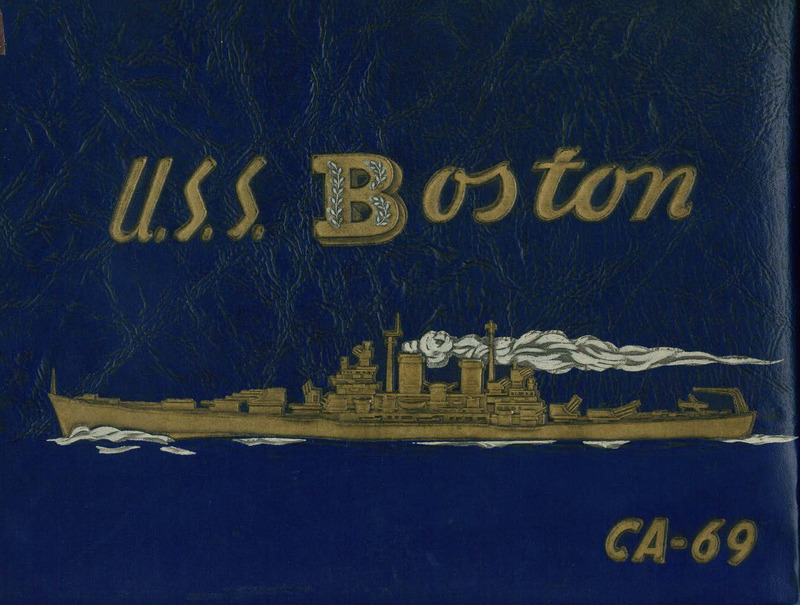
From "The Story of the U.S.S. Boston" by Henry G. Leader, SP (X) 3/C: Built for speed, maneuverability and tremendous fire power, the USS Boston is the second ship of the Baltimore class. Ordered July 1, 1940 prior to the outbreak of the war, her keel was laid June 30, 1941 in the Fore river yard, Quincy, Massachusetts by the Bethlehem Steel Company. On August 26, 1942 Mrs. Maurice J. Tobin, wife of the Honorable Maurice J. Tobin, Governor of the Commonwealth of Massachusetts, sponsored the launching, and on June 30th of the following year, the ship's ensign fluttered in a gentle breeze as she was officially commissioned and accepted by her first commanding officer, Captain John H. Carson, USN. Slipping smoothly through Atlantic waters, the Boston began her maiden voyage on August 13, 1943 en route to the Gulf of Paria, between Trinidad and Venezuela, for the shakedown cruise designed to accustom her crew to the sea and enable officers to detect any possible wrinkles in her makeup. A month later the Boston returned to her home port. a fighting ship with her crew well trained to fight the enemy. On the record of her engineering trial, she was established as one of the fastest heavy ships in the fleet; on the record of her gunnery exercises she was established as a good gunnery ship. After a few more weeks in the port of Boston and some trial runs off Rockland, Maine, the USS Boston set out on November 18 to fulfill the job for which she was designed and built-the defeat of this country's enemy in the Pacific. After passing through the Panama Canal, followed by a two day lay-over in San Francisco, she arrived at Pearl Harbor on the eve of the second anniversary of the Japanese sneak attack. Six weeks were spent in Pearl Harbor waters engaging in more of the exercises that are so essential to the maintenance of the fighting qualities of a First Class Warship.
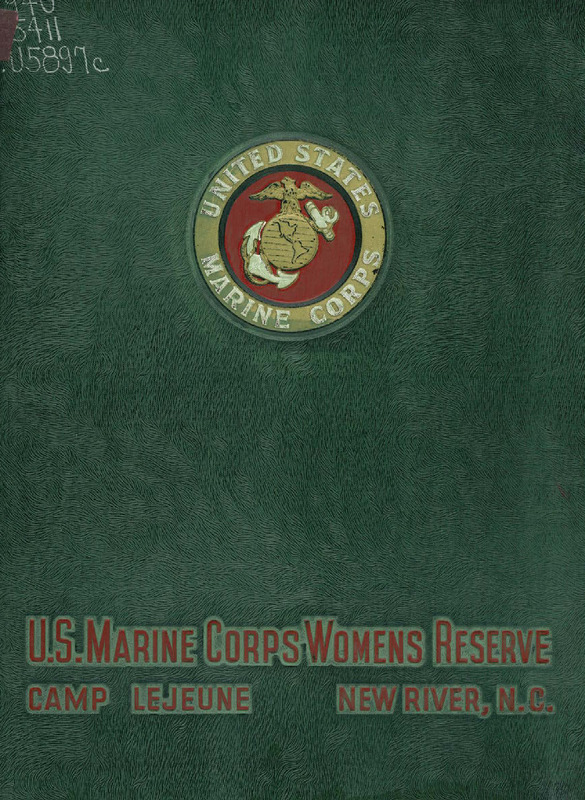
It was World War II that brought to women their first opportunity to serve as an integral part of the Corps. The challenge came on February 13, 1943, with the announcement that the Marines had once more opened their ranks to women and now offered them full membership, including the chance for promotion to non-commissioned and commissioned grades and the privilege of serving in a wide variety of posts. Thus, scientific developments in war-making equipment, the global proportions of World War II, and the desperate need for a never-before-dreamed-of number of Marines, had made women's role in the Corps the most vital and important in history. In response to the challenging ''Free a Marine to Fight'' women began to flock to the procurement offices. Mrs. Ruth Cheney Streeter, of Morristown, New Jersey was appointed director of the new Women's Reserve and commissioned a major in the Marine Corps. Long active in public affairs, a member of the New Jersey State Relief Council, New Jersey Commission on Interstate Cooperation, and New Jersey Board of Children's Guardians, as well as former chairman of the Fort Dix, New Jersey, Citizens' Committee for Army and Navy, she was eminently qualified to take up her new tasks.
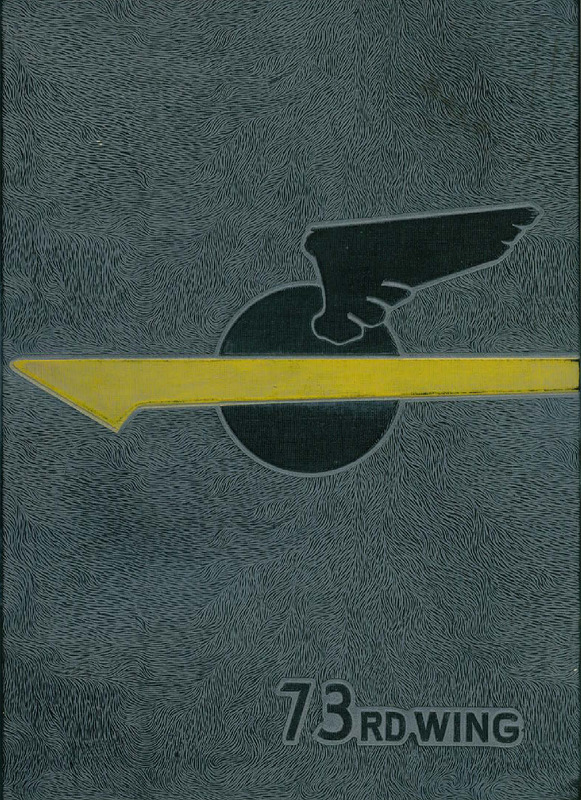
From the Introduction: Before leaving Saipan a number of men with the 73rd Wing and its units expressed a hope that some sort of a history of our organization would be published and made available to all Wing personnel. The Wing historical officer seemed the logical person to do this since he had handled the official history of the Wing which is now on file in Washington. In response to this demand, as well as to other requests received since returning to the States, this volume is prepared. While material in the book is partly borrowed from the official history, it is mostly written and collected now after a few months in the States have mellowed our memories of the Marianas. The 73rd Wing, as a whole, was a homogeneous, hard-working organization. Its personnel were cooperative with one another and did a tremendous piece of work on and from Saipan. The Wing was not only the first 20th Air Force organization to hit Tokyo but it also dropped the largest number of bombs on the Japanese Empire and flew the most missions of any of the 20th's five wings. To the 15,000 men who went through the months on Saipan, those months were long and hard. While these men may not have actually been in the front lines, the Wing's casualty list of both men and airplanes show that we were a fighting organization. Also our living conditions were far from comfortable most of the time. Our food was sometimes inferior and our quarters were not too good. We were subject to Japanese raids during the early part of the period. Nevertheless, our memories of Saipan will always be close to us. While this volume is written primarily from the point of view of the Wing Headquarters itself it should be of interest to all personnel of the Wing's organizations. After all, the Wing did operate as a single unit from Saipan and the groups never did operate independently. The statistics and figures included have to do with the Wing operation as a whole rather than any particular organization. This history will necessarily lack the personal touch that the story of a smaller unit might have. Personalities are pretty much lost in the over-all picture. These 73rd Wing organizations included the four tactical groups-the 497th, the 498th, the 499th and the 500th Bombardment Groups. Also there were the four Air Service Groups--the 65th, 91st, 303rd and 330th. Without these maintenance and engineering specialists and the Service Centers they manned, the Wing would surely have failed.
December 21st, 1943 marked the day of activation of the 716th Railway Operating Battalion. The outfit, sponsored by the Southern Pacific-Railroad, began its life at Fort Sam Houston (San Antonio), Texas with officer personnel drawn chiefly from the sponsor and a cadre made up of "veterans" of the 726th, the unit that had recently completed its technical training on the Santa Fe at Clovis, New Mexico. For the most part, both the officer personnel and the cadre were former railroad men.
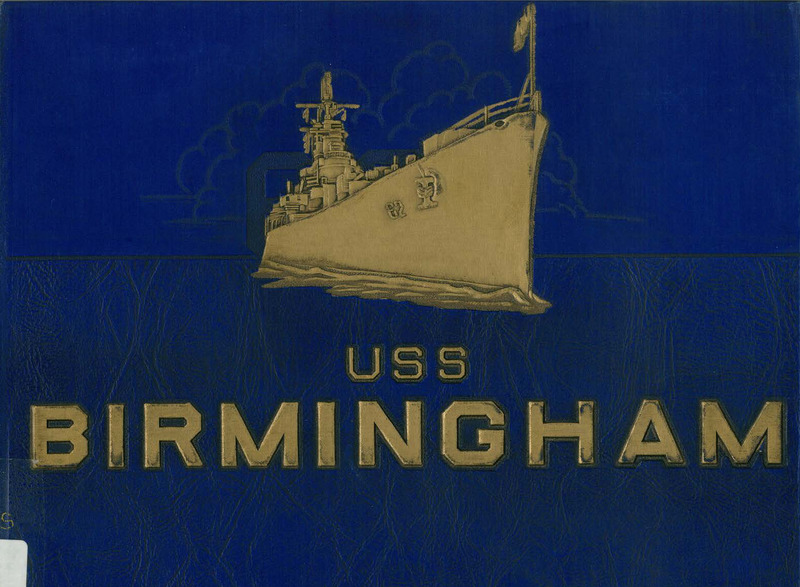
Foreword: It was my good fortune and high honor to be entrusted with the command of the Birmingham from 11 August, 1943 to 22 November, 1944. Those were months filled with action, excitement, and high adventure. The trials and triumphs which we shared together; the knowledge that the success of the ship and the safety of all depended upon the devotion to duty of each; the understanding that the team was more important than the individual; the mutual respect and affection amongst us all; all these things made us "shipmates" in the finest sense of the word. In the face of exhaustion, danger, and grimmest tragedy there was no grumbling, no shirking, and no flinching. Young America need concede nothing in fortitude to other races or other generations. Our steel ships, too, are served by iron men. Never in history had a Captain the good fortune to command a finer crew. --Rear Admiral Thomas B. Inglis
From page 54: "Of the grievances associated with our life at Kweilin, many were trivial and some were imaginary. But one which was real and loomed terribly large was the food. At this time we had no Quartermaster provisions at all--no milk powdered or canned, no jam or butter, no fruit or juices, no Army rations, no yeast, no cornstarch or baking powder, and no beer! And, while various substitutes were employed, we had no American meat, vegetables, flour, sugar, coffee, salt, pepper or condiments of any description. Nearly everything served in our mess hall was produced within sight of our hostel, and we were living in a notoriously poor section of a very poor country. From India, by virtue of occasional ferry-trips, we obtained coffee that was good, but in quantities so limited that it could be served at breakfast only. All of the other substitutes mentioned above were obtained locally, and, except for the salt and pepper, were as poor as the country from which they came. The major source of meat was the water buffalo. However, this beast was too valuable to be slaughtered until old age or disease had ended his days as a draft-animal, with the result that the flesh was literally too tough to cut with a knife. A poor grade of pork was obtainable, but was so expensive that it could be served only occasionally. (We were not sympathetic with the boys in other theaters who complained of a monotonous diet of Spam. Any of us would gladly have given a week's pay for a single can of that Stateside delicacy). It would be no exaggeration to say that more than 90 percent of the meat served in our mess hall was not eaten. Were it not for fresh chicken, served about twice a month, it could be said that none of the meat was fit for human consumption. It was brought to us in carts or trucks from the city of Kweilin. Uncovered during the trip, exposed to flies, street filth and the elements, it was a revolting sight even before it was cooked. And mention should be made of the fact that neither in Kweilin nor in our· hostel was there any form of refrigeration."
From an official commendation [abbreviated]: The 1st Aircraft Repair Unit (Floating), commanded by Colonel Kingsley, serviced this Wing [313th Bombardment Wing] during the period from 2 February 1945 to 21 July 1945. This Unit aided in third echelon of aircraft maintenance as well as fourth echelon of maintenance. The services of this Unit were especially valuable during the initial stages of operation at which time the Wing Service Centers did not have all shop facilities on hand or installed. --J.H. Davies, Brigadier General, USA, Commanding
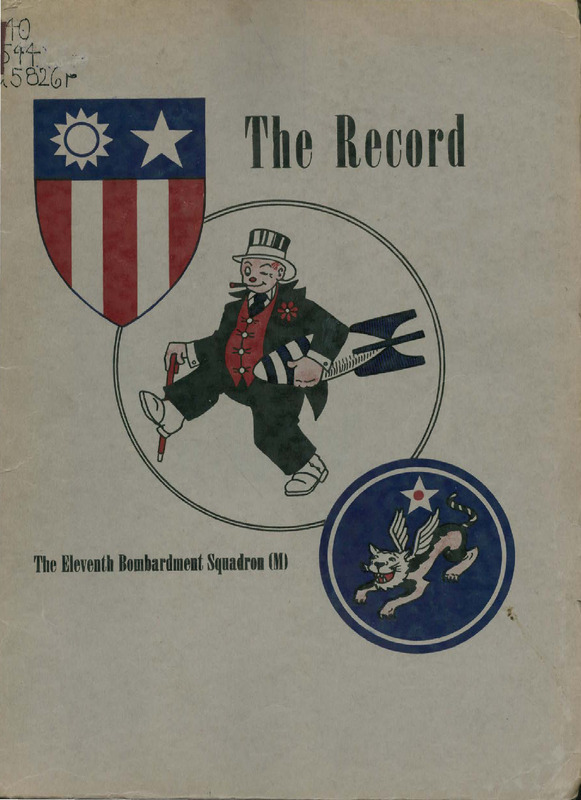
From Chapter 1: The birth and the early creeping of the 42nd Bombardment Group, Medium, may well seem lost in the mists of antiquity that hung over the United States before World War II. Indeed to many of our members, veterans of 60 or 70 missions in the Solomons or in the Indies and Philippines, veterans of the long road home via New Caledonia, Guadalcanal, the Russells, Stirling, New Guinea--whether in the air or on the ground--the early history of the Group is an unknown quantity save for shreds and scraps of information gathered from the casual remarks of "old" oldtimers. But if this history is to be a complete narrative of your Group it is necessary to go back almost beyond the memory of the oldest member. To go back, in fact, to January 15, 1941, when according to the official record, "The 42nd Bombardment Group (M) was activated from the 7th Bombardment Group (H), G.H.Q. Air Force, at Fort Douglas, Utah, under the jurisdiction of G.H.Q. Air Force, with cadre furnished by the 7th Bombardment Group (H)."
"The story of the 79th Division is fact, not fiction. The accomplishments set forth here are sufficient evidence that the individuals of the Division realized and accepted their several responsibilities. To our dear comrades who gave their all to bring about these great deeds let us do homage by renewing with ever greater vigor our determination to close with the enemy and exterminate him." Ira T. Wyche / Major General, U. S. Army Commanding General, 79th Infantry Division
"Fighting across 18 major rivers and scores of smaller streams you have accomplished some of the longest sustained marches in the history of warfare. You have liberated or conquered more than 31,000 square miles of territory, including 600 cities and towns and 4,000 inhabited places. You have captured 540,000 enemy soldiers and killed or wounded at least 89,000 others. ANGERS, CHARTRES, FONTAINEBLEAU, MELUN, MONTEREAU, CHATEAU-TIERRY, EPERNAY, HEIMS, VERDUN. METZ, TRIER. SAARLAUTERN, KAISERLAUTERN, WIESBADEN, KASSEL, WEIMAR, JENA, REGENSBURG. BRAUNAU, LINZ and STEYR were but milestones in your zone of advance. The pathway to our goal has been costly and the blood of dead and wounded comrades marks our way to the liberation of Europe. Let us remember their sacrifices as we exalt in the victory of our arms. Let us prove to them by our conduct now that they did not die in vain; that we have the fortitude to put aside selfish interests and carry on with firm justice and resolute determination to irrevocably crush the Nazi menace and establish freedom and right in war-torn Europe. We have won the war. Let us now win the peace. We shall not for an instant lower our guard. Through our conduct, dress, bearing and example, we shall always maintain the high standards of a well trained and a well disciplined Corps."--Walton H. Walker, Lieutenant General, United States Army
The 366th Infantry was organized at Camp Dodge, Iowa, in November, 1917. The regiment served overseas during the World War as part of the 92nd Division, National Army, and earned credit for battle participation as follows: St. Die Sector (Lorraine), August 23-September 20, 1918; Meuse-Argonne Sector, September 26-0ctober 5, 1918; Marbach Sector (Lorraine), October 8-November, 1918. It is entitled to Lorraine and Meuse-Argonne battle streamers for the Colors. The regiment returned to the United States and was demobilized at Fort Oglethorpe, Georgia, March 25, 1919. On July 26, 1941, it was reconstituted and consolidated with the 366th Infantry which was organized December 16, 1940, and made active February 10, 1941.
Dedication: War brings glory and war brings death. Let no man think the former compensates the latter. This book is not dedicated to the glories of a great combat record. It is a memorial to those who gave their lives to make that record. They are the only heroes. No rank, medals, or words of praise can do justice to their sacrifices.
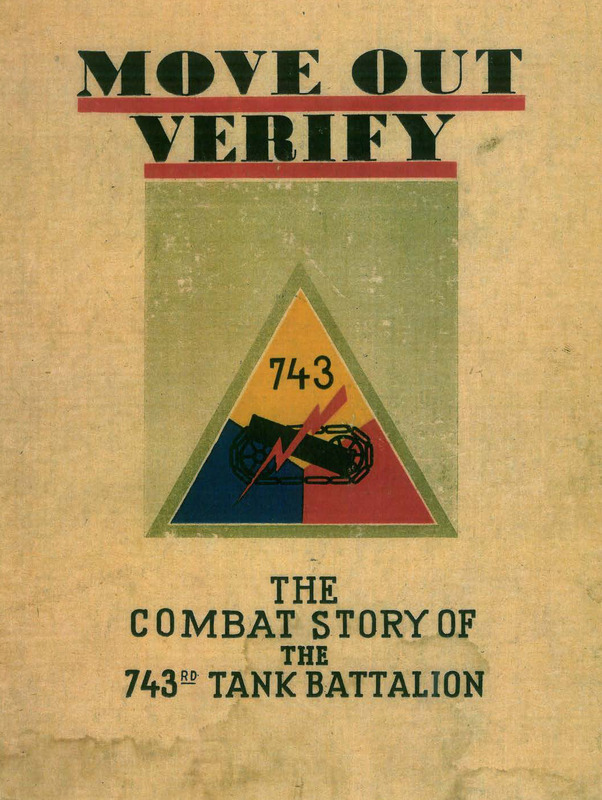
A Battalion truck was driven hundreds of miles through Germany to locate and haul a linotype machine so that type could be set for this book. This is just one of the sometimes fantastic difficulties overcome during the manufacture of these pages in the bomb-devastated city of Frankfurt-on-Main in July 1945. That the book did get printed at all is astonishing to its author. 1st Lt. John D. Hess, aided by German-speaking Tech Sergeant Frank Gartner, looked after the considerable details of publication. The 21 chapter illustrations are by Pfc. Norman E. Hamilton. The writing is by Pfc. Wayne Robinson, who here wishes to acknowledge the great help given by so many, from tank commanders to cooks to personnel clerks, in getting the facts for this combat story.
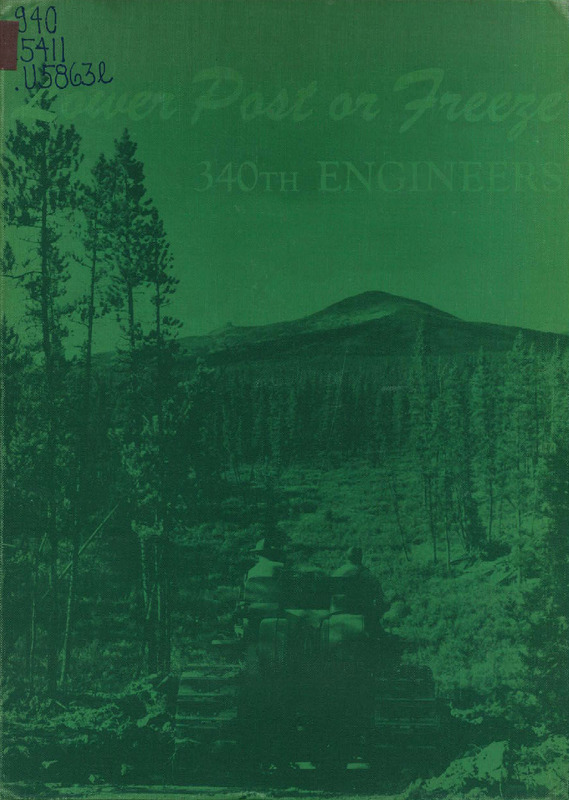
The 340th Engineer General Service Regiment was activated at Vancouver Barracks, Vancouver, Wash., March 5, 1942. The nucleus was a cadre of seven officers and seventy-two enlisted men from the 18th Engineer Combat Regiment, who arrived on March 9. A cadre of 62 enlisted men from Fort Francis E. Warren also arrived on March 9. The remainder of the officers and men came from Fort Leonard Wood, Missouri, during the latter part of March and the first part of April. The commanding officer, Lieutenant-Colonel F. Russel Lyons, arrived on March 27, 1942. Prior to that time the regiment was commanded by Captain John B. W. Corey, and later by Major Reinder F. Schilsky. The short period at Vancouver Barracks was spent in obtaining supplies and preparing for an overseas movement. On the night of April 18, 1942, 35 officers and 883 enlisted men entrained for Seattle, Wash., and thence aboard the USS St. Mihiel to Skagway, Alaska, that famous boom town of '98, arriving there April 22. On April 23, the remainder of the regiment-10 officers and 343 enlisted men-entrained for Prince Rupert, British Columbia, Canada, and thence aboard the SS Prince George to Skagway, arriving on April 25.

![What's the Story? [49th Armored Infantry Battalion]](https://bangorhistory.org/files/large/7f0e01df50ae7058cdcd7d3a8f41b71bf3fe3eed.jpg)