The City of Bangor now has a resident population of about twenty thousand. Yet as the shire town of a county embracing some seventy-five thousand inhabitants; as the trade center and shipping point for a large and rich agricultural section and for many thriving industrial communities; as a point of convergence for numerous important railway and steamship lines, and a consequent tarrying place for great numbers of tourists, sportsmen and commercial travelers; these together with the busy commerce of its port, the metropolitan character of its hotels and the compactness of its business section, give to the city a much more populous appearance than the above figures would indicate.
Introduction: It has been our endeavor in these pages, to depict the scenes and incidents occuring at home, during the Rebellion, rather than the giving of a minute description of the varied experiences of the thousands, who marched away from Eastern Maine, at their Country's call. We lay no claim to high literary merit, simply placing before you, in condensed form, the facts; believing that as the memories of the older readers are quickened, and the younger generation learn of the experiences of fathers and mothers, in their efforts to preserve the Union, all will find something of deep interest.--R.H. Stanley, Geo. O. Hall.
Bangor, the "Queen City of the East," is situated in lat. 44° 40' N., and long. 68° W., at the head of ship navigation on the Penobscot, the largest river of Maine, about thirty miles from its entrance into the bay of the same name, and some sixty miles from the sea. It is distant N. E. from Boston nearly 250 miles, by rail, and W. from St. John, New Brunswick, a little more than 200 miles; the distance from either of these points by water is about the same as by land. It is reached from the West by day and night trains from Boston and Portland, and by a line of first-class passenger steamers making daily trips each way between Boston and Bangor during the summer months, and from two to four trips weekly the remainder of the year. Two trains daily, to and from Bangor, furnish Eastern connections with St. John, Halifax and all important points in the Maritime Provinces.
Bangor is delightfully situated. It is intersected by the Kenduskeag stream, on either side of which are sunny hills covered with lovely homes. The business portion of the town is located on the low land bordering the stream and fronting the broad Penobscot River. The streets throughout the city are lined with magnificent shade-trees, the elm predominating. Elegant residences abound, and well-kept lawns and beautiful gardens are the rule rather than the exception.
"Biographical notices of the founders of more than fifty of the most prominent and noteworthy enterprises in the city, with a concise and reliable account of their rise, progress and present status."--On cover.
The dawn of our Centennial Anniversary was announced by the ringing of bells, and soon after the streets and squares began to fill with people prepared to enjoy the long expected holiday. By railroads, steamers, stages, and other available conveyances, crowds of visitors came into the city lo join in the festivities of the day; the movements of those seeking favorable points for viewing the procession, of the different companies, schools, and societies, rnarching to the rendezvous appointed for its various divisions, the reception of companies from other towns, the music by the almost ubiquitous bands, the beautifully decorated buildings, and the flags waving everywhere in the bright sunlight, all together gave the place an unwonted air of rejoicing.
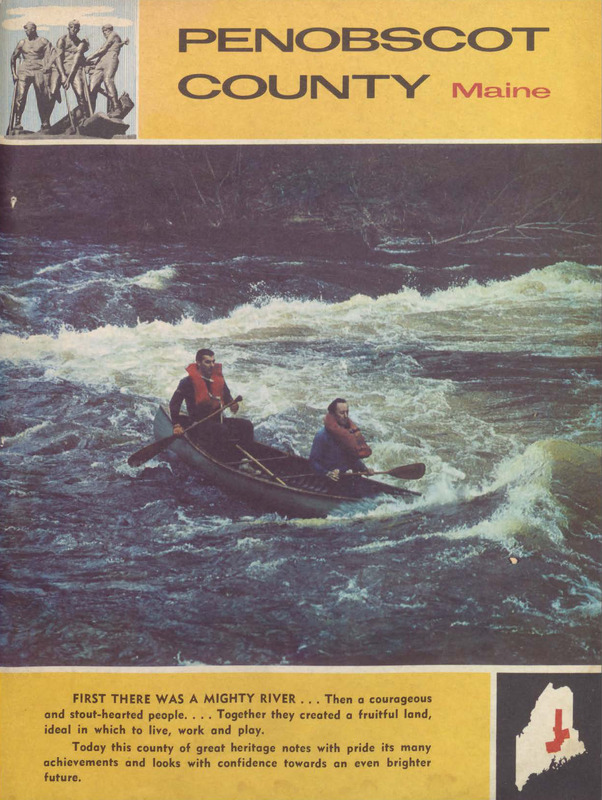
This book has a purpose. It is designed to bring you up to date with Penobscot County. It will indicate the direction the economy is developing, and depict why Penobscot County is a superior place in which to live. It has been prepared under the auspices of the Penobscot County Commissioners with the cooperation of town officials and advertisers loyal to regional development. We hope it will encourage you to visit Penobscot County, begin a business, establish an industry, build a life. We hope you will pay our message the close attention we feel it deserves.
The reader is cordially invited to browse through the pages of this informational booklet on one of Maine's fastest-growing regions. The stories and photos, we are sure, will delight the vacationist, interest the retiree and young couple, and strongly attract the businessman and industrialist. Whatever your demands for living, working or playing, you will discover all the answers in this descriptive magazine on the County that started "with a mighty river". The Penobscot County Commissioners, various town officials, business and professional men, have all cooperated in the preparation of the book, gladly devoting precious time to further the interests of their County.
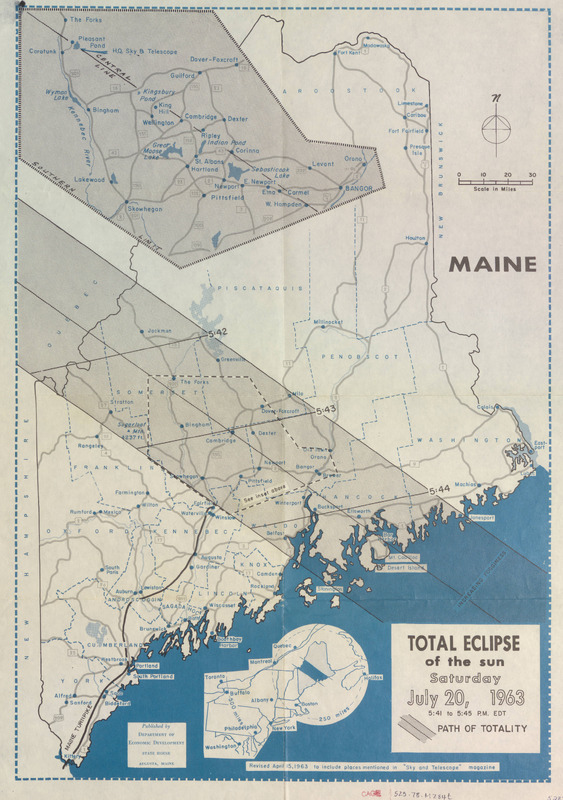
Once about every 360 years ... a total eclipse of the sun will occur on the University of Maine campus. On July 20, 1963, nature will present her most startling phenomenon, a total eclipse of the sun, which will not be seen again in New England in this century. For us at the University of Maine in Orono, partial phase will begin at 4: 38 p.m. EDT, when a slim notch will be seen in the western edge of the sun, cut out by the black figure of the moon which will be passing in front of the sun from west to east. For the next hour the moon will steadily encroach upon the sun until just a thin crescent remains in sight.
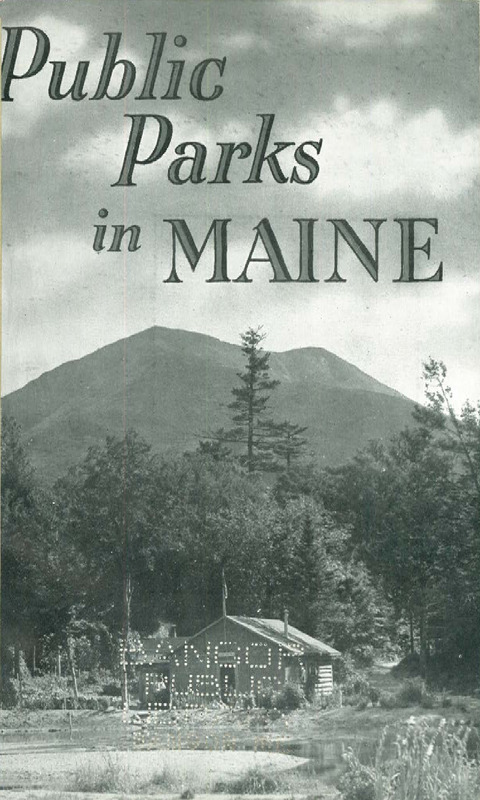
State and National Parks are designed to conserve the natural and historic objects and the wildlife therein and to provide for the enjoyment of the same in such manner and by such means as will leave them unimpaired for the enjoyment of future generations.
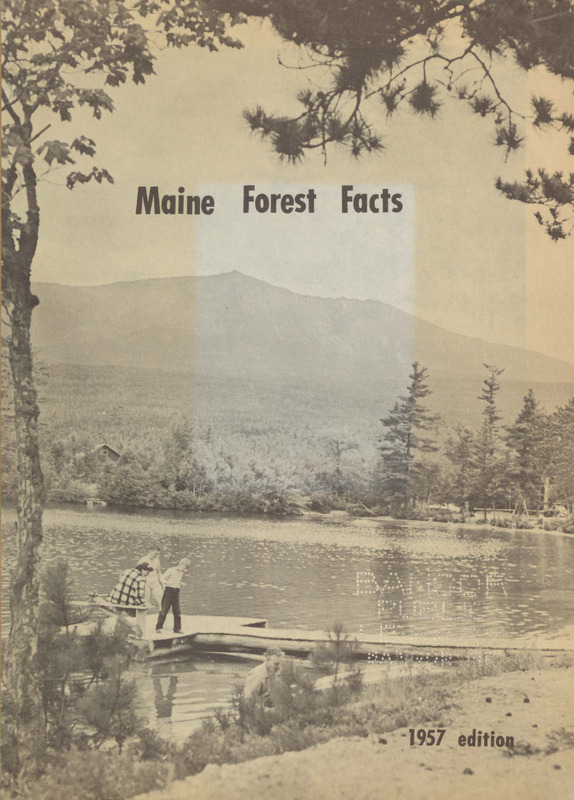
The first spot in the United States touched by the morning sun is timber-tiered Mt. Katahdin, in north-central Maine. From it stretches a carpet of deep forest greenery reaching into every county in the state. No other state has so great a proportion of its surface covered by forests. Maine's development started with the first harvest of its timber resource when the Popham colonists built a ship there in 1607. The economy of the state has been largely built on its forests ever since. The most heavily forested state in the nation, Maine still is important in the forest economy of the United States after 300 years of timber cropping. It is the country's leading producer of white pine lumber and among the leaders in output of pulpwood.
It is proposed to develop for recreational and health about 100,000 acres of forest land extending eastward from the shore of Moosehead Lake to Katahdin Iron Works and Lake Onawa, in the following manner: 1. Purchase of about 70,000 acres of land. 2. A scenic toll road of about 35 miles extending from Moosehead Lake over Lily Bay and Katahdin Iron Works Mountains to Katahdin Iron Works and the public highway in Brownville, supplemented by a branch road of 13 miles from Katahdin Iron Works along the slope of Chairback Mountain Range to the public highway at Lake Onawa and by additional roads or trails to principal lakes of the tract and other points of recreational interest, totalling about 70 miles. 3. A modern recreational hotel on the shore of Moosehead Lake supplemented by a series of camps and camp grounds along the route of the proposed toll road or its branches. 4. The sale of developed and undeveloped land for private camps around hotel or camp centers and elsewhere. 5. A health organization for persons in ill health who are not contagious or hospital cases, based on supervision of a physician, supplemented by a host who shall carry out physicians' prescriptions for exercise as recreational activity.
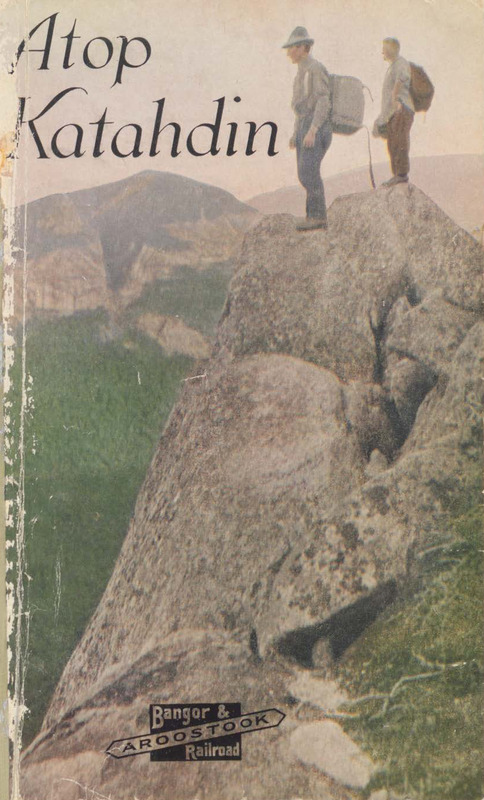
Facts at a Glance: Mount Katahdin is 5,273 feet above sea level. Mount Katahdin is one of the three highest mountains facts east of the Rockies. Mount Katahdin is reached by the Bangor and Aroostook rail road from Norcross, Millinocket and Stacyville stations. Mount Katahdin also can be reached by the Bangor and Aroostook railroad to Greenville, thence overland to the Penobscot's West Branch and down the West Branch to Abol stream 12 miles below Ripogenus. Still another route is from Ripogenus dam by road to Harrington Lake; across the lake to Kidney Pond and thence by the Hunt Trail to Mt. Katahdin. Mount Katahdin has attractions that provide a program for a prolonged stay by the enthusiast. The minimum trip is two days, a day in the ascent, overnight on the mountain and return the second day. The Mt. Katahdin country, the vast expanse over which Katahdin dominates, is one of the outstanding sections of the Maine woods for fishing and hunting and canoeing and for general vacation pleasures. Mount Katahdin offers opportunities for exceptional sport for the devotee of mountain climbing. Its variety of approaches and routes offers relatively easy traveling or some sporty scrambling, depending upon choice of the mountaineer planning to make the ascent.
Mount Katahdin is the o'ertopping feature of the state of Maine which stands conspicuously among the states because of its wealth of natural attractions. It is the center of a vast forest expanse which stretches forth from the mountain's base, and Katahdin's domain is rich in lakes and streams and lesser heights. Katahdin, or Ktaadn as the mountain's name sounds in the pronunciation of the Indian dialects, means "the greatest mountain," and no more appropriate title could be given it.
"The brochure covers the most important aspects of Maine's new boating regulations, gives location, season, baits and lures and methods of catching different species of salt water fishes, list of state parks, suggested canoe trips, camping and tenting grounds and a slew of good places to go fishing in Maine along with lots of other information." (Source: Downeaster, June 3, 1960)
Those who have been to Katahdin want to go again. Those who haven't been often express a longing to get at least a glimpse of that section. But even most of those who have been near or on Katahdin know no more about the country to its north than they could gain from their summit viewpoint. An exception is Myron H. Avery, captain, USNR, a Lubec native who is the State's leading authority on Katahdin and its environs and who has been a prolific writer on the subject. Herewith is the first of two artieles by Capt. Avery which he entitles "The Traveler, Two Decades--Random Notes."
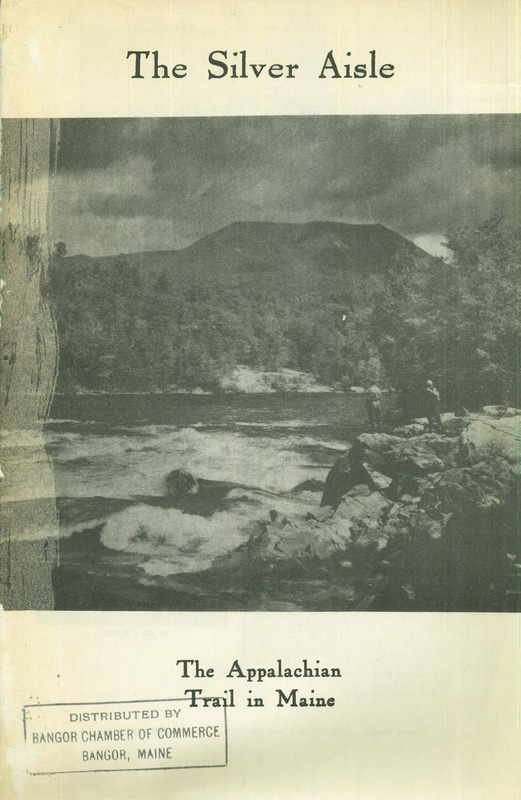
Through somber-hued spruce and fir forests, across the depths of the Maine wilderness with its cathedral-like stillness--unerring in its course as a driven arrow--lies a silvered aisle--the gateway to the finest of Maine's mountains, lakes, forests and streams.
Preface: Nature's bounties have been so richly bestowed upon the State of Maine as to make the depiction, or even the description, of all of its myriad beauties an impossibility. No one volume, however large, however replete with words and pictures, could possibly suffice to accurately portray even a part of its scenic whole. Nor can any man-made medium of portrayal, whether pen, pencil, or artist's brush, hope to capture the matchless beauty of Maine's seashore, hills, fields, lakes and streams. The author has herein done his humble best to depict in word and picture a few, a very few, of Maine's interesting places. If the contents of this volume may serve to give the visitor an incentive to explore Maine's captivating Eden; if it may revive, in the native, a memory of places seen, and enchanting hours spent, then the author has no apology--save one--to offer. And that apology must he, perforce, to Nature.
This collection of over 200 black and white photographs of the State of Maine chronicles landscapes and architecture, as well as revealing social and leisure activities and wildlife of the state.
The Maine Centennial Exposition which opens today will continue through July 5th. It is held in the Portland Exposition Building located on Park Avenue and is open daily, except Sundays, from 10.30 a.m. to 10.30 p.m. The purpose of this Exposition is to show goods made and sold in the State of Maine; to foster unity of purpose among business men; to build up, strengthen and aid the industrial and agricultural interests, as well as develop Maine's wonderful resources. It is being conducted for the Maine Centennial Committee by the State Chamber of Commerce and Agricultural League.
Foreword: This Route Book is presented to the Tourist with the compliments of the National Touring Bureau of The B.F. Goodrich Company. It is published and distributed with the object of stimulating touring and road improvement--of providing exact and convenient directions for the tourist, and of adding still more to the meaning of "Goodrich Service." It charts the maine lines of automobile travel in Maine, New Hampshire and Vermont with connecting routes to Montreal and Quebec, the Lake George and Lake Champlain district and into New Brunswick and Nova Scotia. Goodrich Guide Post signs are erected on a number of these routes. This Guide Post work will be continued so as to cover all of the main lines of automobile travel, same being erected only at confusing xroads, forks and left and right-hand turns. A Goodrich Guide Post sign will be furnished gratis to any responsible party for erection at a confusing turn or xroad.
Closing paragraph: Our sun is as bright as theirs; our skies as blue, our snow as clean and pure, our hills as steep, our air as rich in ozone and in life. Yes, our winter in Maine is as wondrous in beauty as that of the Alps or of Norway. We have the winter; we have always had it; we always will have it. The day will never come to Maine when, from Christmas almost to Easter, there will not be the crisp frosty dawns, so familiar to all of us, when the sled runners cry aloud as they pass down the road. There is nothing else in all the world so beautiful as a mid-winter day in Maine, with its dawn full of protest, its noon blazing in the sunlight, its sunset golden on the gleaming western hills, and its nights, with the snows glistening to the moon, and the pathway of the old country road stretching from your feet away into glory. This is the land of all the best of the white gods of winter. It is for us to appreciate it; to foster it; to spread about the truth concerning its health-giving properties; to convert its ancient liability and loss not only into a present asset but an increasing gain; to help it build up and invigorate new races of men and women, who shall stir and energize mankind. We must learn to love winter, talk of its beauties when we are at home or abroad, to describe truthfully its poetry and its loveliness. Then, with big and beautiful hotels, with civic sports and other increasing devotion to outdoor life, we shall see winter do its proper share towards enriching us commercially, as well as physically and spiritually.