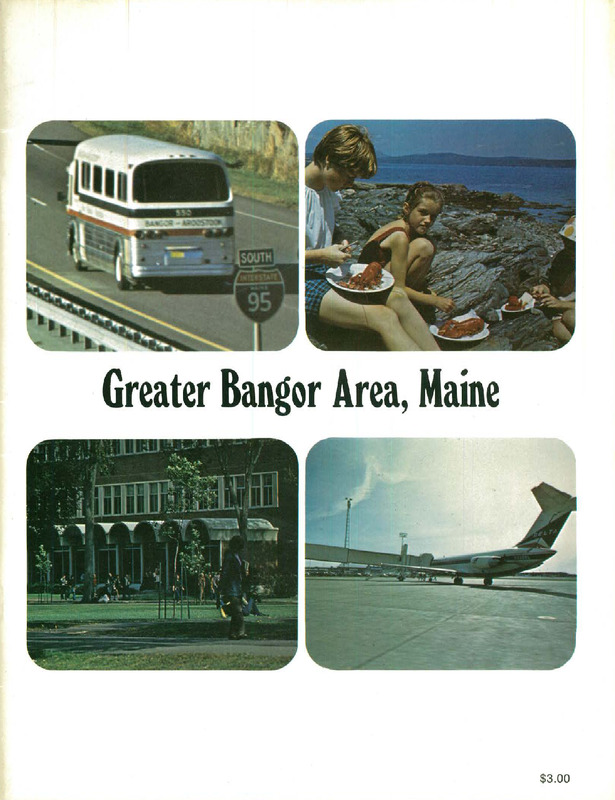
The Greater Bangor Chamber of Commerce and its member firms take pride in presenting the Bangor area story. We are pleased to make available this book, which presents the assets of the Bangor area in words and pictures.
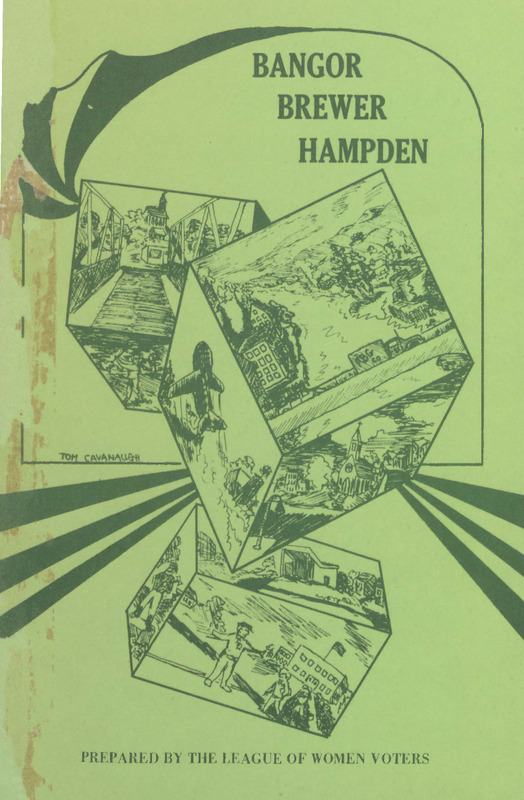
Details the history, local government, education, municipal services, recreation, and planning and development of Bangor, Brewer, and Hampden circa 1973. Among the pictures are the Bangor International Airport and the Paul Bunyan statue.
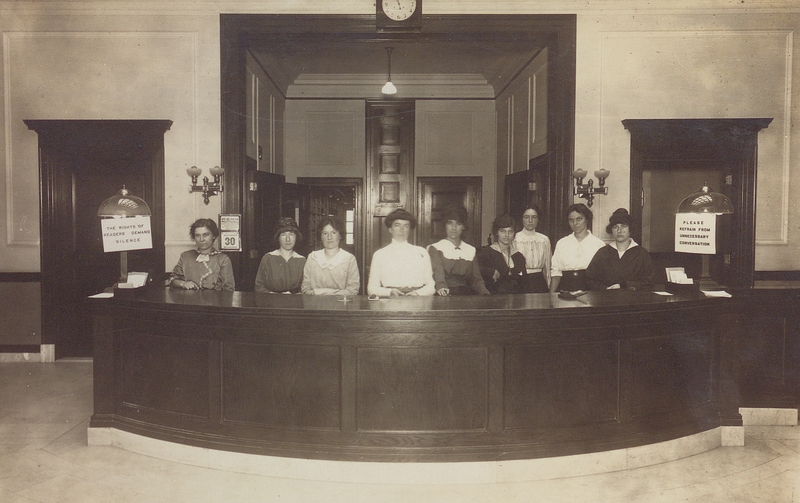
Many more pictures could and perhaps should have been taken to fully show all the varied and diverse activities that go on both in full view of the public and behind the scenes at the Bangor Public Library. However, I have tried to give the viewers of these photos a bird's-eye-view of some of the highlights of the activities carried out in their library. It is my hope that through these pictures the viewer will have a better understanding and appreciation of one of the community's prime sources of educational as well as recreational materials.
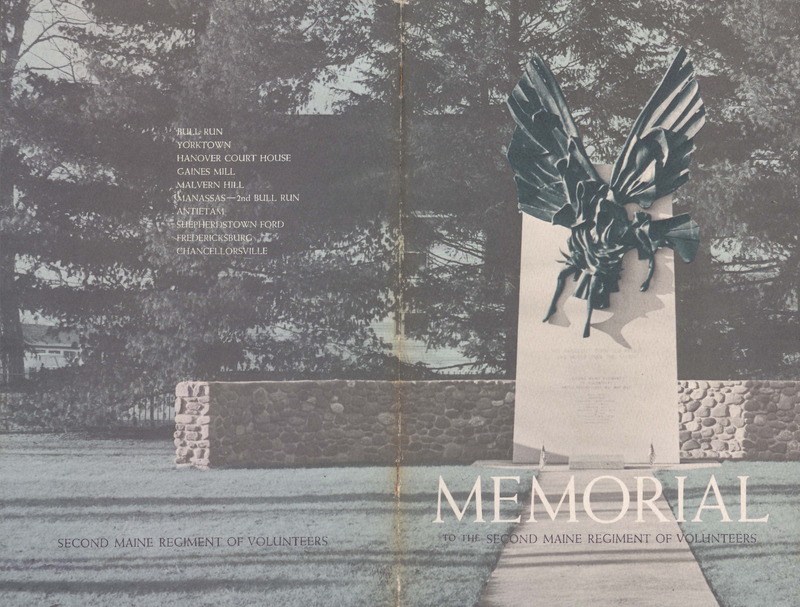
Foreword: The purpose of the publication of this booklet by Mount Hope Cemetery Corporation is to make more widely available the story of the heroic Second Maine Regiment of Volunteers in the Civil War. The memorial structures erected on the cemetery grounds will serve to perpetuate the name and record of the Regiment among those who have occasion to visit the premises. It is hoped that this booklet combining the history of the Regiment with pictures of the memorial will reach a larger audience and thus carry out the intent of the donor Luther H. Peirce, to honor in the highest degree the comrades with whom he shared the fortunes of war. The following account of THE SECOND MAINE REGIMENT is quoted from "Maine in the War for the Union: A History of the Part Borne by Maine Troops in the Suppression of the American Rebellion" by William E. S. Whitman and Charles H. True, Lewiston, Maine, 1865, Nelson Dingley, Jr., & Co., Publisher. The text is the complete chapter 3 of that book.
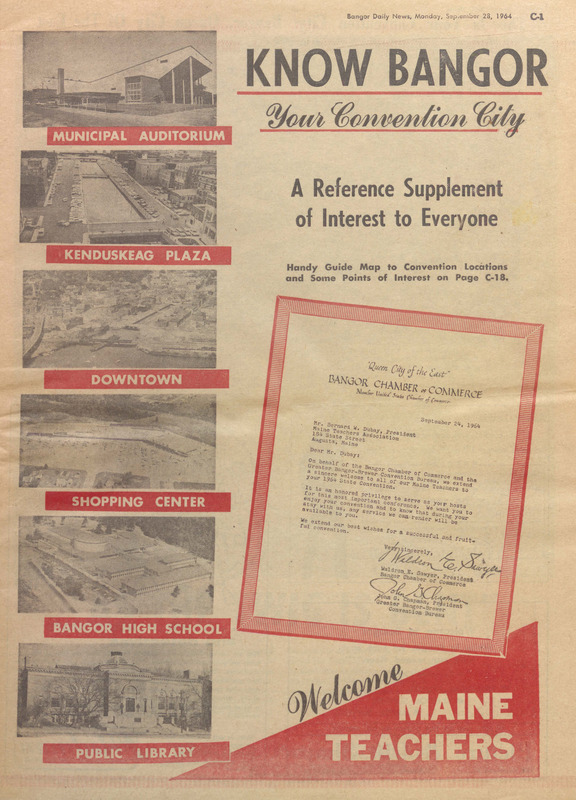
A special section of the Bangor Daily News marketed to attendees of the 1964 Maine Teachers Association Convention in Bangor, Maine. "On behalf of the Bangor Chamber of Commerce and the Greater Bangor-Brewer Convention Bureau, ws extend a sincere welcome to all of our Maine Teachers to your 1964 State Convention. It is an honored privilege to serve as your hosts for this most important conference. We want you to enjoy your convention and to know that during your stay with us, any service we can render will be available to you. We extend our best wishes for a successful and fruitful convention."
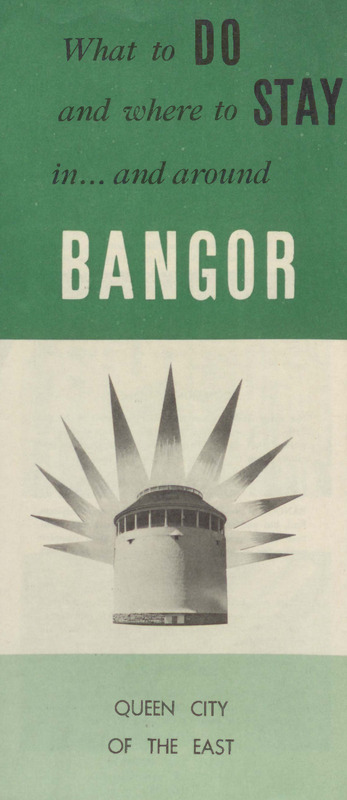
A late 1950s or early 1960s brochure describing entertainment, leisure, educational, and social activites in Bangor and Brewer, Maine. Includes pictures of the Bangor House, Penobscot Hotel, Queen City Motel, Twin City Motel, Mokler's Travel Lite Motel, and Fairmount Terrace Motel.
A pocket-sized guide listing schools, churches, and streets in Bangor and the surrounding area, circa 1957. Includes brief description of several towns, as well as the University of Maine in Orono.
An informational packet compiled by Robert H. Patten of the Industrial Development Department of Bangor, Maine, touting the advantages of Bangor for industries looking to develop in the Bangor area.
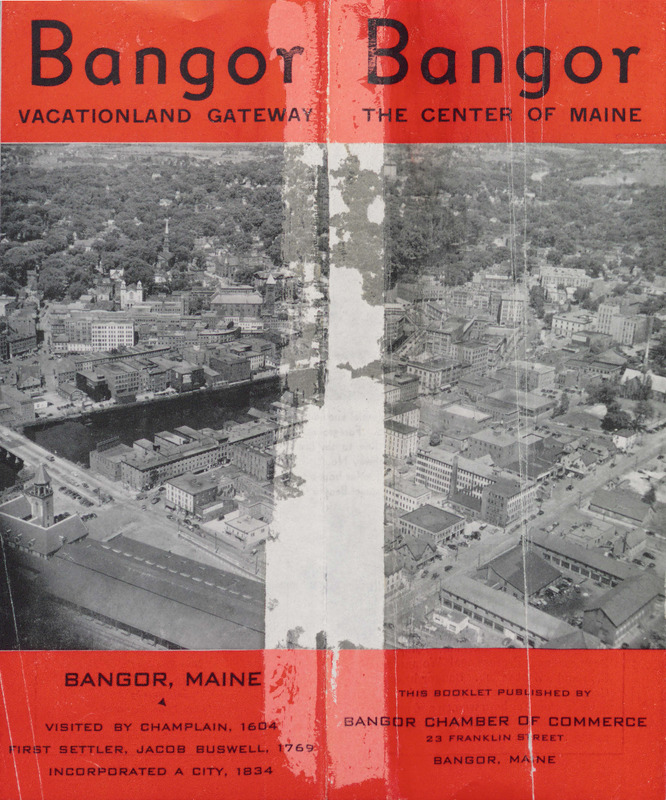
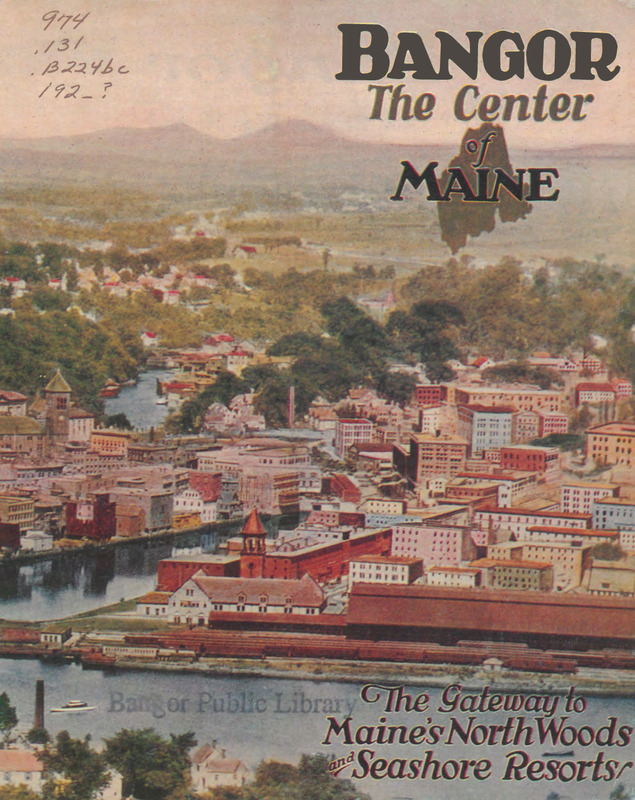
A listing of recreational and tourist activities in Bangor and the greater Bangor area circa 1955. Features several photographs, including an aerial photograph of Bangor.
This evening the Jewish community of Bangor is celebrating the fortieth anniversary of the founding of its Hebrew School. For forty years there has been a sufficiently cohesive group of Jews in Bangor not only to maintain such a school, but also to change the methods and physical surroundings of the school in keeping with the developments in modern educa-tional methods as well as in relation to the community's growth and needs.
Beginning at 9:00 AM, May 31, the Book of Honor, in its special case, flag guarded, will be on perpetual display in the foyer of the Bangor Public Library, there to remain until other provision may be made. A page of the Book will be turned each day, God willing, forever. The title page of the Book reads "Bangor Remembers Her Sons Who Died for Victory, 1941-1945". Following pages which carry the speeches read during tonight's program, are 101 separate pages each one carrying the photograph and brief biography of a Bangor man who died for victory. Then follows a page carrying the names of nine Bangor men who died but of whom photographs were not available to the City in time for inclusion in the Book. Lastly comes a colophon page telling how and by whom the Book was made. The biographical pages are arranged in the order in which the men died. The photographs are of uniform size, enlarged or reduced from originals lent by relatives. All biographies are of identical length--fifty words--whatever the rank or grade of the man. Each biography gives the man's military record, his decorations, his schools, his civil occupation, and something of his personal interests, his serial or file number, his dates of birth and death, his rank, grade, or rating and his unit at death. The Book is entirely engrossed and illuminated by hand. It is bound by hand in the finest leather, gold tooled, and with the seal of the City and the insignia of the services on its cover. There is no other copy.
Foreword: It seems desirable for me to write down that most of my knowledge of the early life of Cliff Cottage has come directly from the letters of my grandfather Godfrey to his sons Frank and Fred whose full names were John Franklin Godfrey and George Frederick Godfrey. Some of my knowledge came directly from my father to me and some of it came to my brother as he had heard it from his parents. My grandfather, my father and my mother all wrote diaries which, together, give a real picture of their periods. Of course my own memories have been called on to a great extent but none of these sources could have produced a connected story if it had not been for the kindness of Mrs. Henry Elliott in helping me read old diaries as well as in copying and helping me reread and correct what I have gathered and tried to put into readable language. For all of her assistance I wish to express my gratitude.--A. G. Clifford
Bangor's proximity to the many and varied recreational centers of Eastern and Northern Maine, is many times a magnet in bringing conventions to the City. One-day side trips to Acadia National Park, Bar Harbor and Mt. Desert Island will add to the enjoyment of a stay in Bangor, while a motor trip to Moosehead Lake, only 75 miles distant, will offer you scenic and panoramic views of Maine's wonderful advantages and resources. The opportunity for fishing trips to the many lakes within 50 miles of Bangor is ever present.
Bangor in an important tourist and recreational center. It is the gateway for toursists and vacationists to Acadia National Park, Bar Harbor and Mt. Desert Island, the Moosehead Lake and Mount Katahdin regions, to the many near-by seacoast resorts, to Aroostook and Washington Counties, to New Brunswick, Nova Scotia, Prince Edward Island and to Quebec and the famous Gaspe Peninsula.
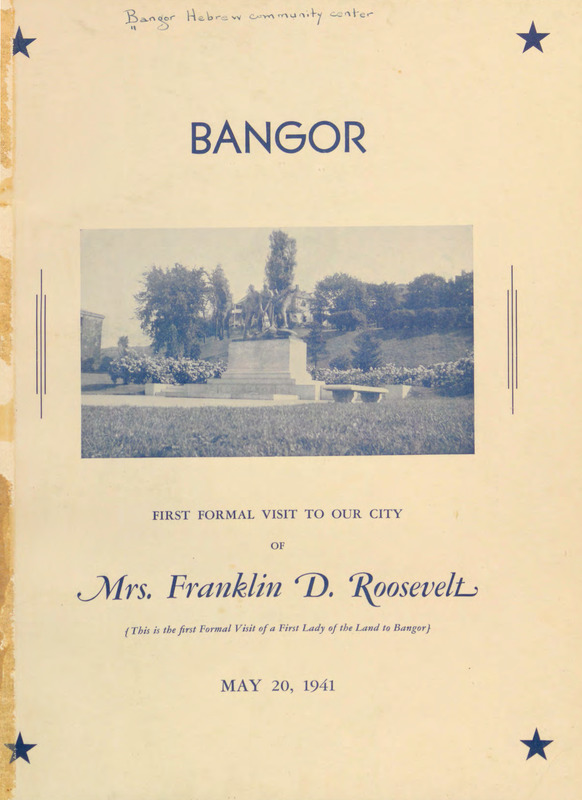
Souvenir program of First Lady Eleanor Roosevelt's visit to Bangor on May 20, 1941. Provides a brief biography of Eleanor Roosevelt, her schedule in Bangor, a snapshot of Bangor's civic organizations, and reprint of publicity that appeared in the Bangor Daily News and Bangor Daily Commercial.
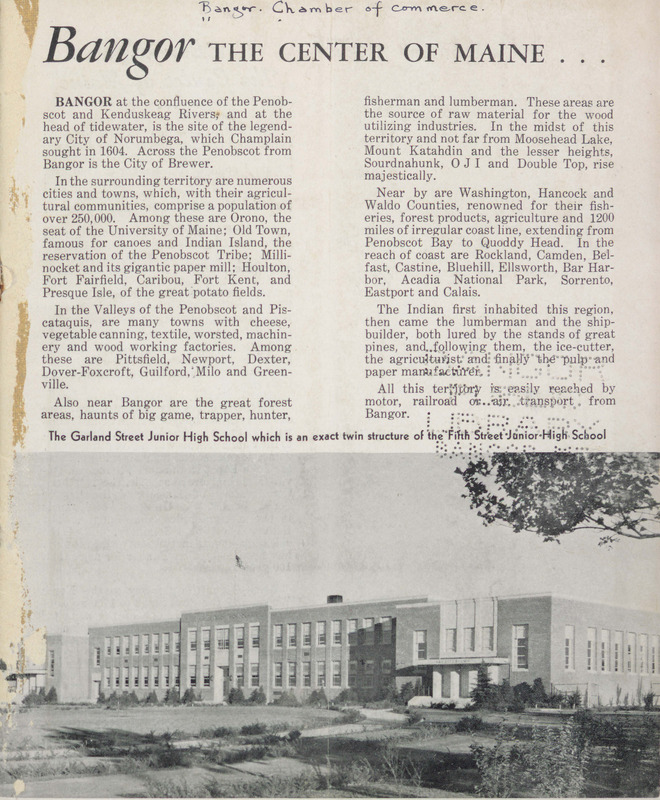
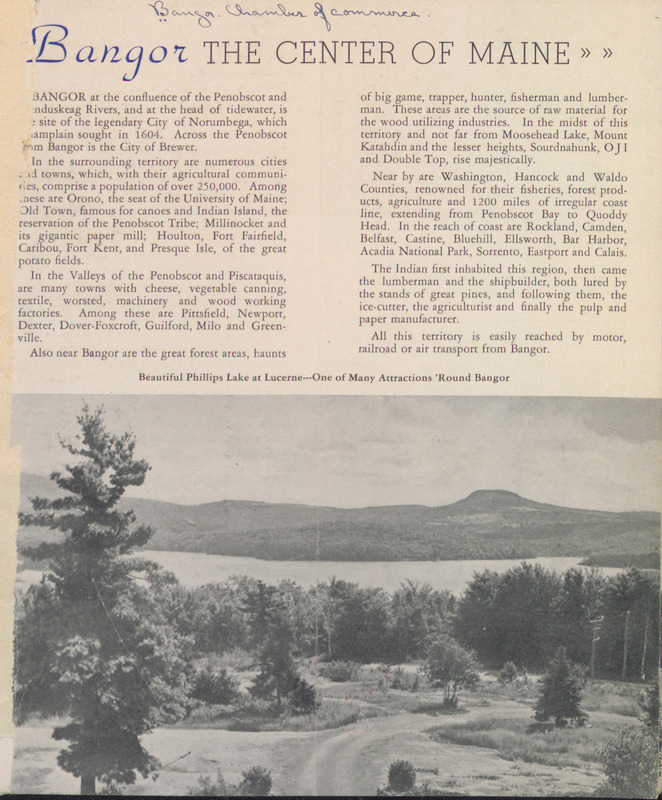
Bangor at the confluence of the Penobscot and Kenduskeag Rivers, and at the head of tidewater, is site of the legendary City of Norumbega, which Champlain sought in 1604. Across the Penobscot from Bangor is the City of Brewer. In the surrounding territory are numerous cities and towns, which, with their agricultural communities, comprise a population of over 250,000. Among these are Orono, the seat of the University of Maine; Old Town, famous for canoes and Indian Island, the reservation of the Penobscot Tribe; Millinocket and its gigantic paper mill; Houlton, Fort Fairfield, Caribou, Fort Kent, and Presque Isle, of the great potato fields.
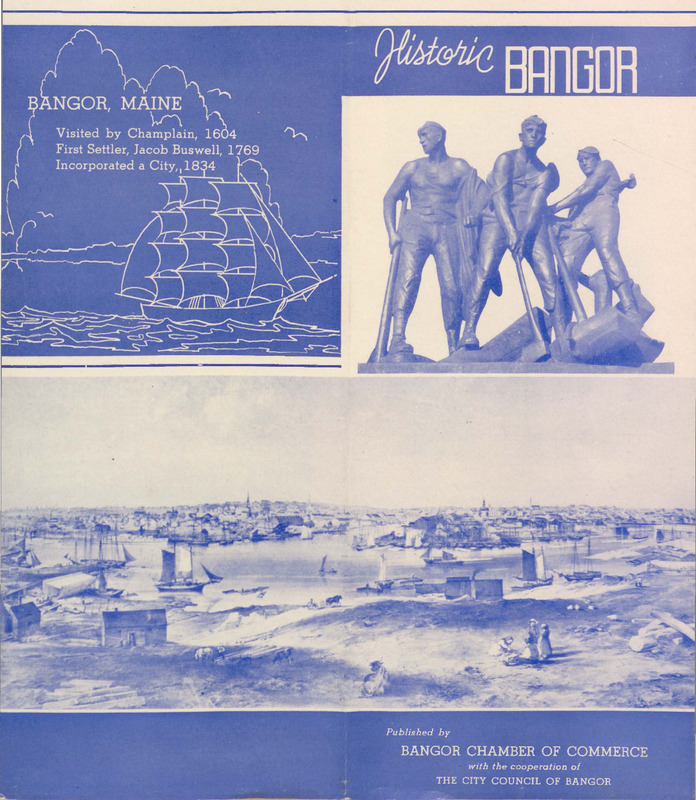
Facts, photographs, and anecdotes about Bangor's first century as a city, including reminiscences of several residents in their late nineties who witnessed Bangor grow from a small city to a logging industry metropolis.
Scrapbook consisting of newspaper clippings from a February 1934 issue of the Bangor Daily Commercial commemorating the first 100 years of Bangor, Maine, as a city. Features many historical narratives and photographs of Bangor sites and citizens.
One may follow the rugged coast farther East through the blueberry barrens into Washington County, the heart of the sardine and blueberry canning industry and the entrance to Canada. Again, one may turn North to the rich farming region of Aroostook, famous for its potatoes, forests and grain. Still another North road leads up the Piscataquis Valley to Mooschead Lake, the great fishing and hunting territory and the starting point of many canoe trips. To the West and North lead the highways to the White Mountains, the Rangeleys, Quebec and Montreal.
Regulations cover Vehicles in Motion; Right of Way; Speed of Vehicles; Stopping, Standing, and Turning; Control of Horses; Stealing Rides; Obedience to Police; and more.
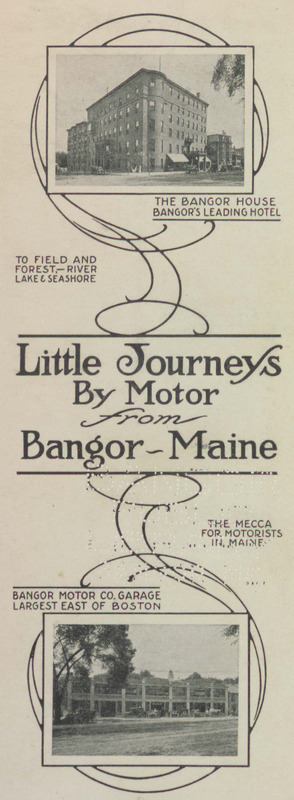
"Ask the man who knows," and he will tell you that Bangor, Maine, is one of the liveliest, most energetic, most attractive cities in all New England. It is a good city to visit--easy to reach, by a pleasant run over good roads--and there are many and varied attractions around about the town to keep the visitor well entertained, even though his stay is of considerable duration. A lot of automobile parties have declared they have had "the outing time of their lives at Bangor, Maine"; it is logical, therefore, to believe that you and your party will find this widely popular recreation city well worth visiting.
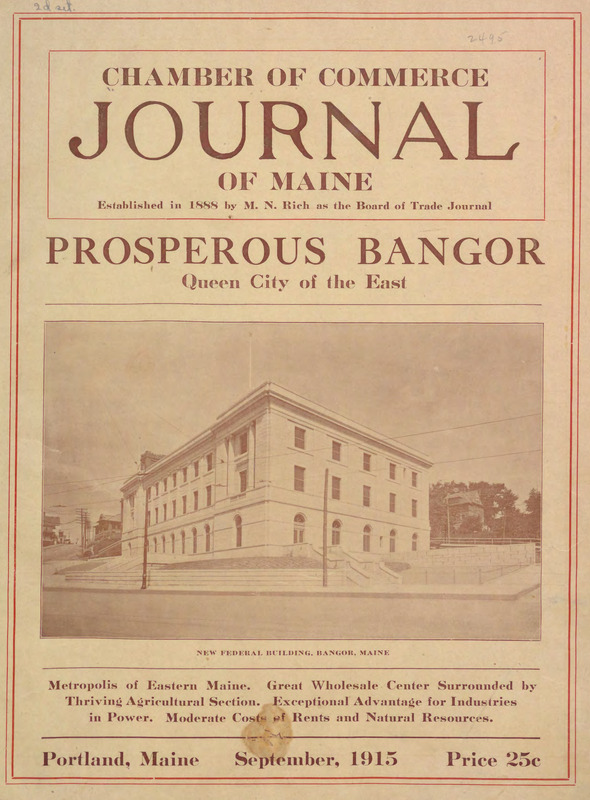
Metropolis of Eastern Maine: As will be noticed, the present number of the Chamber of Commerce Journal of Maine gives considerable space to setting forth the attractions, the business enterprises and the schools of Bangor, which is fittingly called the metropolis of Eastern Maine. Long ago Bangor took a front place among the progressive cities of New England, and the disastrous fire of April 30, 1911, which burned over an area of fifty-five acres, destroying about three million dollars' worth of property, proved only a temporary setback. Bangor, to-day, shows many improvements over the city of four years ago. Larger and handsomer buildings, in the majority of cases, have replaced those that were burned, and the spirit, enterprise and indomitable energy of her citizens have continued unabated.
In Observance of the One Hundredth Anniversary of the Publication of the Initial Issue of Bangor's First Newspaper, The Bangor Weekly Register by Peter Edes. Bangor House, Saturday, November Twenty-seventh Nineteen hundred and fifteen.