The gutted ruins of the Central Congregational Church of Bangor on French Street after the 1911 fire. The church was built in 1902, with Frank A. Bourne as the architect. The stonework was "pink Bay of Fundy" granite. It was considered one of the finest examples of a Gothic style church in New England.
Labeled "Bangor Fire Demolishing ruins of P.O. Bldg. 2 years later" on the slide. Although congressional funds were quickly approved to construct a new Federal Building housing the customs office and post office, there was debate about what to do with the old building that was destroyed during the Bangor fire of 1911. Finally, it was decided to demolish the old shell and create a fireblock with the gap. The area is today the Kenduskeag Park. The spectators are probably members of the fire department, which was also in charge of demolishing the building with dynamite.
After the Great Fire, the ruined remains of the Morse-Oliver Building were dynamited. Although several other buildings incorporated their former structures when they were rebuilt, the city's reorganization and rebuilding plan required broader roads and relocated buildings. After the seven story building was destroyed, no other buildings in the downtown district were built as tall, most confining themselves to four stories.
This view after the fire of April 30, 1911, shows the ruins of the Morse-Oliver Building on the corner of Exchange and State streets that have been partially dynamited to permit rebuilding. A wheeled ladder rig, probably owned by Bangor Hydro, is being used to repair downed lines. As the streets were slowly re-opened to traffic, many of the Bangor residents chose to ride instead of walk--an early automobile is bumper-to-bumper with horse-drawn buggies.
Cleaning up after the fire of 1911 was a lengthy process. This hand-colored slide shows a horse drawn ladder device used by Bangor Hydro as they restrung electrical lines next to the Morse-Oliver building on the left. The gap between buildings on the left had been filled, until the fire, by what was locally known as "Undertaker Row" because of the numerous embalming and funerary houses there. Exchange Street had been mostly cleared of rubble in this image, but not of spectators, who assembled for a better view. An early automobile can be seen as well as a delivery wagon, but gawkers came from further afield en masse: Maine Central Railroad offered a special rate on a same-day return ticket to view the ruins. Travelers would have arrived at Union Station, built in 1907 and distinguished by the tower in the center of the picture.
The fire of 1911 left downtown Bangor in ruins. This is Franklin Street which was the only means of passage between the two parts of the city after the fire.
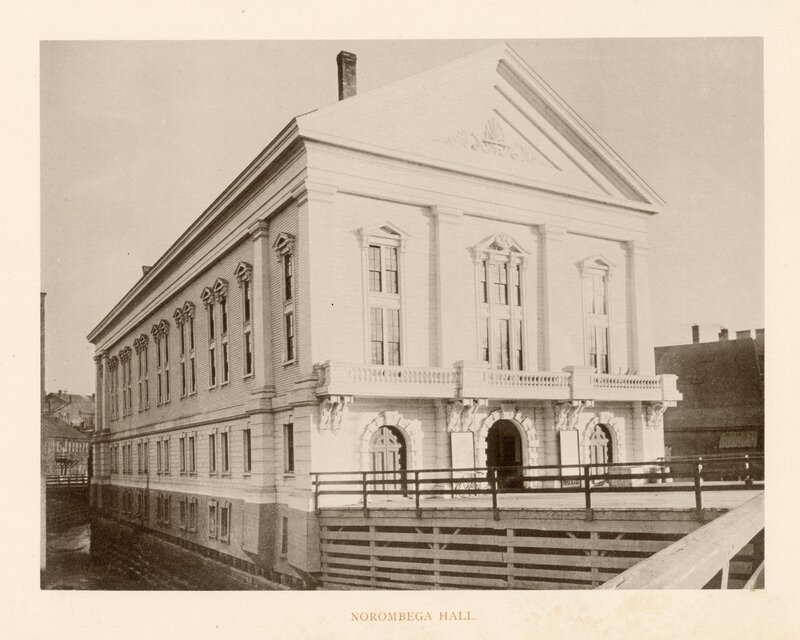
This view of the burned district was photographed from the opposite bank of the Kenduskeag Stream across Franklin Street. The ruins in the foreground are unidentified. The Graham Building is on the left, opposite the ruins of Norombega Hall. The church steeple at the top of the frame belonged to the Center Congregational Church, a prime specimen of New England Gothic architecture.
The Graham building housed the Odd Fellows, Knights of Malta, several other secret societies and the Nickle Theatre. Built in 1906 and designed by Wilfred E. Mansur, it was designed to follow a curve in Central Street, had the first concrete foundation of a business building in Bangor, and combined the Chicago Style with Beaux Arts classical details. After the fire, it was torn down and replaced with various single story businesses and the temporary post office. Here, a pair of workers clear rubble, one driving a horse and cart on the right, and another waiting on the left. The picture shows a view down Franklin Street, and the other buildings in the image are unidentified.
The Graham building housed the Odd Fellows, Knights of Malta, several other secret societies and the Nickle Theatre. Built in 1906 and designed by Wilfred E. Mansur, it was designed to follow a curve in Central Street, had the first concrete foundation of a business building in Bangor, and combined the Chicago Style with Beaux Arts classical details. After the fire, it was torn down and replaced with various single story businesses and the temporary post office.
Ruins of the United States Custom House and Post Office after the fire of April 1911. These buildings were built in 1853-55 between State Street and Central Streets. The architect was Ammi B. Young with an addition added on in 1869-1870 by architect Alfred Bult Mullett. This view is taken from the Kenduskeag Stream.
This photograph was taken a few days after the Bangor Fire of April 30, 1911. It shows the ruins of the Bangor High School that was located on the "Bruce lot" now "Abbot Square" on Harlow Street. This High School building was built in 1852. The replacement High School was built across Harlow Street, with the Public Library built next to it.
Only a wall remained of the church on the corner of Harlow and Center after the fire. What was once a fine church sits diminished into a pile of charred bricks. The people walking by are dressed in their Sunday best, suggesting that this picture may have been taken on the afternoon of the fire. The onlookers seem troubled by the ruins of the magnificent church. Today, the reconstructed church is at 56 Center Street.
Ruins of the First Congregational Church at Broadway and State streets. This was the third church building built on this site, completed in 1853. It is said that during the fire of April 30, 1911, the burning church spire on top of the hill at State Street could be seen from miles away. The fourth church building on this site was built in 1912-1913. It was called All Soul's Congregational Church and consisted of the united congregations of the First Congregational Church and Central Congregational Church, also burned in the fire.
This view is of the Central Congregational Church on French Street after the 1911 fire. The church was designed by Frank A. Bourne in 1902 in the stone Gothic style. The exterior stone work was of pink "Bay of Fundy" granite from St. George, New Brunswick, with trimmings being of Indiana limestone. It was the most expensive church erected in Bangor before the fire of 1911.
After the Bangor Fire this hand-colored lantern slide shows the ruins of the buildings on Main Street. The Kenduskeag stream is on the left, the Graham Building is at the center. The Graham Building, 74-92 Central Street, was the home of several of Bangor's secret societies, including the Odd Fellows and the Knights of Malta. It was built in 1906, designed by Wilfred E. Mansur, and its long, slightly curved three-story shape was designed to enhance the curve of the street. It was noted for its roof balustrade and terracotta molded details, following the Beaux-Arts tradition established by some of the recently constructed buildings, such as the Merrill Trust, and in 1907 a vaudeville theater was built into the first story. The building was burned in the fire, and was replaced with several single-story buildings including the temporary post office.
Hand-colored lantern slide showing the Graham Building on the left, and the ruined plot where Norombega Hall stood in the foreground. Behind that is the Federal Building, and in the distance the Morse-Oliver and Stearns buildings. The image was taken from Franklin Street.
Possibly this picture was taken as the ruins still smoked; the left foreground of the image shows a fire hose snaking over the trolley tracks. Spectators, including one on a bicycle, are out to view the ruins of the Morse-Oliver building on the left, and of the Stearnes building on the right.
The ruins of the seven-story Morse-Oliver building on Exchange and State Streets after the Bangor Fire. The building housed many businesses, including F.H. Clifford, advertisement writers; Tyler, Fogg & Co, bankers, brokers, and safe dealers; American Realty Co, loggers; the Hamlin Lumber Co.; the headquarters of the Bangor & Aroostook Railroad and of Northern Telegraph Co, several real estate agents and appraisers; stenographers, and various others. The hand-colored lantern slide is captioned "Bangor Fire Ruins of Morse-Oliver Building."
In the wake of the fire, which was only contained after midnight by hastily erected fire walls, most of downtown Bangor was left in ruins. As investigators evaluated the remains, traffic was directed to Franklin Street. "Bangor Fire the morning after the only thoroughfare open over the Kenduskeag Stream" is written on this lantern slide.
Hand-colored lantern slide showing the New England Telephone & Telegraph Co. at 45 Hammond Street, one of the first buildings to catch after the fire jumped the Kenduskeag Stream early in the afternoon. Newspapers reported that the girls who operated the switchboard stayed until almost the last minute, and that the last message sent out was a request to Boston that a replacement switchboard be sent as soon as possible. The destruction of the Exchange hampered communication from Bangor to other communites from the outset of the fire. Sensationalist New York newspapers reported that daring young men climbed to the burning roof to manually splice into the wire, stories which the Bangor Daily dismissed as an example of overwrought big-city journalism. The spiderweb of lines in the foreground demonstrates the extent of the damage to a central dispach.
This hand-colored lantern slide shows the Bangor Public Library and the Historical Society burning during the fire of 1911. The pile of lumber hints at the scale of destruction; many blocks in the buisiness section were lost, and the conflagration has clearly spread in the background. The trolley tracks are also shown.
This view shows the fire in progress next door to S. L. Crosby Co, sporting goods, 136 Exchange Street. Haynes & Chalmers Hardware Store, 176 & 178 is to the right of the fire. The Fairbanks Company, 208 Exchange Street, is on the left. This colored slide reads "Bangor Fire 1911, Fairbanks Building - Rear of Exchange Street."
A colored slide showing the Bangor Fire in progress taken near the river. The Fairbanks Company, 208 Exchange Street, is on fire as well as Hodgkins & Fiske Co, 190-194 Exchange Street, dealers in furniture, carpets, rugs, pianos, stoves, etc. S. L. Crosby Co, 136 Exchange Street, and Haynes & Chalmers, 176 & 178 Exchange Street, can be seen to the right of fire. A group of businessmen are gathered along the waterfront.
This hand-colored lantern slide shows the Bangor Public Library catching fire in 1911. The library's collection, valued at $300,000, as well as that of the Bangor Historical Society, was entirely lost. Also pictured are the Bangor Savings Bank and Fred T. Hall & Co, grocers. Many of the spectators are still dressed in their Sunday best.