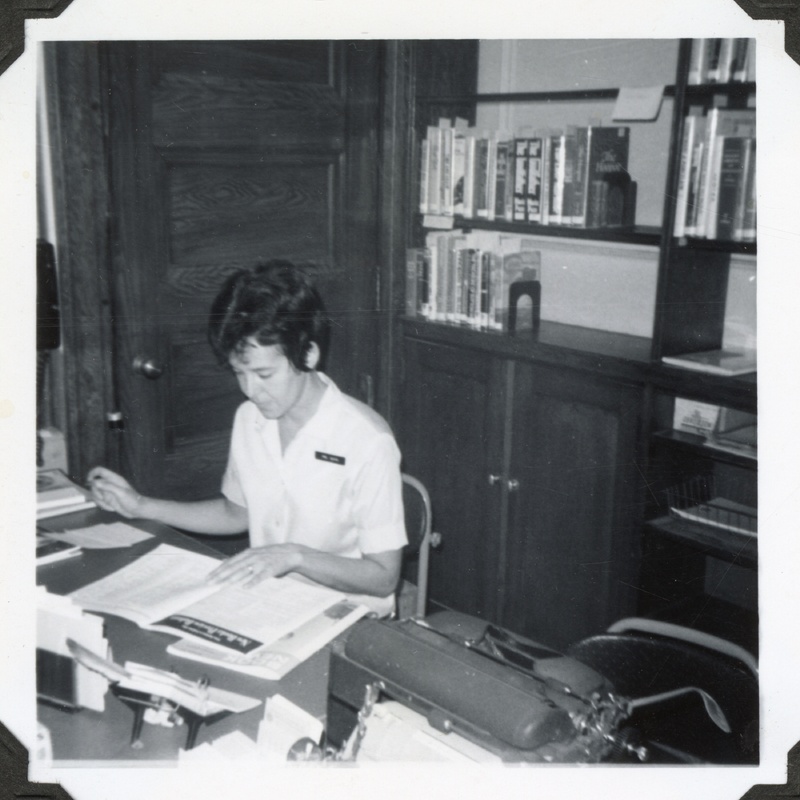
Mrs. Benita Davis, Circulation Librarian, not only co-ordinates and oversees the work of the Circulation Department, but also assists in the selection of books for the library collection. To help her in selection she uses professional library publications which carry brief synopsis of new publications.
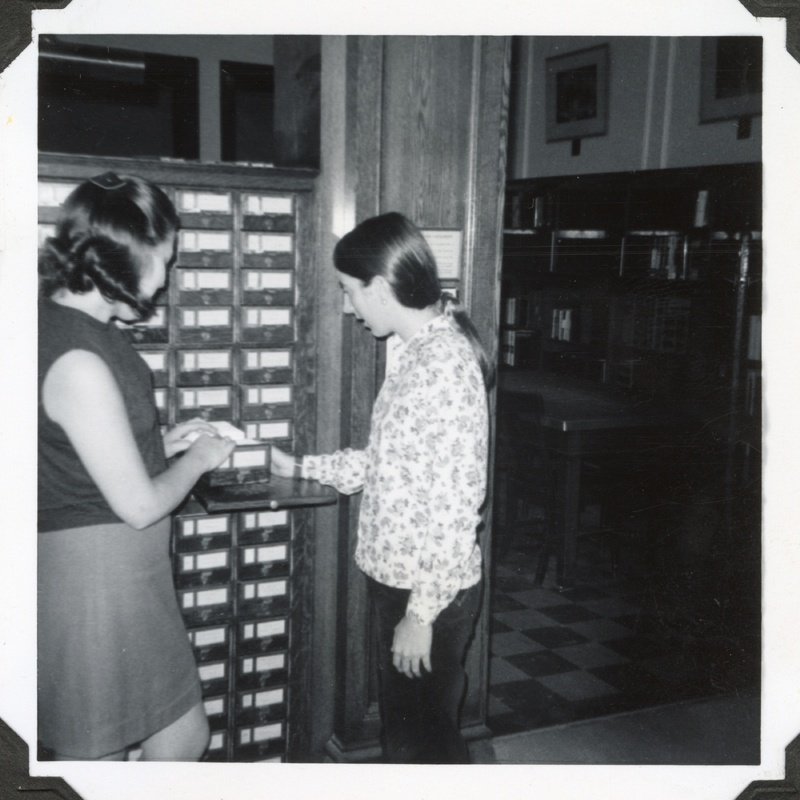
The public card catalog sometimes proves difficult for the average patron to use. Miss Gretchen Miner (left), circulation desk assistant, gives this young lady a helping hand in looking up the book she is seeking.
With four floors of old stacks and two floors of new, it is apparent that a considerable amount of walking is required of the circulation assistants. Lee Leighton, part-time assistant, returns from the stacks with a patron's selection of books.
At the circulation desk, First Assistant Mrs. Carol Phelps using the new charge out machine checks out books to a patron, while a young man waits for his book selections to be brought from the closed stacks behind the circulatión desk.
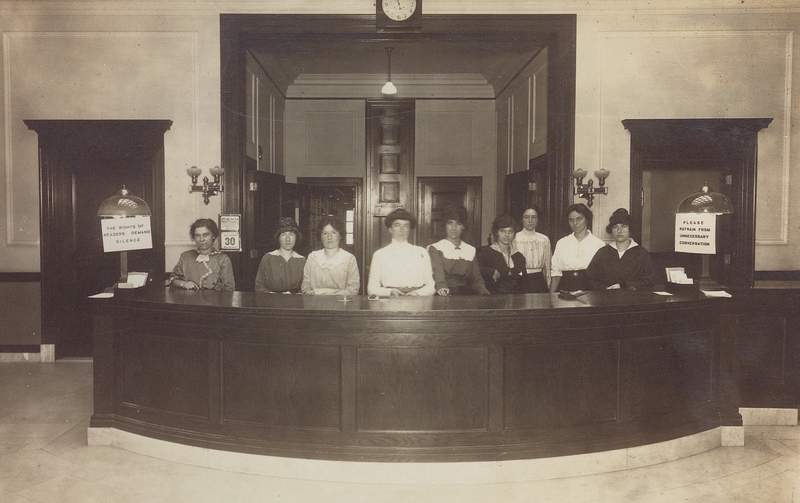
The large main lobby contains the public card catalog on the left, the circulation desk in the background and several thousand of the newer fiction and nonfiction books available for circulation.
Bangor Public Library founded in 1883 opened its doors on Harlow Street on December 20, 1913. The main building houses three public service departments--Circulation, Children's and Reference. Behind the scenes departments include Office personnel, Accessions and Classification Department, Catalog Department, Periodicals and Binding Department and Extension Department. The stacks are located at the rear of the building.
Dear Newcomer: It is a pleasure to welcome you to Dow Air Force Base and the State of Maine. You will find the base a beautiful installation and the community a friendly place in which to live and work. We are a part of the Strategic Air Command whose strength and deterrent posture is known throughout the world. Our success depends upon you; we can remain alert and strong only through your dedicated and energetic efforts. we know you will be proud to be a part of the Dow community and we invite you to join in the cordial relationship between the base and the cities of Bangor and Brewer. This guide will acquaint you with the facilities and services at Dow and in the State of Maine. Again, welcome on behalf of all the personnel presently enjoying their stay at Dow.--George W. R. Zethren, Colonel, USAF Commander
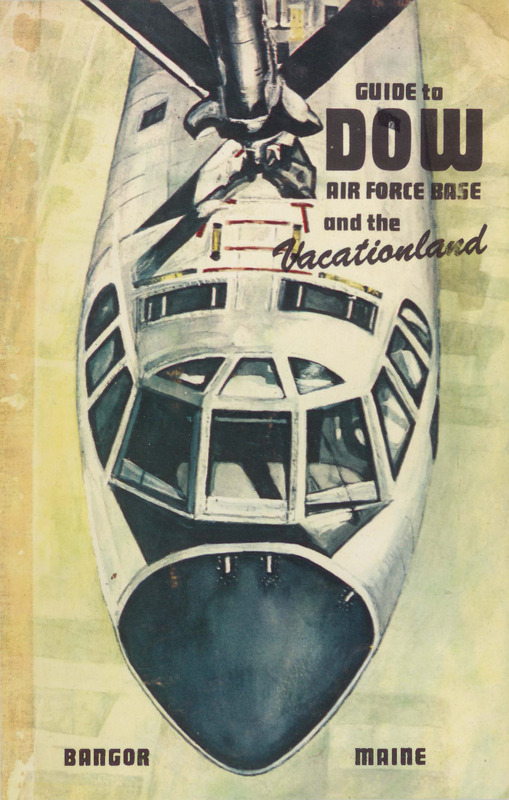
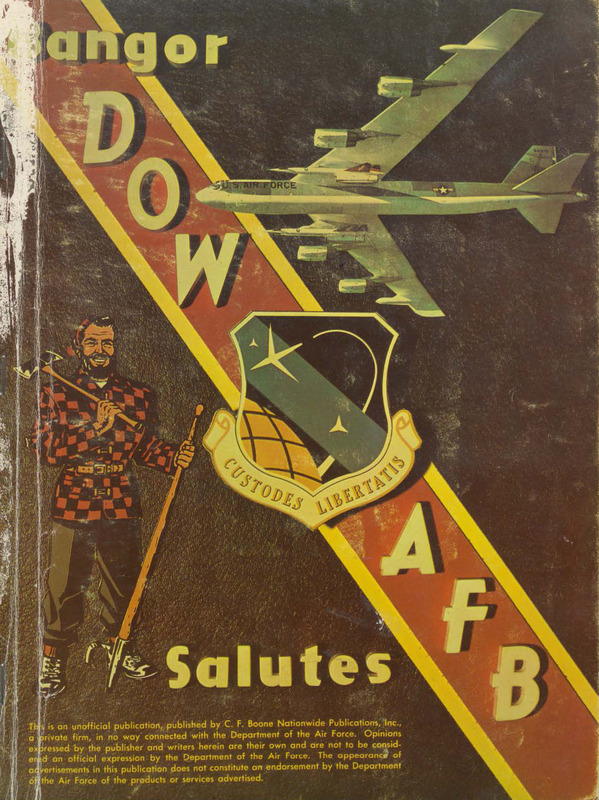
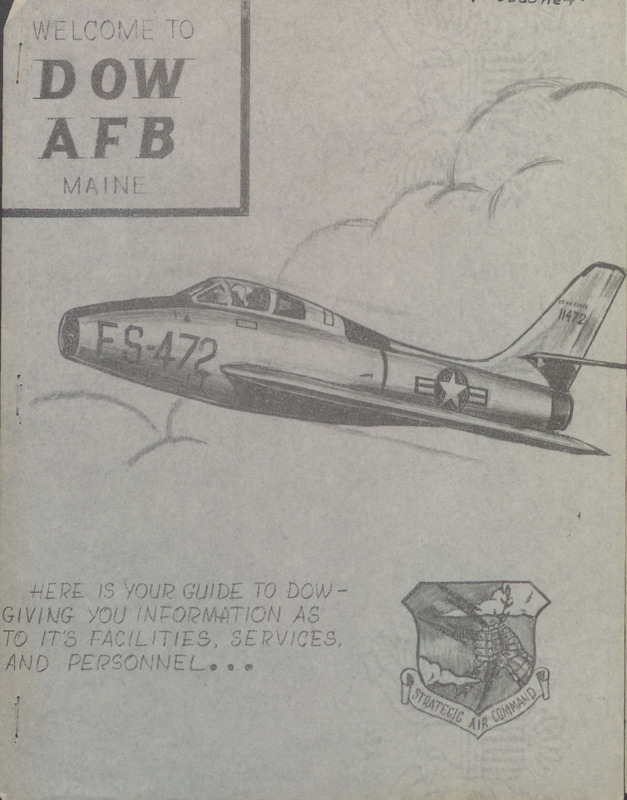
Welcome to Dow Air Force Base. In its role as a Strategic Air Command heavy bomber base, Dow is one of the most vital and historic installations in the United States Air Force. Dow is located in the suburbs of Bangor, Maine and as such, is one of the eastern-most bases in the Continental United States. Because of the fact that a permanent change of station is most often a strange and confusing experience, probably the most important questions you have now are those concerning facilities that are available at Dow, the local community, the people with whom you will work and the machinery at your disposal to help minimize "settling in" problems. We hope the information contained in this guide will answer most of your questions and that you will find Dow and the city of Bangor a friendly community and that you will enjoy your tour here.
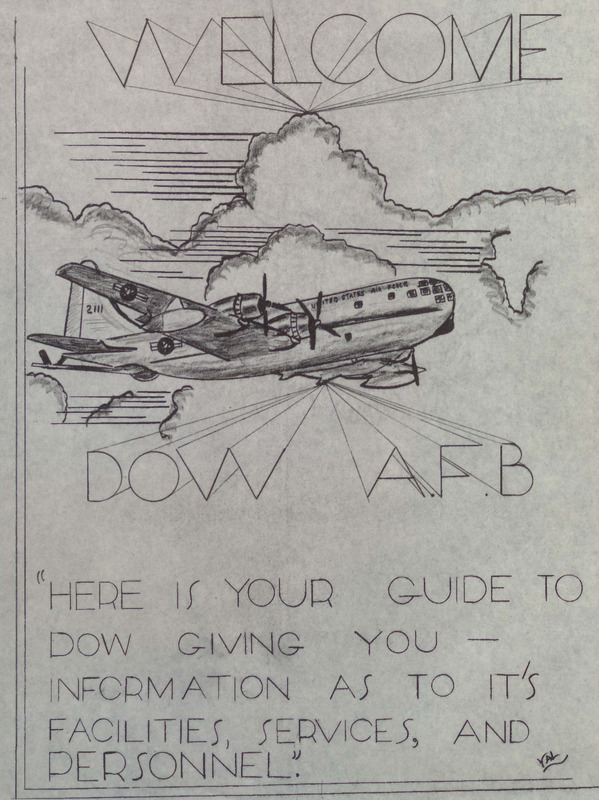
Introduction to Dow: This booklet has been designed to help you become acquainted with your new station. It covers where to go and who to see for information pertaining to your on and off duty hours. The back portion of the booklet, titled Community Resources Section, includes a wealth of information on the educational and recreational facilities available in the the greater part of Maine.
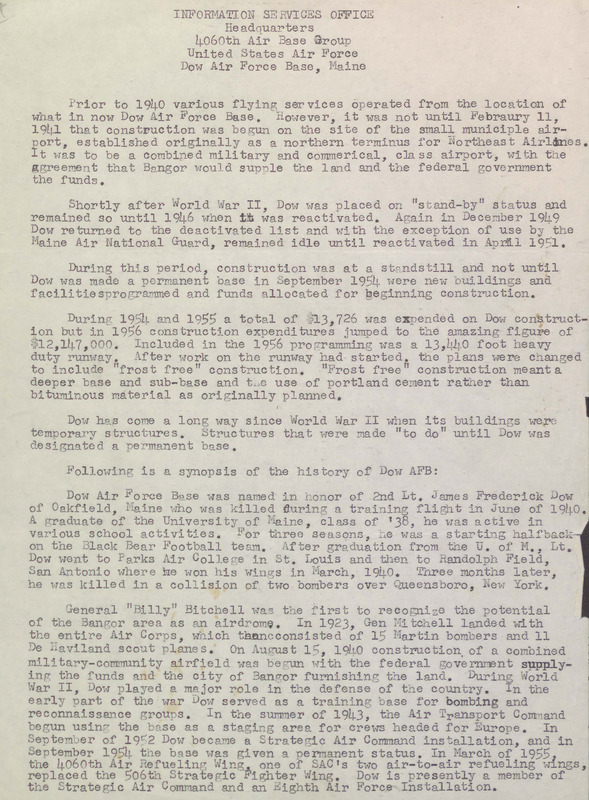
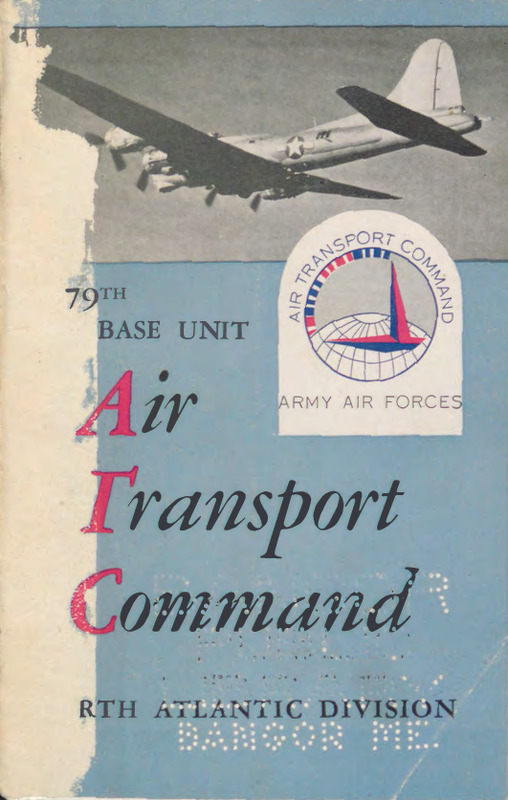
On August 15, 1940 construction of a combined military-community airfield was begun with the federal government supplying the funds and the city of Bangor furnishing the land. During World War II, Dow played a major role in the defense of the country. In the early part of the war Dow served as a training base for bombing and reconnaissance groups. In the summer of 1943, the Air Transport Command begun using the base as a staging area for crews headed for Europe. In September of 1952 Dow became a Strategic Air Command installation, and in September 1954 the base was given a permanent status. In March of 1955, the 4060th Air Refueling Wing, one of SAC's two air-to-air refueling wings, replaced the 506th Strategic Fighter Wing. Dow is presently a member of the Strategic Air Command and an Eighth Air Force Installation.
This brochure is presented as a reference to certain information, services, and facilities which may prove useful during your stay. All personnel are at your disposal for any assistance necessary to accomplish the purpose of your visit.--Orie O. Schurter, Colonel, USAF Commander
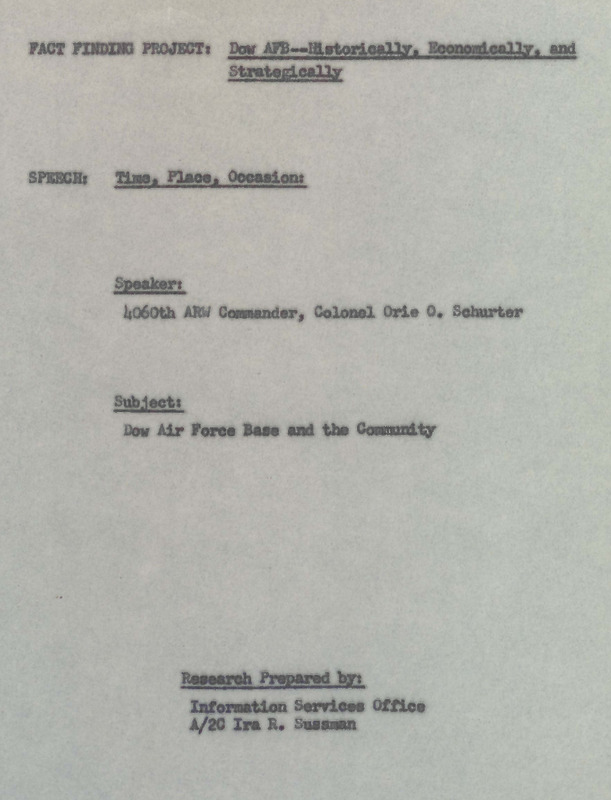
Outline and research notes for a speech on the subject "Dow Air Force Base and the Community." Includes: History (1923-1945); History (1946-1955); Stategic Location and Utilization; Mission; Economy--Decentralization Program.
This brochure is presented as a reference to certain information, services, and facilities which may prove useful during your stay. Our mission is to organize and train a force capable of providing adequate protection for Strategic Air Command bombardment and reconnaissance combat elements through escort and air defense, organize and conduct air-to-air refueling operations, provide for low level photographic reconnaissance, organize and train a force capable of destroying the forces, resources, and installations of an enemy, be prepared to implement established operations orders, participate in reserve training, and perform special missions as directed by higher headquarters. All personnel are at your disposal for any assistance necessary to accomplish the purpose of your visit.--Richard O. Hunziker, Colonel, USAF Commander
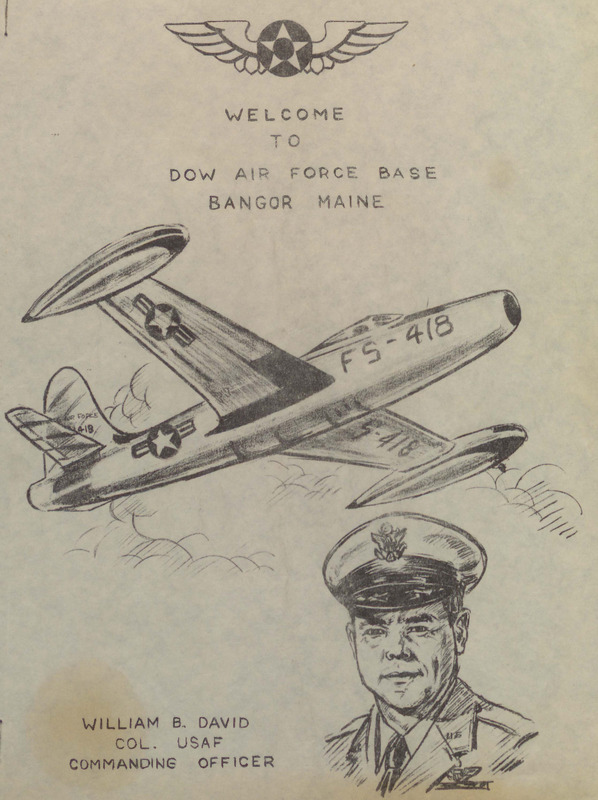
A Message from Your Commanding Officer: I welcome you to Dow Air Force Base and sincerely hope that your tour with us will be a pleasant one. My desire is to make your duty and off duty time as pleasant as possible. I urge each member of the military service regardless of rank to take advantage of the opportunities described in this booklet. The airman who takes advantage of the environmental surroundings of Maine will find himself well rewarded. As your commander I urge you to participate wholeheartedly in the base activities as it is a direct means for raising your efficiency, morale, and the development of better airmen and future citizens.--William B. David, Colonel USAF Commanding
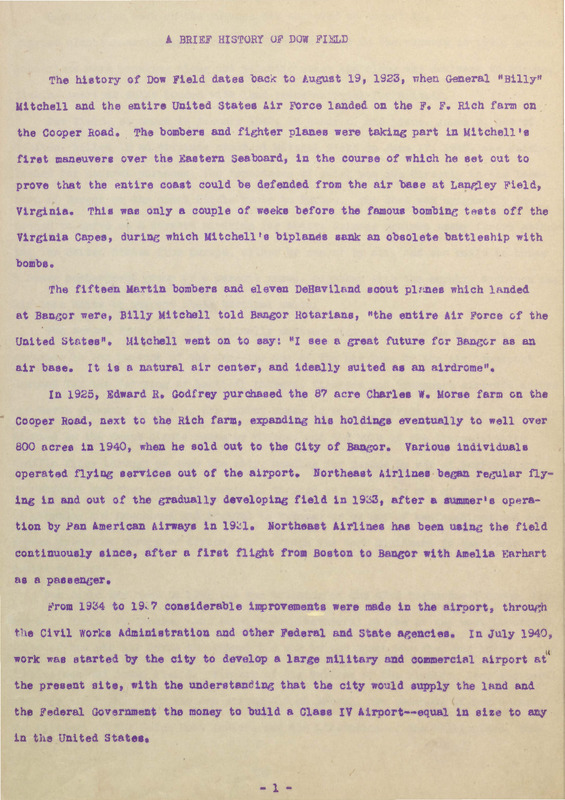
The history of Dow Field dates back to August 19, 1923, when General "Billy" Mitchell and the entire United States Air Force landed on the F. F. Rich farm on the Cooper Road. The bombers and fighter planes were taking part in Mitchell's first maneuvers over the Eastern Seaboard, in the course of which he set out to prove that the entire coast could be defended from the air base at Langley Field, Virginia. This was only a couple of weeks before the famous bombing tests off the Virginia Capes, during which Mitchell's biplanes sank an obsolete battleship with bombs. The fifteen Martin bombers and eleven DeHaviland scout planes which landed at Bangor were, Billy Mitchell told Bangor Rotarians, "the entire Air Force of the United States". Mitchell went on to say: "I see a great future for Bangor as an air base. It is a natural air center, and ideally suited as an airdrome".
Dow Field, formerly called the Bangor Air Base, dates back to February 11, 1941, when construction began on the site of a small municipal airport, established originally as a northern terminus for Northeast Airlines. Most of the construction was completed during the summer and fall of 1941. Numerous buildings for barracks, storage, hangars and hospitals, were erected on what was formerly a low, swampy area. Extensive filling and seeding have produced an attractive area of well-kept lawns and fields, landscaped with thousands of trees typical of the local scene. In 1941 and 1942, Dow Field was used mainly as a training base for bombing and reconnaissance groups, and as a training base for an aviation engineering regiment. One large bombardment group from Dow Field sailed on the maiden voyage of the Queen Mary as a troop ship pilots flew their own planes, of course but the large ground echelon went by boat.
Bangor will have a new city directory, this year. A 1921 edition of this most useful, and to many lines of business almost indispensible, work will be published in midsummer, or as soon as the canvass can be made and the book printed. Cannon & Co., which has published Bangor directories since 1891, the last edition being in 1919, has sold the copyright to the Portland Directory Co. which has been in existence since 1823. Frank W. Elsdon, advertising manager of the company is in Bangor and work on the advertising section of the Bangor book will commence today ... Practically all of the features of the present directory which also includes Brewer, will be retained, including the valuable local information, statistics and historical data. An important new feature will be the addition of the names of all women over 18 years. This is a feature which will be much appreciated. While the names of single women over 15 and widows have always appeared, the married women have been left out of it except in some few instances as the the head or member of a business. By the new way, Mrs. Judith Japonica Jones, will get her name in with her husband, Timothy Tallyrand Jones, and will not have to wait for the old man to die. And of course the girls and the widows who get married will not be dropped out, which will be comforting. (Source: Bangor Daily News, January 25, 1921)
The Bangor and Brewer directory for 1919 is being delivered to subscribers by Cannon & Co., the publishers. A new directory always is welcome, and this one doubly so, for none has been Issued since 1916, the new 1918 having been omitted on account of the war. The new directory has the same familiar features, but is printed on thinner paper and the type pages have been slightly lengthened, making a more compact volume. In compiling the new directory the publishers found more changes than in any previous period. 3459 new names being added, and 3231 old names dropped, a gain of 228. In Brewer 764 new names were added and 734 old names dropped, a gain of 30. Mr. Cannon, being asked if there was a scarcity of rents in Bangor, said that only the real estate dealers and people looking for rents the past summer could adequately describe the situation tion and and that in the book the business address only of many persons is given, for the reason that the houses they were occupying on Aug. 1 when the directory went to press, had been sold, and they were uncertain as to their future places of residence. (Source: Bangor Daily News, September 19, 1919)
The new directory outwardly looks much the same as the old one, but even a hurried review of it shows there are several new features. The new street directory, which takes each street and tells where it starts from, the number at each cross street or avenue, gives the number of each schoolhouse, church, or public building, and the number where the street ends, will be appreciated by those who want to know where a certain number is before they start. No need to ask which end a cross street numbers from, for a glance at the directory shows. Some of the street names remind us that Bangor is spreading out. Could all of us tell where East Broadway, Lancaster avenue, Tyler avenue, Yale or Henry street are? if we were asked, but all these streets are on the new map. An interesting table is one compiled by the College of Arts and Sciences, U. of M., giving the earliest and latest snowfalls and freezes since 1869, which will settle many an argument on the weather. For the politician there are the two votes on commission form of government, special election and the vote by wards for mayor for several years, political committees, etc. (Source: Bangor Daily News, August 2, 1916)
The city directory for 1914, issued by Cannon & Co., has made its appearance, accompanied as usual by the Brewer Directory and a new map of Bangor and Brewer. The volume has the same familiar features, and is of the same size as its predecessors. The publishers have retained all the old features and have added several new ones. The new names added to the Bangor directory this year number 2471, while 2407 old names we dropped, leaving a gain of 64. This, the publishers say, is a very gratifying showing, as the canvass of 1912 was taken in the height of the rebuilding boom after the fire of 1911, and this year the greater number of the names dropped were those of carpenters, masons, painters and teamsters, who found employment here at that time. The boarding and lodging houses show a decrease in inmates this year, while the residential section shows a good increase, which is permanent, and represents families rather than Individuals. In Brewer the new names were 650, and the names dropped 602 leaving a gain of 48. In the business directory an increase is found in the number of corporations, the number given in the new directory being 216, while there were only 203 in 1912. The last directory gave the names of only 71 lawyers, while the new directory shows 83. Bangor's health is looked after by 53 doctors and 116 nurses according to the new directory, while in 1912 the directory gave 51 doctors and 99 nurses. (Source: Bangor Daily News, July 23, 1914)
The Bangor directory, the 1912 edition of which has just been distributed by Cannon & Co., compilers and publishers, will probably be the most used book during the coming 12 months of any that Bangor and Brewer people will have occasion to refer. Mercantile houses, hotels, railroad offices, telephone and telegraph companies and professional men use it extensively and the newspaper offices especially find it of great assistance. The directory gives not only the name but the home and business addresses and occupation and much supplementary information such as the mayors of Bangor, opening and closing of navigation, water rates of the city, port statistics, stage lines, tax rates and valuations of the city, personnel of the fire and water departments, the alarm numbers, public carriage regulations, post office hours and rates of postage, judiciary of the state and county officers, justices of the peace and notaries public, classified directory of Bangor merchants and professional men, the ward boundaries, personnel of the city government and subordinate officers, the churches and their pastors, the officers and meeting nights of fraternal societies and labor organizations, the officers of Bangor corporations and log driving companies, the census of the state and the public schools and their teachers. These facts for Brewer are also included. (Source: Bangor Daily Commercial, August 17, 1912)
The Bangor Directory for 1910-11, just issued by Cannon & Co., comprises as it should the cities of Brewer and Oldtown and the towns of Orono and Veazie, and is especially valuable for the reason that it has been eight years since a directory of the up-river municipalities has been published. The volume gives the names, place of business or occupation and residence of nearly 20,000 people within the limits of Greater Bangor and besides gives street and classified directory of the three cities, a new map of Bangor and Brewer, and a great amount of civic, society and miscellaneous information. Copies may be obtained of the publishers or of E, F, Dillingham, bookseller, Bangor. (Source: Industrial Journal, December 1, 1910)