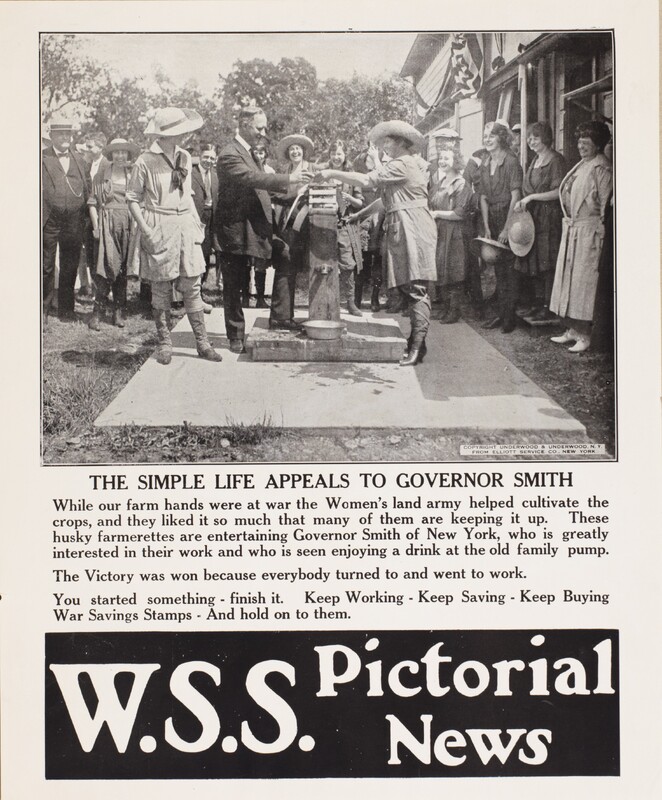
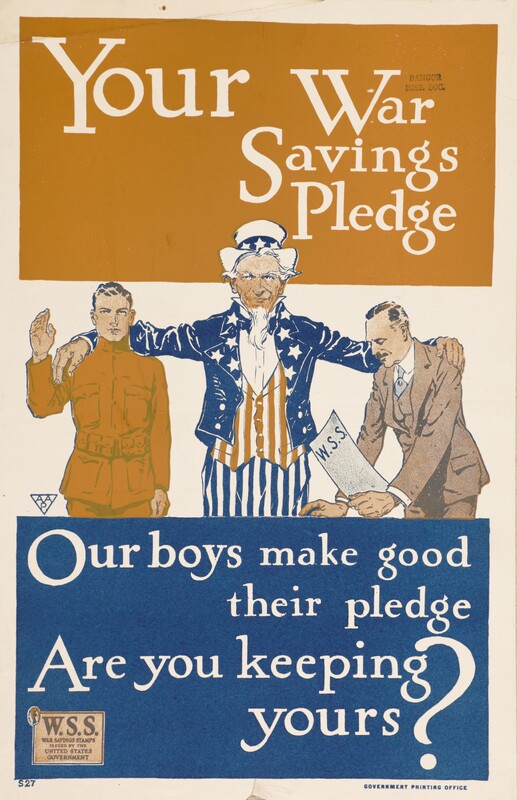
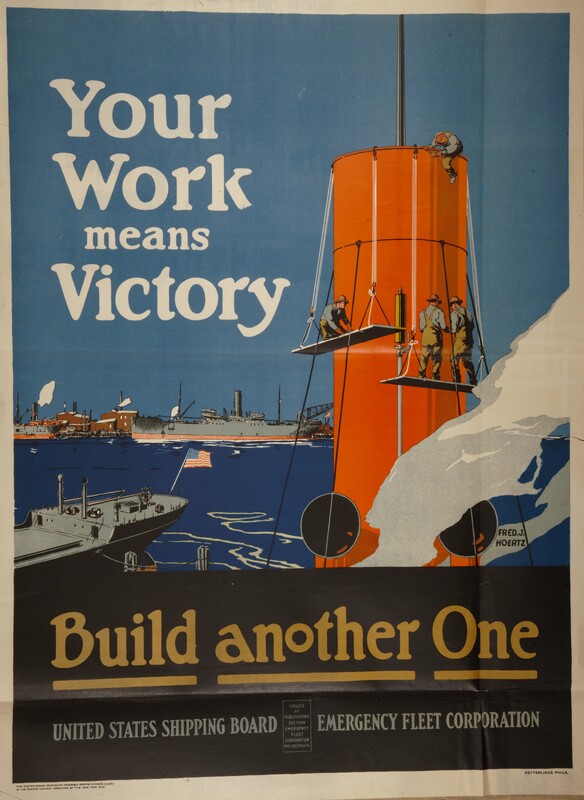
While our farm hands were at war the Women's land army helped cultivate the crops, and they liked it so much that many of them are keeping it up. These husky farmerettes are entertaining Governor Smith of New York, who is greatly interested in their work and who is seen enjoying a drink at the old family pump. The Victory was won because everybody turned to and went to work. You started something -- finish it. Keep Working -- Keep Saving -- Keep Buying War Savings Stamps -- And hold on to them.
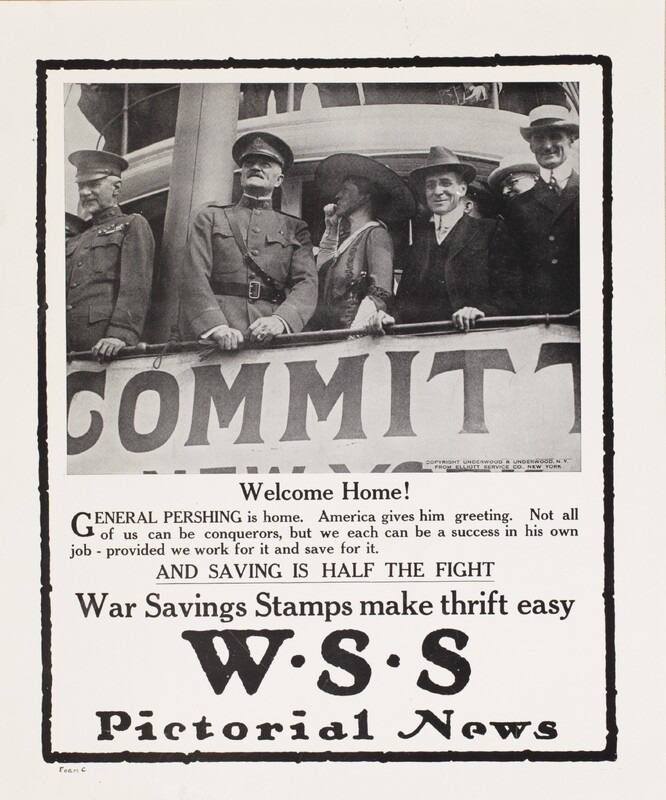
General Pershing is home. America gives him greeting. Not all us can be conquerors, but we each can be a success in his own job provided we work for it and save for it. And saving is half the fight.
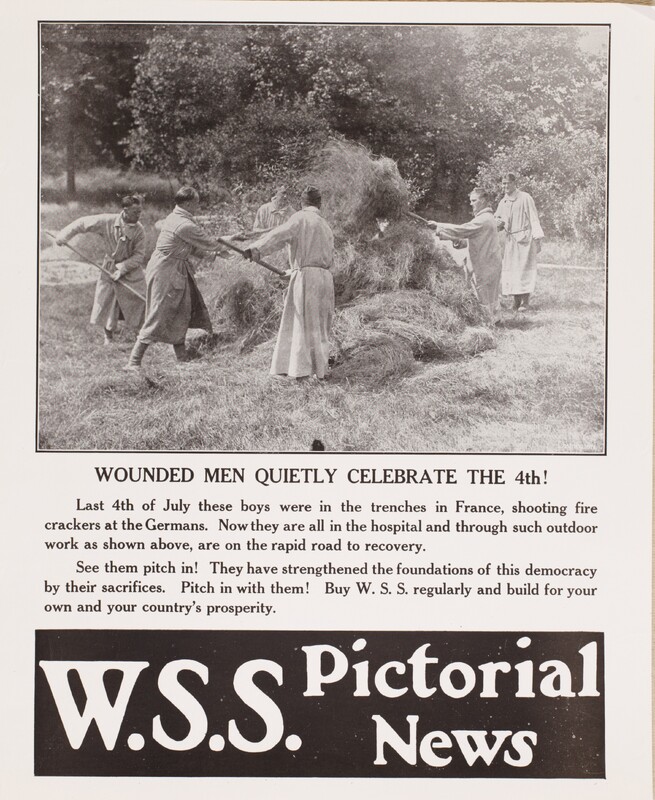
Last 4th of July these boys were in the trenches in France, shooting fire crackers at the Germans. Now they are all in the hospital and through such outdoor work as shown above, are on the rapid road to recovery. See them pitch in! They have strengthened the foundations of this democracy by their sacrifices. Pitch in with them! Buy W. S. S. regularly and build for your own and your country's prosperity.
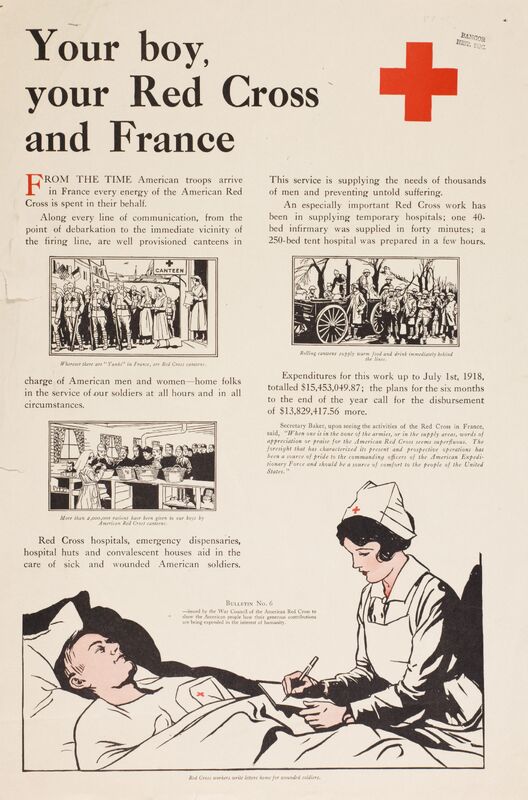
From the time American troops arrive in France every energy of the American Red Cross is spent in their behalf. Along every line of communication, from the point of debarkation to the immediate vicinity of the firing line, are well provisioned canteens in charge of American men and women-home folks in the service of our soldiers at all hours and in all circumstances. Red Cross hospitals, emergency dispensaries, hospital huts and convalescent houses aid in the care of sick and wounded American soldiers.
Prologue: There isn't too much difference between a good outfit and usst another one that does its routine job in its own routine way. It isn't the draft board, army selection, or luck; it's just a happy circumstance when certain men are chosen as officers and others for enlisted men--and it's even a happier circumstance when they click into a well geared machine. But an outfit isn't a machine either. It's a group of 600 individual personalities who are thinking 600 different ways towards getting the job done. It's the 600 different ways of thinking that makes an outfit good. It's the American soldier with his self-initiative, imagination, intelligence and ability. It's the American officer with his leadership and knowledge, and it's the American field commander with his patience and restraint--that makes a good outfit. We, the men of the 48th Engineers, want to tell you the story of our outfit--the 48th Engineer Combat Battalion. Signed, The Staff
From the introduction: Our Army had grown until it numbered millions. Parents, wives and relatives had watched America's young men march off to distant training camps without being able to visit them and learn from personal observation how those men were being prepared for modern warfare. America was financing a war effort. It wanted to know how its money was being expended. The Bureau of Public Relations of the War Department wanted an answer. It was discovered in the Army War Show... With the full cooperation of all branches, a force of approximately 700 men was assembled at Fort George G. Meade, Maryland, on May 20, 1942. There were units from the Signal Corps at Fort Monmouth, Engineers from Fort Belvoir, Mechanized Cavalry from Fort Knox, Mechanized Infantry from Fort A. P. Hill, Chemical Warfare Service from Edgewood Arsenal, and a small but effective operating squadron from the Air Corps. A tank, anti-tank and several service units were added, and at Pittsburgh the task force was joined by a negro cavalry unit from the Ninth Cavalry of Fort Riley, Kansas.
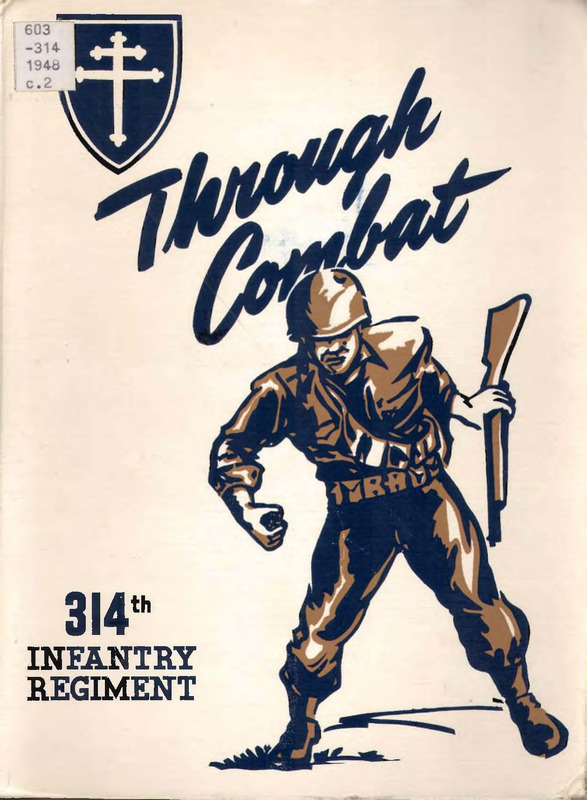
Officers and Men of the 314th Infantry: The history of our regiment has been written in this book long after the fighting ceased. It does not tell the complete story. A book many times its thickness could not do that. The story of the Falcon Regiment is written on the fields, the valleys, the hills and the forests of France and Germany with the blood of the dead and wounded, and the sweat of those who lived. The history is complete in detail and will linger on as fear in the mind of Germany and as gratitude in the heart of America forever. In deeds, not words, is the history of tlle 314th Infantry written. We are proud of the accomplishments of our fine regiment. It is a story of American men who gave their all that the country they called home might live. I desire to express my appreciation to each indiyidual for the part he played in making final victory possible. Some contributions were large, some were small, but the combination makes an epic of a brave regiment of a grand division that was given an important mission to perform, and performed that mission in the highest tradition of the United States Army. May the comradeship, the self-sacrifice and the devotion to duty displayed while wearing the Cross of Lorraine never die. May your lives and the lives of those around you be richer for this experience.--W. A. Robinson, Colonel, 314th Infantry, Commanding
Foreword: This war is done. The guns have ceased their cough and the dead are restored to the dust from which they sprang. The earthbound living struggle on--snarled in ruthless strife and shabby prejudice. Once more the needle chatters in the roughened groove of peace. But in his brief moment of selfless freedom the warrior widened our horizon. He revealed the unity and strength of which we are capable . This book is more than a record of high achievement. It is of the future no less than of the past. It is prophecy. It marks the altitude to which the spirit of man can soar. It is a portent of what life may be when we have learned to labor, as these soldiers did, for the common good. It will remain a fount of refreshment when the heart grows heavy and the light of hope burns dim. --Howard Vincent O'Brien
Preface: It was Christmas, 1944, when we met for the first time on the torn, frozen fields of battle. Gold braid no more. If there were any sharply creased, olive drab uniforms, they were crammed with sweaters, field jackets, and every article of clothing available, issue or otherwise. In place of polished, ox-blood boots, there were outside-in combat shoes, for the green sloping fields of an American army camp. There were rocky, shell torn patches of soil, and always the uneasy, restless noises of things happening ... We are fortunate who read this, for we do not have to share the loneliness of those left behind never to forget the suddenness and violence with which they were forced to rest. Call it a dedication if you like, or a hero's epitaph, but let us not forget their sacrifice in order that we might enjoy what they lay down their lives to make possible. The whole world is their tomb, and in far off places, where only history declares it, there is enshrined in every breast, not with words or pictures, but with what is in the heart, a eulogy for them.
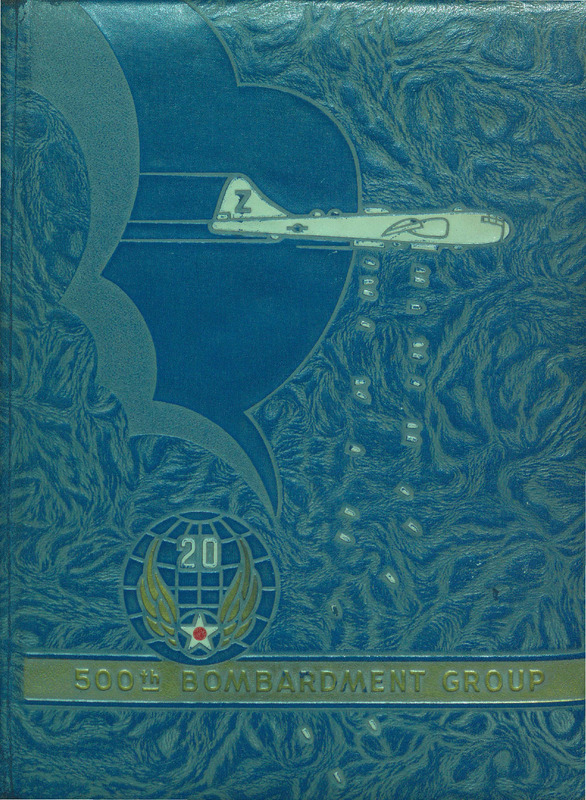
Foreword: There was a certain irony in the "face saving" surrender of the Japanese after the bombing of Hiroshima and Nagasaka, for it came when the war against their Empire had already been decided. When the B-29s moved into the Marianas, the war moved into a different epoch. Before the use of the atomic bomb, the US had proved that it could wipe out Japanese cities, one after another, without the need to bring ground troops to close quarters at all. When the war ended, the AAF had the ability to knock out a city a night with incendiary attacks alone. The chief agents of the annihilation of the land of the rising sun were the Superforts and the people who made up the Bombardment Groups that supported, maintained and flew them. This book is about just one of those Groups, the 500th, which came under the command of the 73rd Bombardment Wing, pioneer in carrying the full strategic, striking power of the Air Forces to the heart of Japan. The pictures that follow were selected because of interest to former men of the 500th and are not intended to portray the broader history of the Pacific War nor even of the total B-29 program on Saipan. Inasmuch as possible, only photographs that tell a story were chosen. The people in the scenes are there because of what they are doing and not because they were members of a certain Squadron or Section. Due to combat losses, reorganization and other exigencies of military service, many men frequently changed from one responsibility to another. Quite often a position was held by several people during the course of the Group's history. For this reason, only top command and staff personnel who held those positions during the peak of the 500th's effort against the enemy are pictured in that section of this volume. It is my hope that you feel, as I do, that we had the privilege of serving our country in the best Group in the world's best Air Force.--Glenn E. McClure
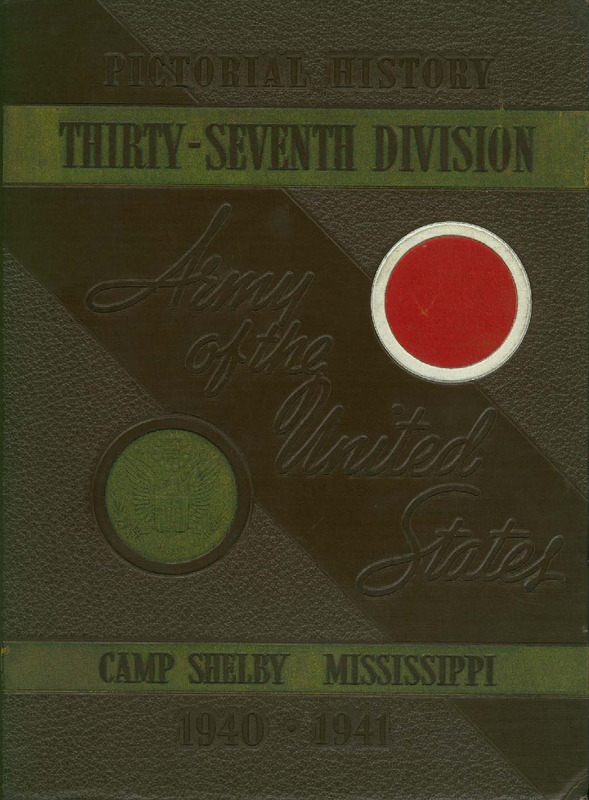
History of the Thirty-Seventh Division: Against the rich pageantry of its own brilliant history, the 37th Division stands today as a strong and vital link in Uncle Sam's new defense system, with 18,000 Buckeyes converted into top-notch soldiers under the command of Major General Robert S. Beightler, at Camp Shelby, Mississippi. Ohio men from the rolling farm country, the dynamic industrial towns, the picturesque shores of Lake Erie, have been welded into a powerful combat force to carry on the glorious traditions of the division which had its origin in the earliest days of the nation.
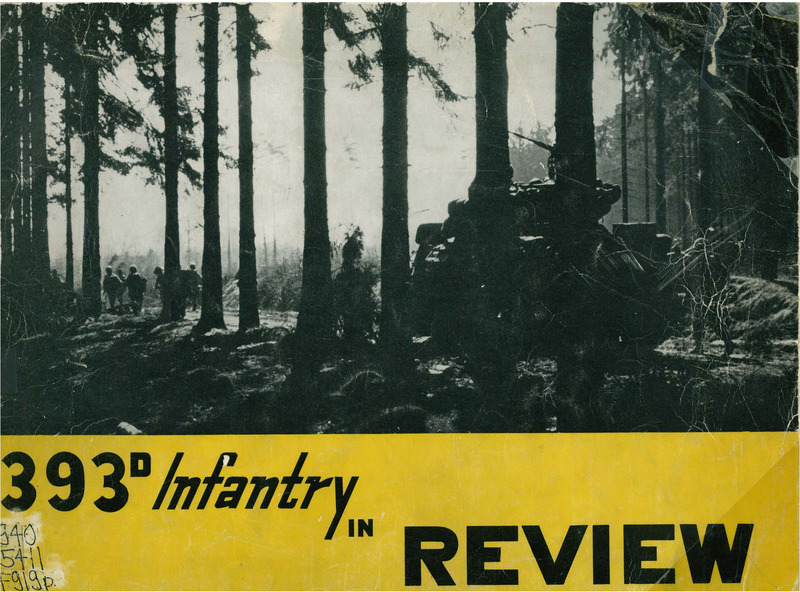
Preface: This book has been compiled from official and unofficial sources to afford men who have been in combat with the 393rd Infantry a review of the Regiment's action in the European Theater of Operations. With emphasis placed on the unit rather than individual action, the book has omitted stories of personal heroism. Names of men in pictures have been purposely omitted. To each man. who fought with the 393rd Infantry belongs credit for the hard-fought battle. To him belongs also the privilege of relating his deeds. Some five thousand men participated with the regiment in combat--to each this book is the background of his own fight. Effort has been made to show action of every section that comprises an infantry regiment in combat. A sincere endeavor was made to encompass all who played a part in building a fighting team. If you are able to recall some of the joy and hell you experienced with the regiment, the 393d Infantry in Review is a success. Dedicated to our buddies who gave their lives...
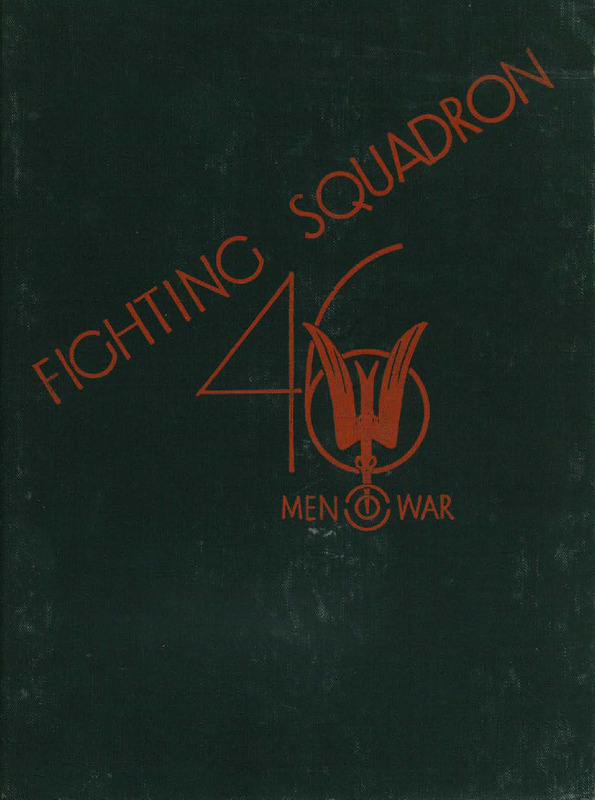
Preface: This history is dedicated to the Fighter Pilots of VF 46 with my admiration, respect and affection. It is a narrative of the Squadron from its inception to the end of its first and last carrier combat tour of duty. Opportunities of splashing large numbers of enemy planes in "Turkey Shoots", enjoyed by some of our contemporary Air Groups, simply did not present themselves to 46. Any AGC will concede there is a great deal of luck in being assigned to Strikes or CAP where the hunting was good. We were not lucky in our assignments. Every opportunity to inflict damage on the enemy, however, was capitalized, thus contributing to their ultimate defeat in some of the most important actions of the war...
Foreword: This history of how brave men fought and won has been compiled from all available sources. Testimony of many members of the Regiment, official reports, personal observations of the several contributors to this story, and personnel and award files are the most important of these sources. The history is a narrative of several thousands of men who were brought together in a common cause. It is an attempt to tell where these men went, what they did, and how they lived. It does not attempt to gloss over failures nor to exaggerate the many successful actions. To the best of our knowledge, it is a simple, straightforward story of what actually occurred, with no coloring, padding, nor superlative. The history was written for the most part during combat. Its greatest failure is obviously that it does not mention many, many men who fought with courage and distinction through all or most of the campaigns. We have suffered in knowing that we could not speak of every man who contributed to the record of the 120th Infantry ... We hope that this work in some measure may recall the rugged but heroic days, the rough but ready comradeship, of the memorable months when the Regiment was in combat in the European Theater of Operations. If the purpose of this book were to tell the history of the I 20th Infantry in detail from its origin, one might devote the entire volume, and many more besides, dealing with the fascinating story of its part in the Revolutionary, the Mexican, and the First World Wars. But since this work is of limited scope, the story of the 120th must deal almost entirely with its combat record in World War II.
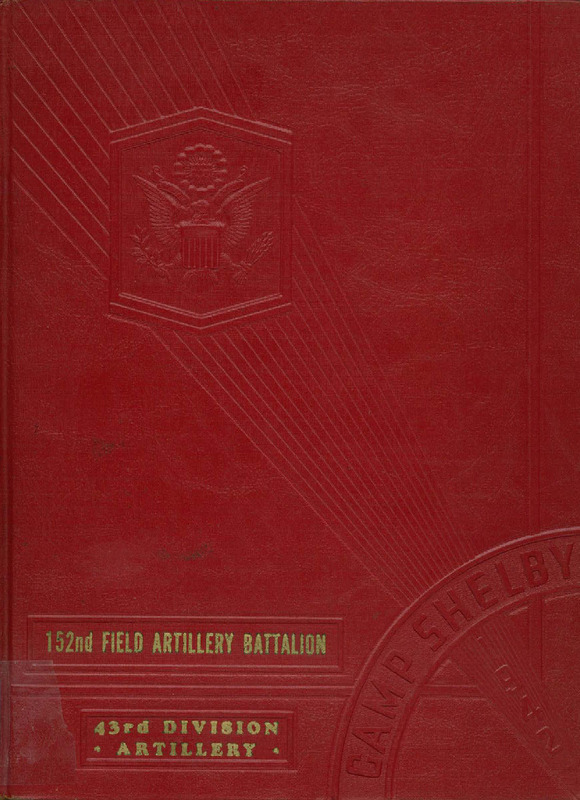
History of the 43rd Infantry Division: With the decision, following the World War, to organize two National Guard Divisions in each of the nine Corps Areas the 43rd Division came into being. Inasmuch as many of the units of the Division had formerly been a part of the famous wartime "Yankee" Division (26th), they were allowed to keep their World War designations, with the result that the Division has within it units that have histories covering every war in which the nation has participated. The combined histories of the units of the 43rd reads like a roll of honor of history of America, and the battle streamers amassed by these units reveal the farflung engagements in which men of the New England States have been called upon to defend their country's interests.
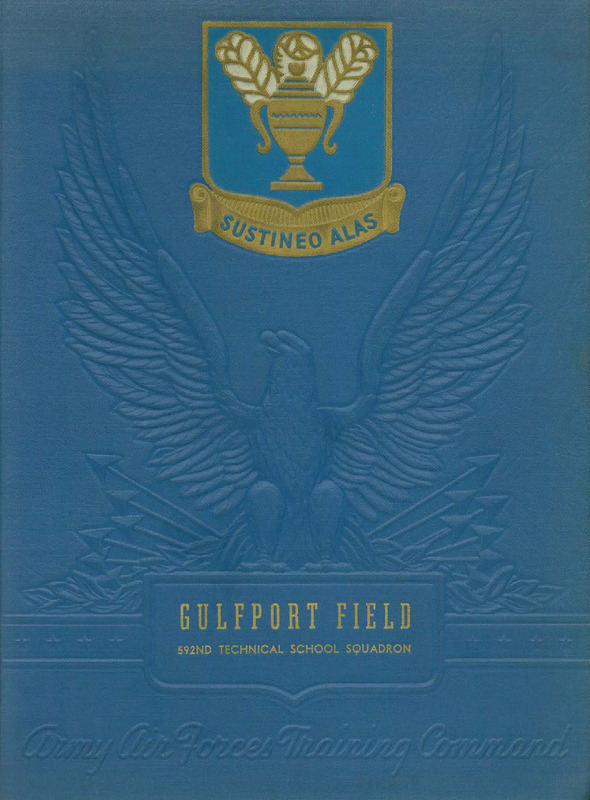
Basic Training Center No. 11 was activated at Gulfport Field on July 14, 1943. The center was in full operation by the time it was formally established. Raw recruits were being received in a steady flow from reception centers. The Basic Training Center takes the recruits, lectures them on military customs and courtesy, on basic military principles and rules. These men are taught to drill. They become soldiers. During his stay in the Basic Training Center, every phase of the recruit's civilian life is studied. His education, his civilian background, his aptitude for specific types of work-all are closely examined. His military classification is then determined after a study of these factors and in almost every instance the recruit's preference coincides with the scientific determination of his abilities. Gulfport Field is located along the coastal plain of the Gulf of Mexico. Here, beneath the semi-tropical sun of one of the nation's most famous resort areas, students and permanent party men alike divide their time with duty, recreation and physical training. Men who guide the destiny of Gulfport Field realize that soundness of body is essential to an alert, active life. Drill and calisthenics keep muscles toned and provide a refreshing change from the long hours of duty.
On July 4, 1944, Headquarters Battery, Eighth Division Artillery--properly known as the artillery "nerve center" moved out of crowded landing craft and began the long climb up the hill at Omaha beach and then along the dusty Normandy roads that led to combat. Marching inland, the battery took up a position near the village of La Haye du Puits, prior to jumping off in a Seventh Corps attack. Here men and officers got their first taste of combat as German guns--88s and bigger--began almost immediately to drop into the battery area, inflicting several casualties. Nonetheless, the battery proceeded with its duties--chiefly those of maintaining wire and radio communication--and played an instrumental role in the Eighth Division's seizure of immediate objectives. When the First Army's attempt to break out of the Normandy Peninsula (the attack began July 26) proved successful, the battery moved with considerable speed, following in the wake of the Fourth Armored Division's rapid advance. Along the road that led to Rennes, a sizeable Breton city, the battery got its first real taste of Jerry strafing when a flight of ME-109s chewed up the highway with machine guns and cannon and added considerably to our roster of Purple Hearts. Rennes fell. We rested, discovered cidre, tried our luck with the French language, then moved to the outskirts of Brest and played our vital part in the reduction of that large port.
It is with pride and emotion that I indorse this story of the Transportation Corps in the European Theater of Operations. This story is your story: it is the story of your aching muscles, long and arduous hours of unsung labor, and your devotion to duty. It is the story of the unsung stevedore working in the holds and on the quay sides. It is the story of the weary truck driver with his load of precious cargo moving to the front along strange roads with lights blacked out. It is the story of the duck driver, ferrying vital supplies amid mine-infested waters. It is the story of train and engine crews moving over unknown paths to strange destinations with that same spirit of American railroad man has shown for generations. It is the story of the weary but alert dispatcher, humble section hand, switchman, and dispatch rider, each doing a vital part. It is the story of the back shop, round house and harbor craft crews; grimy, faithful, essential. It is the story of the tug boat crews in strange and dangerous waters, and the story of the RTO at outlying dumps, control points, and stations. It is the story of men and women working long and arduous hours at desks throughout the Theater. In short, it is your story; it is a tribute to you, and you may well take pride in it.--Frank S. Ross, Major General, U.S. Army, Chief of Transportation
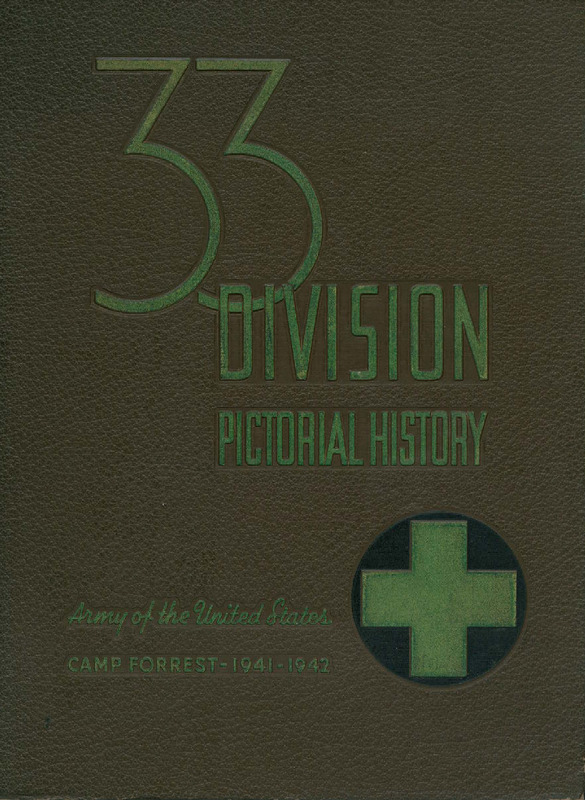
Publisher's Acknowledgment: When this book reaches you and you and you, the men of the 33rd will be here and there--and "over there." Officers and men will have taken their places with different units to create new Divisions--to form the nucleus of new fighting units. Some of the Commanding Officers and many officers of the staff and line and enlisted men will have taken up their new posts. But wherever they are they will carry on the great tradition of the 33rd Division--the old Prairie Division that brought glory and fame to Illinois in every engagement in which the men of Illinois were engaged. The Editors and Publishers of the Army Press desire to express their appreciation to the Division Commander, Major General Samuel T. Lawton, the Chief of Staff, Colonel H. E. Thornton, the Division Historian, Lt. Colonel Julius Klein, and to every officer and enlisted man in the 33rd Division who has helped to make this permanent record of the 33rd possible. Without their help and guidance, and without the cooperation on research and editorial material by the Division Historical section, this book would not have been possible.
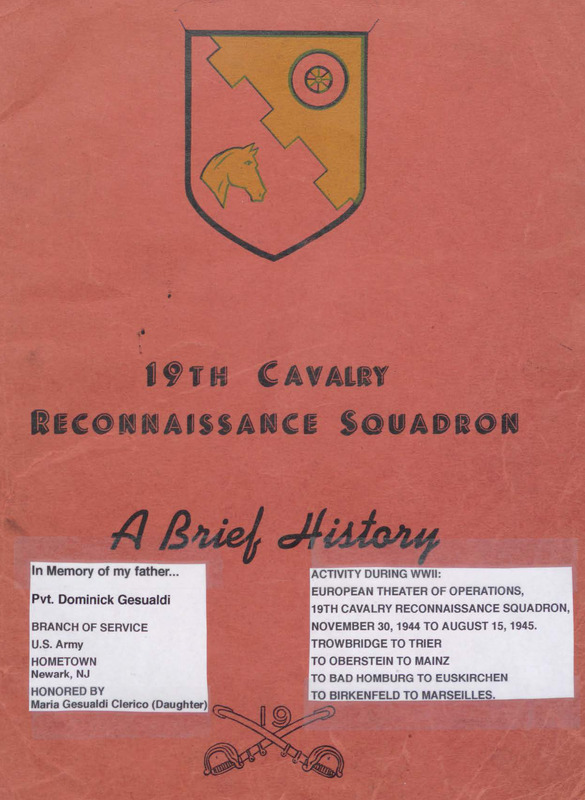
Sample paragraph: The 19th, under command of Lt. Col. George W. Busbey (class of West Point, 1924), moved to Saco, Maine, with the mission of patrolling the long and irregular coast of Maine from the Canadian border to New Hampshire. Col. Busbey, former instructor at the Cavalry School, Fort Riley, Kansas, had been executive officer of the 16th Regiment. He was distinguished by a pair of waxed handlebar moustaches which gave him the nickname of "Handlebar Hank" on Tennessee maneuvers, but later, in the 19th, he was generally known among the men as "Uncle George."