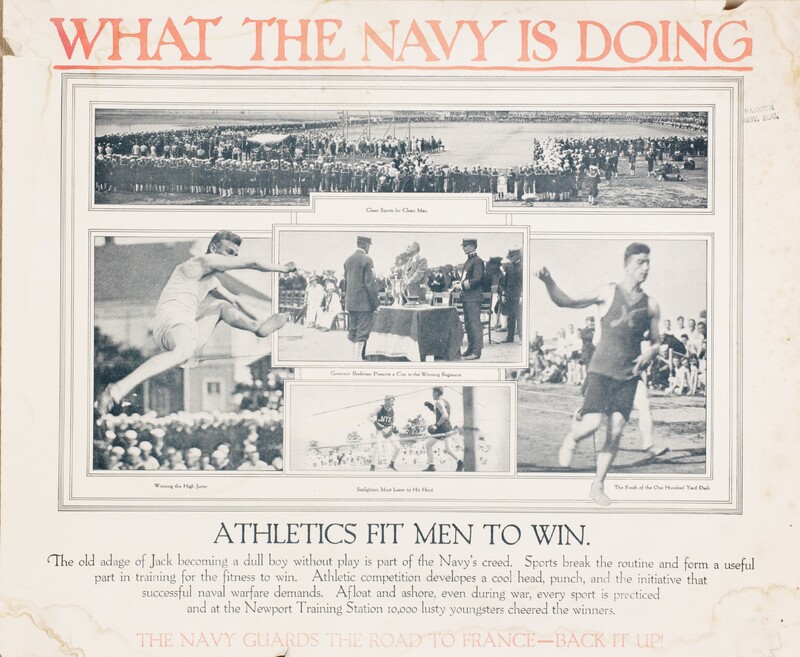
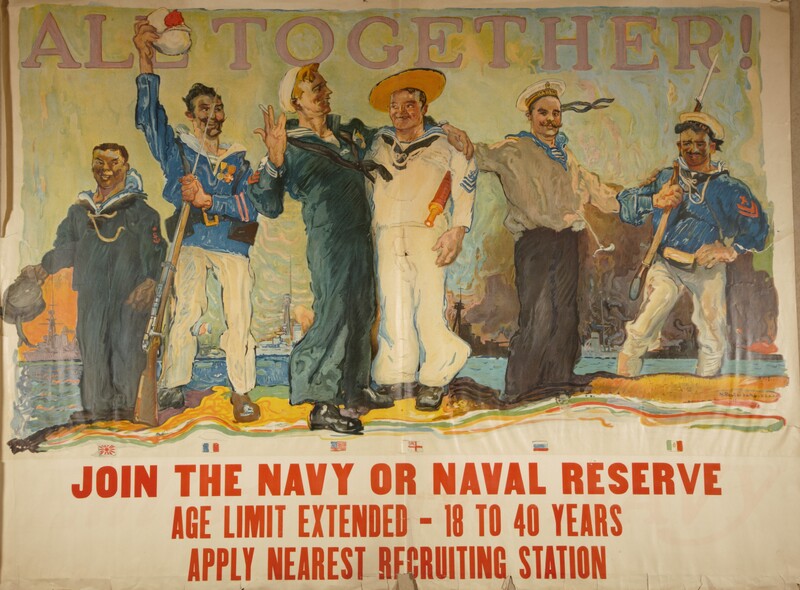
The old adage of Jack becoming a dull boy without play is is part of the Navy's creed. Sports break the routine and form a useful part in training for the fitness to win. Athletic competition developes a cool head, punch, and the initiative that successful naval warfare demands. Afloat and ashore, even during war, every sport is precticed and at the Newport Training Station 10,000 lusty youngsters cheered the winners. The Navy guards the road to France--Back it up!
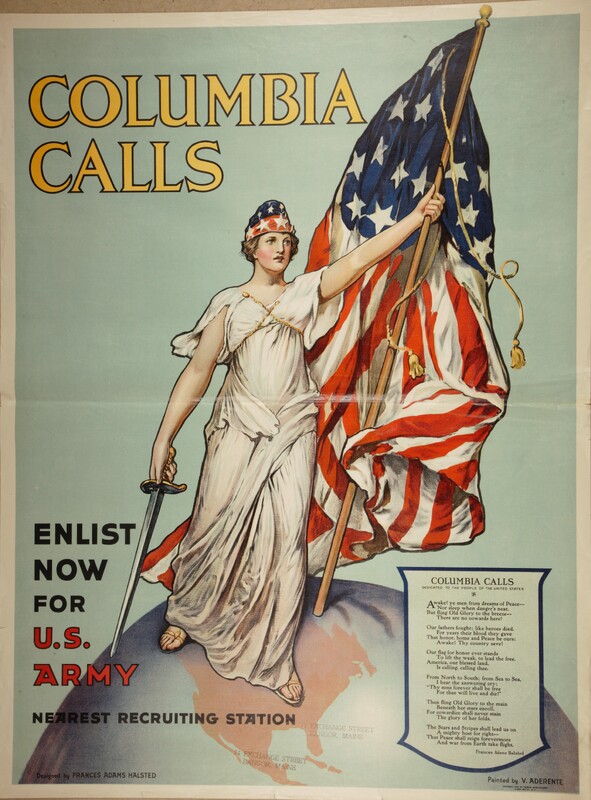
Enlist now for U.S. Army. Nearest Recruiting Station. Columbia Calls, dedicated to the people of the United States. Awake! wake! ye men from dreams of Peace--Nor sleep when danger's near, But fling Old Glory to the breeze--There are no cowards here! Our fathers fought; like heroes died. For years their blood they gave That honor, home and Peace be ours: Awake! Thy country save! Our flag for honor ever stands To lift the weak, to lead the free. America, our blessed land, Is calling, calling thee. From North to South; from Sea to Sea, I hear the answering cry: "Thy sons forever shall be free For thee will live and die!" Then fling Old Glory to the main Beneath her stars enroll. For cowardice shall never stain The glory of her folds. The Stars and Stripes shall lead us on A mighty host for right--That Peace shall reign forevermore And war from Earth take flight.
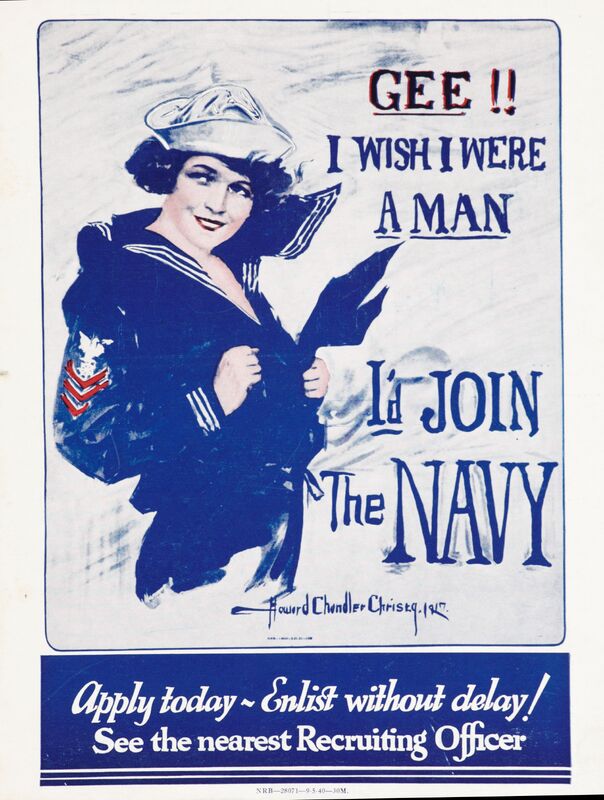
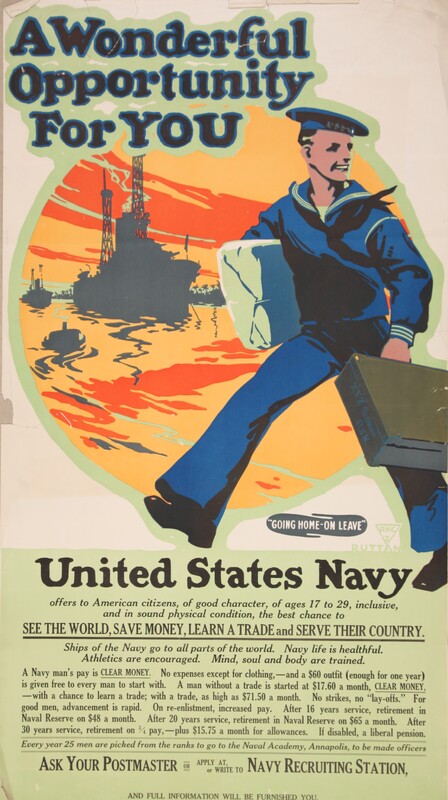
United States Navy offers to American citizens, of good character, of ages 17 to 29, inclusive, and in sound physical condition, the best chance to see the world, save money, learn a trade, and serve their country. Ships of the Navy go to all parts of the world. Navy life is healthful. Athletics are encouraged. Mind, soul and body are trained. A Navy man's pay is clear money. No expenses except for clothing, and a $60 outfit (enough for one year) is given free to every man to start with. A man without a trade is started at $17.60 a month, clear money,--with a chance to learn a trade; with a trade, as high as $71.50 a month. No strikes, no "lay-offs." For good men, advancement is rapid. On re-enlistment, increased pay. After 16 years service, retirement in Naval Reserve on $48 a month. After 20 years service, retirement in Naval Reserve on $65 a month. After 30 years service, retirement on 3/4 pay,--plus $15.75 a month for allowances. If disabled, a liberal pension. Every year 25 men are picked from the ranks to go to the Naval Academy, Annapolis, to be made officers. Ask your postmaster or apply at, or write to Navy Recruiting Station, and full information will be furnished you.
This book, placed in the Bangor Public Library as a memorial by the City of Bangor, contains the names of the one hundred and thirteen Bangor men who died for victory in World War II. It contains the photographs and biographies of one hundred and ten of these men. A page of the book is turned each day.
Broadcast to the Nation, 9 December 1941: The true goal we seek is far above and beyond the ugly field of battle. When we resort to force, as now we must, we are determined that this force shall be directed toward the ultimate good as well as against immediate evil. We Americans are not destroyers--we are builders. We are now in the midst of a war, not For conquest, not for vengeance, but for a world in which this nation, and all that this nation represents, will be safe for our children. So, we are going to win the war and we are going to win the peace that follows. And in the difficult hours of this day--and through dark days thal may be yet to come--we will know that the vast majority of the members of the human race are on our side. For, in representing our cause, we represent theirs as well--our hope and their hope for liberty under God.
13 May 1940, his first address to the House of Commons after assuming office to conduct the war: I have nothing to offer but blood, toil, tears, and sweat. We have before us an ordeal of the most grievous kind. We have before us many, many long months of struggle and of suffering. You ask, What is our policy? I will say: "It is to wage war, by sea, land and air, with all our might and with all the strength that God can give us; to wage war against a monstrous tyranny, never surpassed in the dark, lamentable catalogue of human crime. That is our policy." You ask, What is our aim? I can answer in one word: Victory--victory at all costs, victory in spite of all terror, victory however long and hard the road may be; for without victory there is no survival. Let that be realized; no survival for the urge and impulse of the ages, that mankind will move torwards its goal. But take I up my task with buoyancy and hope. I feel sure that our cause will not be suffered to fail among men. At this time I feel entitled to claim the aid of all, and I say, "Come, then, let us go forward together with our united strength."
Of the military cemetery at Gettysburg, Pennsylvania 19 November 1863: Fourscore and seven years ago our fathers brought forth on this continent a new nation, conceived in liberty and dedicated to the proposition that all men are created equal. Now we are engaged in a great civil war, testing whether that nation, or any nation so conceived and so dedicated, can long endure. We are met on a great battlefield of that war. We have come to dedicate a portion of that field as a final resting place for those who here gave their lives that that nation might live. It is altogether fitting and proper that we should do this. But, in a larger sense, we cannot dedicate, we cannot consecrate, we cannot hallow this ground. The brave men, living and dead, who struggled here have consecrated it far above our poor power to add or detract. The world will little note, nor long remember, what we say here; but it can never forget what they did here. It is for us, the living, rather to be dedicated here to the unfinished work which they who fought here have thus far so nobly advanced. It is rather for us to be here dedicated to the great task remaining before us, that from these honored dead we take increased devotion to that cause for which they gave the last full measure of devotion; that we here highly resolve that these dead shall not have died in vain; that this nation, under God, shall have a new birth of freedom; and that the government of the people, by the people, for the people, shall not perish from the earth.
Inscription in the Memorial Church, Harvard University, Cabridge, Massachusetts: While a bright future beckoned, they freely gave their lives and fondest hopes for us and our allies, that we might learn from them courage in peace to spend our lives making a better world for others.
Commissioned October, 1944 by the City Council of the City of Bangor, Maine. Henry C. Knowlton, Chairman with the advice of Horace S. Estey, City Manager. Compiled by the Librarian and Staff of the Bangor Public Library. Written by L. Felix Ranlett, Librarian. Engrossed by Irving Bookstein, Boston, Massachusetts. Bound by Frederick W. Young, Harcourt Bindery, Boston, Massachusetts. Photographic copying by Preston M. Williams, Bangor, Maine and Cooper Studio of Photography, Boston, Massachusetts. Finished March, 1947.
Chairman Edward N. Hurley cables: "We want you and the boys in the trenches to know that the men in the yards are going the limit to provide in record-breaking time the ships that will carry more Men, Food and Munitions to the intrepid American Expeditionary Forces." General Pershing replies: "The launching of nearly 100 ships on the Fourth of July is the most inspiring news that has come to us All ranks of the Army in France send their congratulations and heart-felt thanks to their patriotic brothers in the shipyards at home. No more defiant answer could be given to the enemy's challenge. With such backing we cannot fail to win. All hail, American Ship-Builders!"
"... The wrong done to France by Prussia in 1871 in the matter of Alsace-Lorraine, which has unsettled the peace of the world for nearly fifty years should be righted, in order that peace may once more be made secure in the interest of all."