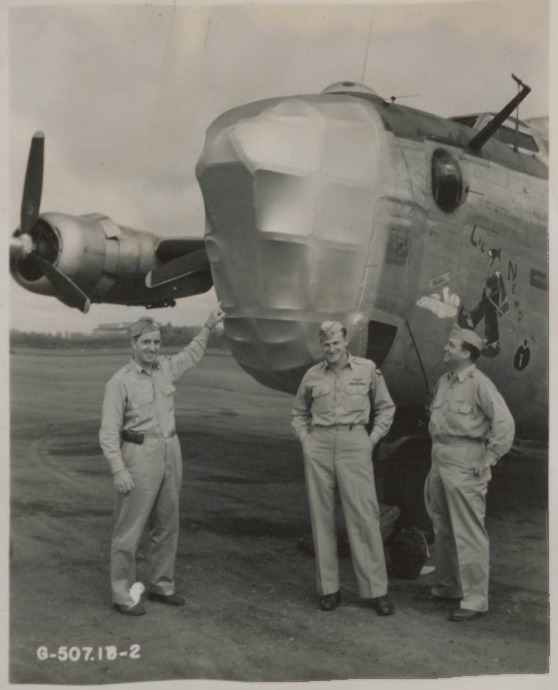
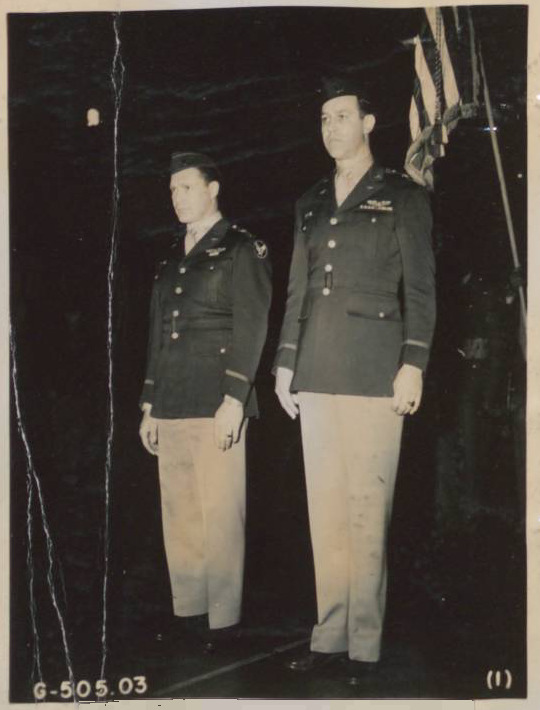
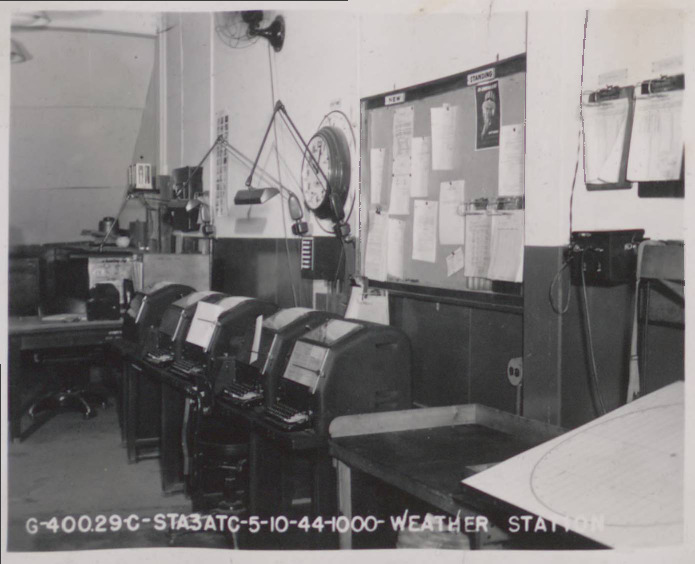
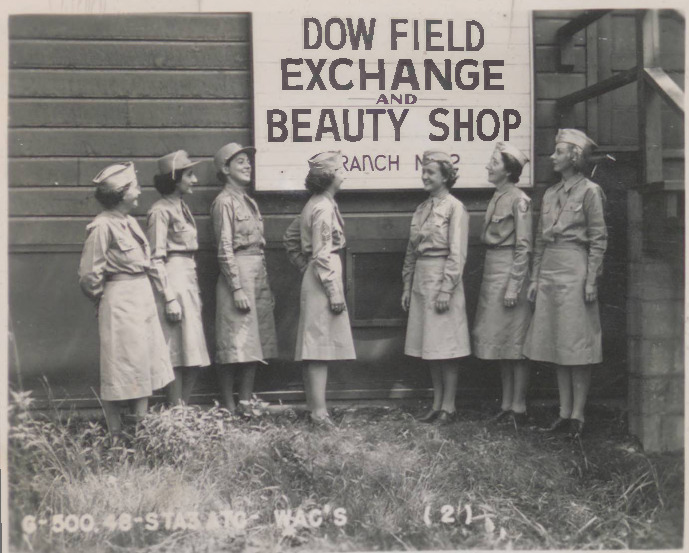
Photographs, drawings, and pamphlets compiled by First Lieutenant Annis G. Thompson for the 43rd Bombardment Group. The photographs document far-ranging movements and locations, especially in the Pacific, and include many close-ups of airplane nose art. The drawings appear to be primarily by W. Clark Gamble, including his rendition of the Battle of the Bismarck Sea.
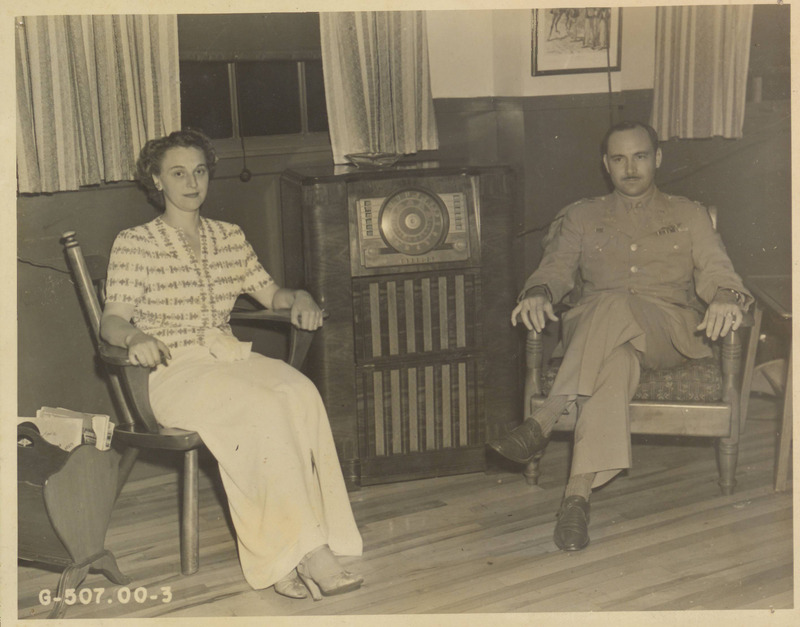
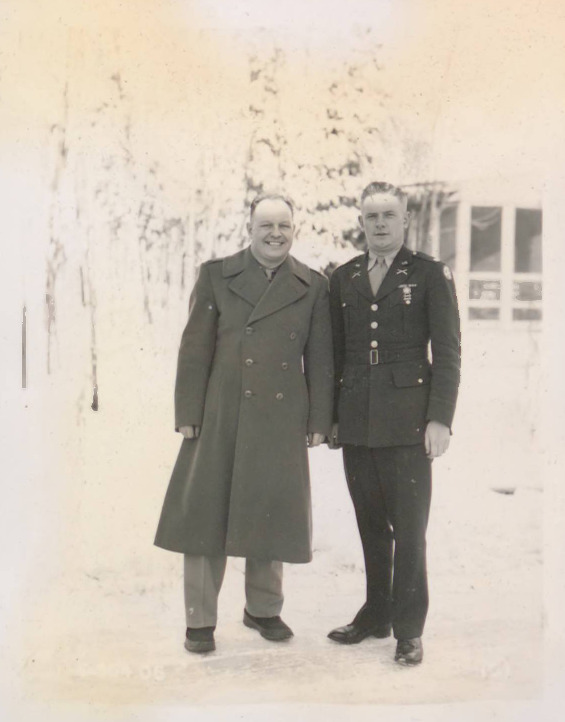
Photographs of soldiers and officers from the 43rd Bombardment Group and the 1379th AAF at Dow Field in Bangor, Maine. The photographs show military exercises on the base, leisure activities on and off the base, and an open house held for the public.
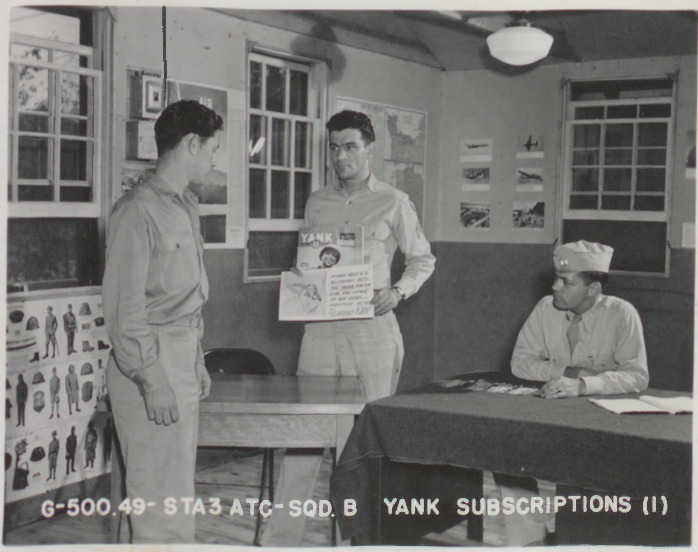
Photographs of soldiers at the train station in Bangor, office activities, parties, religious ceremonies, a few views of soldiers serving as firefighters in Bangor, soldiers and family members on a ski trip, and more.
Photographs of soldiers and families at leisure spots around Maine, a few photographs of the Flying Torah, two dozen photographs of base members visiting the Lac-Beauport area in Quebec, several weddings at the base, sled dogs on a military plane, and more.
Photographs of soldiers from Dow Field serving as firefighters on Exchange Street in downtown Bangor in January 1945, music performed for patients at the base hospital, airplane nose art, the Flying Torah, an open house at Dow Field in which the public was shown a display of paratroopers in action, Maine lake leisure activities, and more.
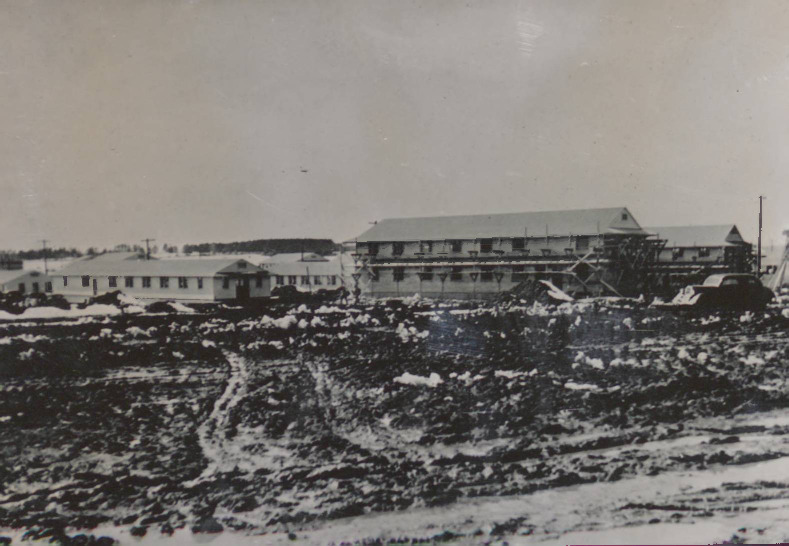
Photographs of various construction projects, airplane nose art, aerial photographs of planes on the ground at Dow Field, several parties and drills (including office work being performed while wearing gas masks), scenes of coastal Maine, and a December 1944 snowstorm.
Predominantly photographs of leisure activities around the base, near Mt. Kineo, Bucksport, and elsewhere across Maine. Near the end, a few dozen photos show training at Dow Field in September and October of 1944. The last few images are group pictures of service members in 1944.
Features a series of photographs of Army patrols in the Southwest Harbor, Bar Harbor, and other Acadia areas. Army Patrol Boat P-359 is among the boats included.
Dear Newcomer: It is a pleasure to welcome you to Dow Air Force Base and the State of Maine. You will find the base a beautiful installation and the community a friendly place in which to live and work. We are a part of the Strategic Air Command whose strength and deterrent posture is known throughout the world. Our success depends upon you; we can remain alert and strong only through your dedicated and energetic efforts. we know you will be proud to be a part of the Dow community and we invite you to join in the cordial relationship between the base and the cities of Bangor and Brewer. This guide will acquaint you with the facilities and services at Dow and in the State of Maine. Again, welcome on behalf of all the personnel presently enjoying their stay at Dow.--George W. R. Zethren, Colonel, USAF Commander
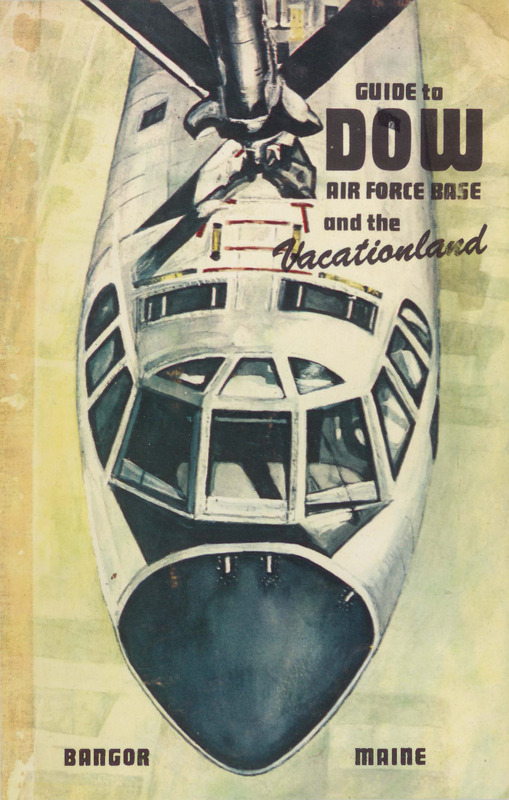
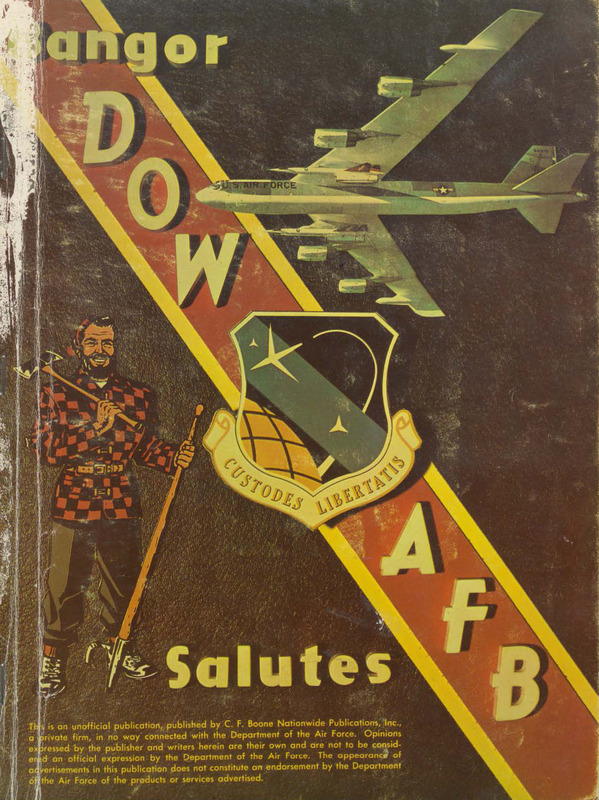
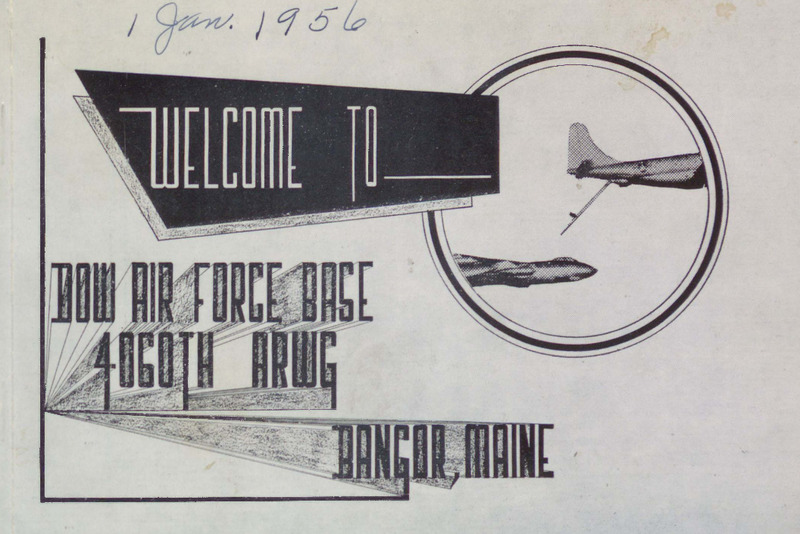
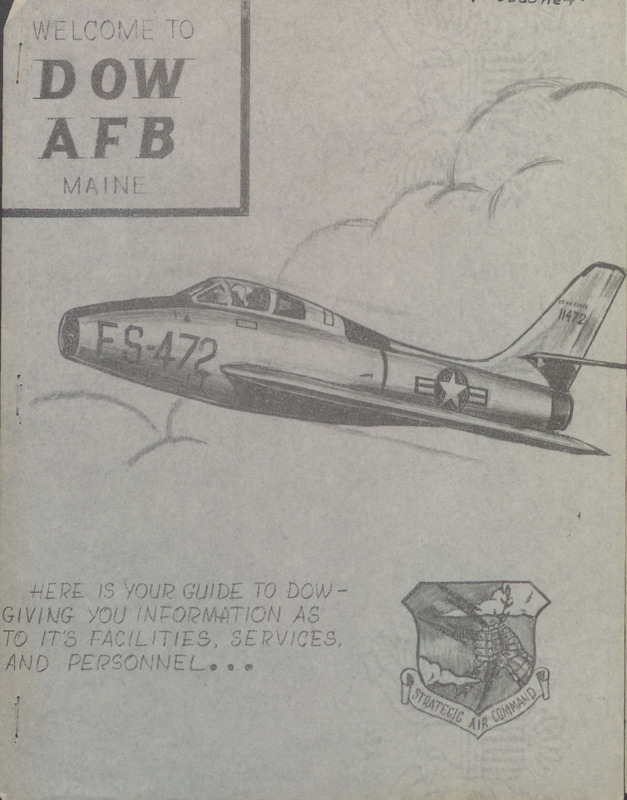
Welcome to Dow Air Force Base. In its role as a Strategic Air Command heavy bomber base, Dow is one of the most vital and historic installations in the United States Air Force. Dow is located in the suburbs of Bangor, Maine and as such, is one of the eastern-most bases in the Continental United States. Because of the fact that a permanent change of station is most often a strange and confusing experience, probably the most important questions you have now are those concerning facilities that are available at Dow, the local community, the people with whom you will work and the machinery at your disposal to help minimize "settling in" problems. We hope the information contained in this guide will answer most of your questions and that you will find Dow and the city of Bangor a friendly community and that you will enjoy your tour here.
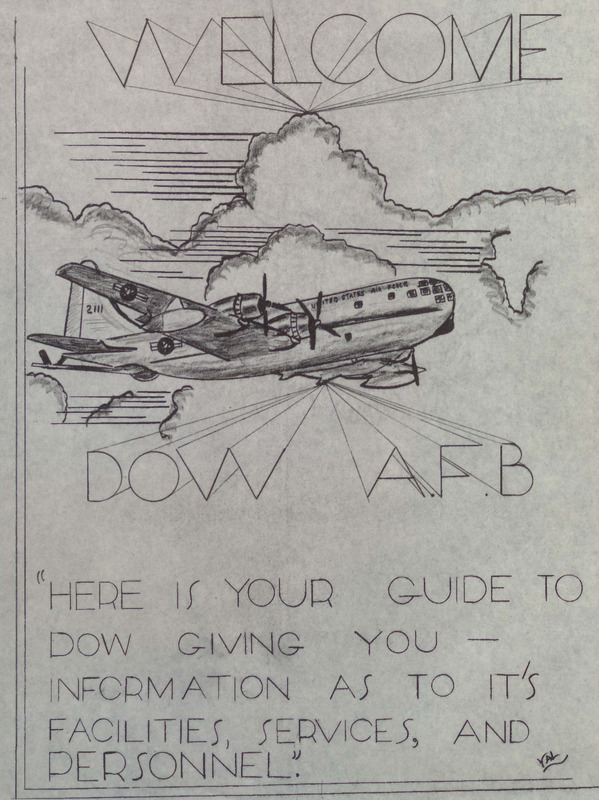
Introduction to Dow: This booklet has been designed to help you become acquainted with your new station. It covers where to go and who to see for information pertaining to your on and off duty hours. The back portion of the booklet, titled Community Resources Section, includes a wealth of information on the educational and recreational facilities available in the the greater part of Maine.
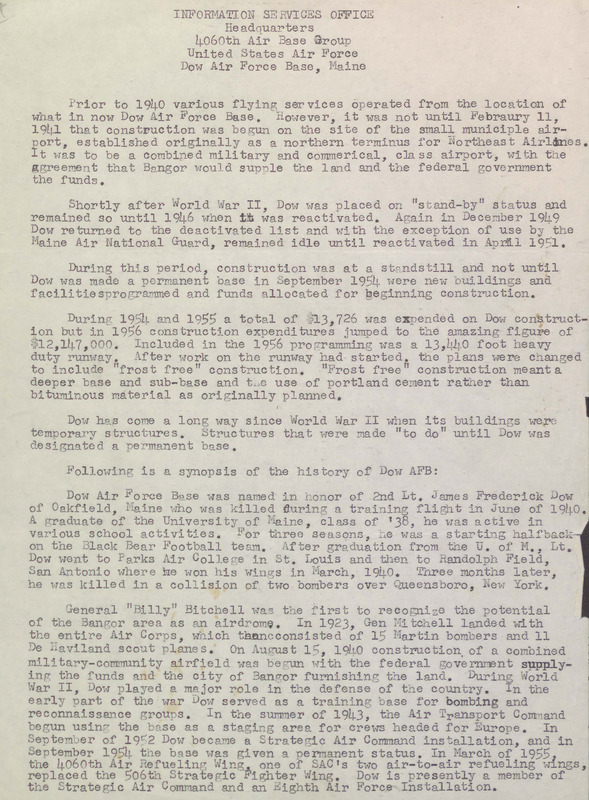
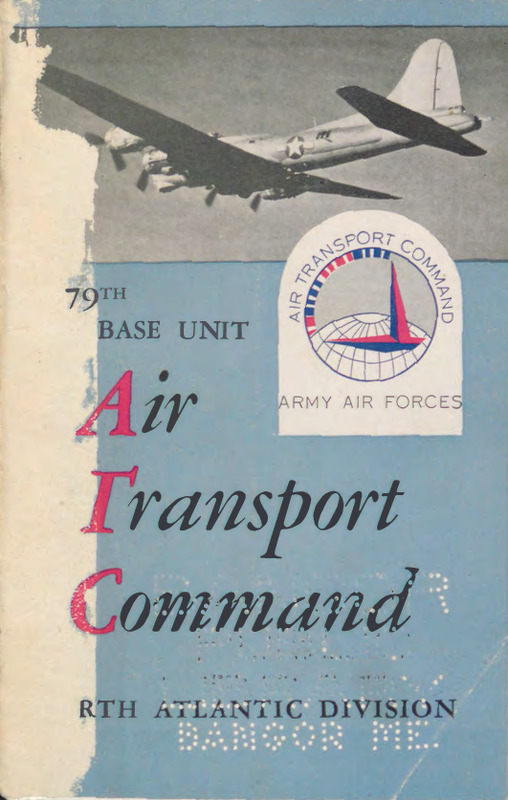
On August 15, 1940 construction of a combined military-community airfield was begun with the federal government supplying the funds and the city of Bangor furnishing the land. During World War II, Dow played a major role in the defense of the country. In the early part of the war Dow served as a training base for bombing and reconnaissance groups. In the summer of 1943, the Air Transport Command begun using the base as a staging area for crews headed for Europe. In September of 1952 Dow became a Strategic Air Command installation, and in September 1954 the base was given a permanent status. In March of 1955, the 4060th Air Refueling Wing, one of SAC's two air-to-air refueling wings, replaced the 506th Strategic Fighter Wing. Dow is presently a member of the Strategic Air Command and an Eighth Air Force Installation.
This brochure is presented as a reference to certain information, services, and facilities which may prove useful during your stay. All personnel are at your disposal for any assistance necessary to accomplish the purpose of your visit.--Orie O. Schurter, Colonel, USAF Commander
Outline and research notes for a speech on the subject "Dow Air Force Base and the Community." Includes: History (1923-1945); History (1946-1955); Stategic Location and Utilization; Mission; Economy--Decentralization Program.
This brochure is presented as a reference to certain information, services, and facilities which may prove useful during your stay. Our mission is to organize and train a force capable of providing adequate protection for Strategic Air Command bombardment and reconnaissance combat elements through escort and air defense, organize and conduct air-to-air refueling operations, provide for low level photographic reconnaissance, organize and train a force capable of destroying the forces, resources, and installations of an enemy, be prepared to implement established operations orders, participate in reserve training, and perform special missions as directed by higher headquarters. All personnel are at your disposal for any assistance necessary to accomplish the purpose of your visit.--Richard O. Hunziker, Colonel, USAF Commander
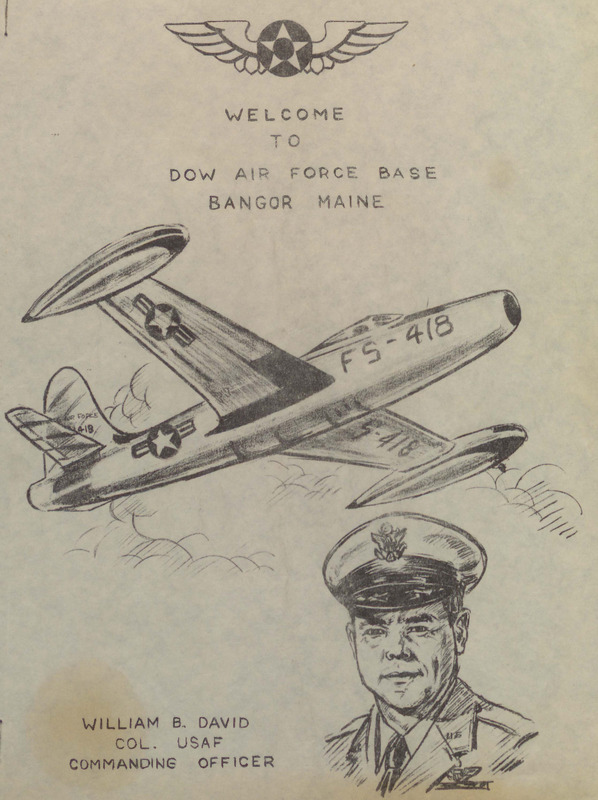
A Message from Your Commanding Officer: I welcome you to Dow Air Force Base and sincerely hope that your tour with us will be a pleasant one. My desire is to make your duty and off duty time as pleasant as possible. I urge each member of the military service regardless of rank to take advantage of the opportunities described in this booklet. The airman who takes advantage of the environmental surroundings of Maine will find himself well rewarded. As your commander I urge you to participate wholeheartedly in the base activities as it is a direct means for raising your efficiency, morale, and the development of better airmen and future citizens.--William B. David, Colonel USAF Commanding
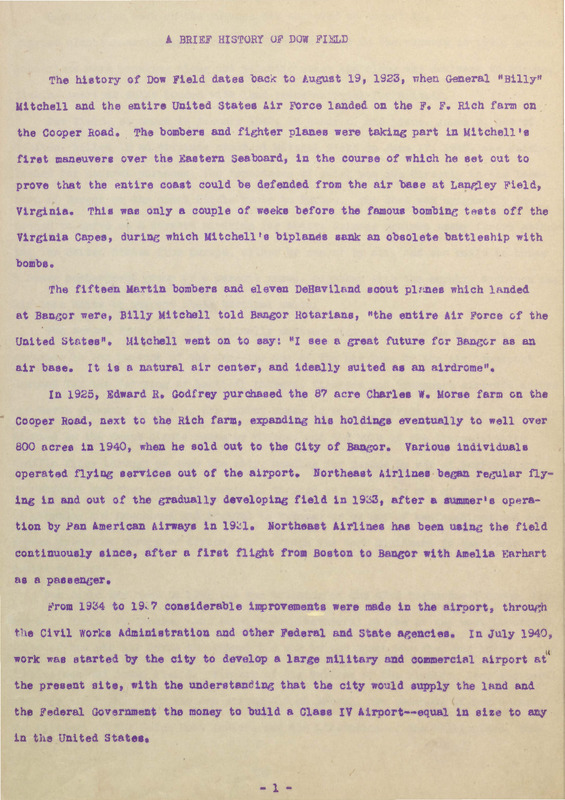
The history of Dow Field dates back to August 19, 1923, when General "Billy" Mitchell and the entire United States Air Force landed on the F. F. Rich farm on the Cooper Road. The bombers and fighter planes were taking part in Mitchell's first maneuvers over the Eastern Seaboard, in the course of which he set out to prove that the entire coast could be defended from the air base at Langley Field, Virginia. This was only a couple of weeks before the famous bombing tests off the Virginia Capes, during which Mitchell's biplanes sank an obsolete battleship with bombs. The fifteen Martin bombers and eleven DeHaviland scout planes which landed at Bangor were, Billy Mitchell told Bangor Rotarians, "the entire Air Force of the United States". Mitchell went on to say: "I see a great future for Bangor as an air base. It is a natural air center, and ideally suited as an airdrome".
Dow Field, formerly called the Bangor Air Base, dates back to February 11, 1941, when construction began on the site of a small municipal airport, established originally as a northern terminus for Northeast Airlines. Most of the construction was completed during the summer and fall of 1941. Numerous buildings for barracks, storage, hangars and hospitals, were erected on what was formerly a low, swampy area. Extensive filling and seeding have produced an attractive area of well-kept lawns and fields, landscaped with thousands of trees typical of the local scene. In 1941 and 1942, Dow Field was used mainly as a training base for bombing and reconnaissance groups, and as a training base for an aviation engineering regiment. One large bombardment group from Dow Field sailed on the maiden voyage of the Queen Mary as a troop ship pilots flew their own planes, of course but the large ground echelon went by boat.
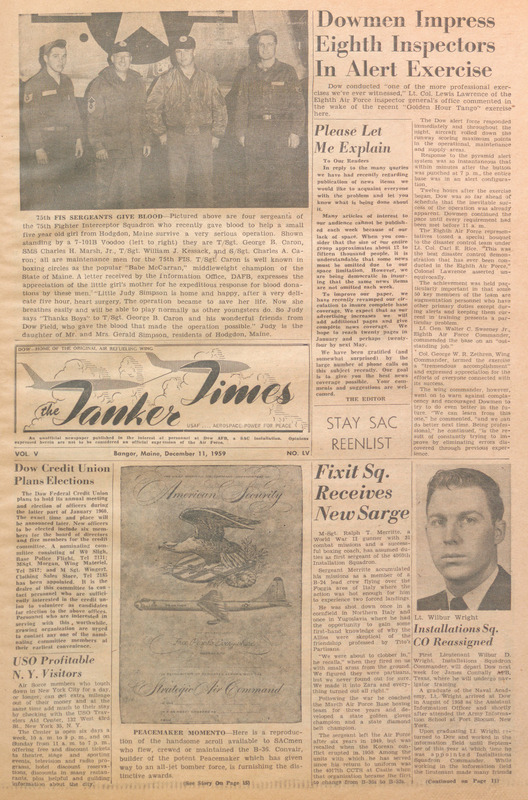
Pictured above are four sergeants of the 75th Fighter Interceptor Squadron who recently gave blood to help a small five year old girl from Hodgdon, Maine survive a very serious operation. Shown standing by a 7-101B Voodoo (left to right) they are T/Sgt. George B. Caron, SMS Charles H. Marsh, Jr., T/Sgt. William J. Kessack, and S/Sgt. Charles A. Caron; all are maintenance men for the 75th FIS. T/Sgt. Caron is well known in boxing circles as the popular "Babe McCarran," middleweight champion of the state of Mame. A letter received by the information Office, DAFB, expresses the appreciation of the little girl's mother for the expeditious response for blood donations by these men. "Little Judy Simpson is home and happy, after a very delicate five hour, heart surgery. The operation became to save her life. Now she breathes easily and will be able to play normally as other youngsters do. So Judy says "Thanks Boys" to T/Sgt. George B. Caron and his wonderful friends from Dow Field, who gave the blood that made the operation possible." Judy is the daughter of Mr. and Mrs. Gerald Simpson, residents of Hodgdon, Maine (photograph). -- Airman Second Class Larry L. Hoskinson 4060th Armament & Electronics Maintenance Squadron, has just returned to Dow after completing the Aircraft Electronics Navigation Equipment Technician (ARN-14) course held at Plattsburg AFB, New York (photograph). -- First Lieutenant Francis E. Brandon, Jr., is the Information Officer for the 75th Fighter Interceptor Squadron and will be this squadron's contact for news that one might like to have published in the Tanker Times (photograph).
A portrait of the late second Lt. James F. Dow, for whom this base was named, was unveiled at the Dow Officers Club Saturday night. Present for the cermonies were (left to right) Col. George W.R. Zethren, Wing Commander; Robert N. Haskell, who presented the painting on behalf of the Civilian Advisory Council; Mrs. David Cotton of Houlton, a sister of Lt. Dow; Mrs. Daryl W. Pelletier, another sister of Lt. Dow (photograph). . -- With the 75th FIS picking off the Blue League basketball title at the season's halfway point, our spotlight turns to the Tigers' playing coach, Lt. Marvin Long. A native of Salisbury, Maryland, Marv played his high school basketball there (photograph). -- S/SGT Art Ramalho contributes a column called the "Service Club Lowdown"
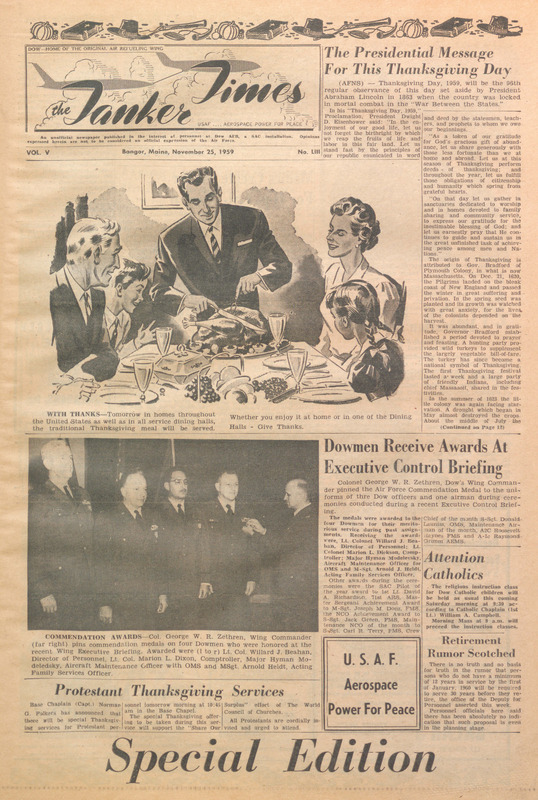
The face of Bangor's Paul Bunyan receives a touch up by Mr. J. Norman Martin of Tom Kane Advertising. The job was recently completed when city officials noticed that the paint had begun to chip and asked Dow to furnish a de-icer to use on the job. The OMS de-icer is operated here by TSgt. Robert E. Dlckens (photograph). -- Col. George W. R. Zethren, Wing Commander (far right) pins commendation medals on four Dowmen who were honored at the recent Wing Executive Briefing. Awarded were (left to right) Lt. Col. Willard J. Beahan, Director ot Personnel, Lt. Col. Marion L. Dixon, Comptroller, Major Hyman Mod ledsky, Aircraft Maintenance vfficer with OMS and MSgt. Arnold Heldt, Acting Family Services Officer (photograph). -- A view of the construction currently underway on the new school for the Capehart area. Just started, the school will be finished in time for Capehart youngsters to occupy next September at the start of the school year. The last of the Capehart housing units have been inspected, accepted and committed to the new occupants (photograph).
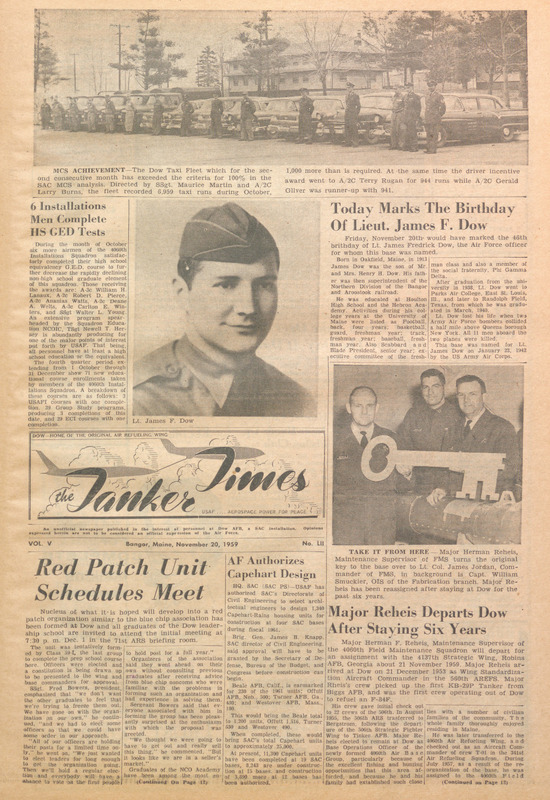
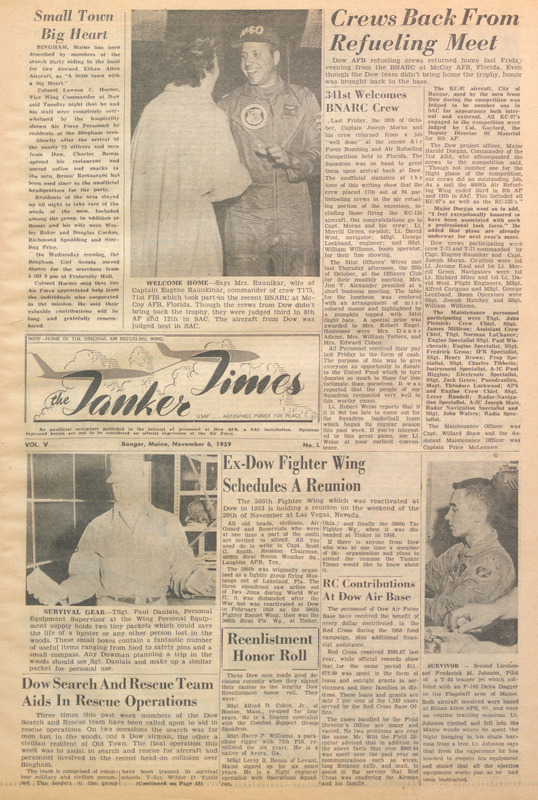
Friday, November 20th would have marked the 46th birthday of Lt. James Fredrick Dow, the Air Force officer for whom this base was named. Born in Oakfield, Maine, in 1913 James Dow was the son of Mr. and Mrs. Henry H. Dow. His father was then superintendent of the Northem Division of the Bangor and Aroostook railroad. Lt. Dow lost his life when two Army Air Force bombers collided a half mile above Queens borough. New York. All 11 men aboard the two planes were killed. This base was named for Lt. James Dow on January 23, 1942 by the US Army Air Corps (photograph of Lt. Dow). -- The Dow Taxi Fleet which for the second consecutive month has exceeded the criteria for 100% in the SAC MCS analysis. Directed by SSgt. Maurice Martin and A/2C Larry Burns, the fleet recorded 6,959 taxi runs during October, 1,000 more than is required. At the same time the driver incentive award went to A/2C Terry Rugan for 944 runs while A/2C Gerald Gllver was runner-up with 941 (pretty amazing photograph). -- Mrs. Betty M. Cabeen, wife of MSgt. Richard Cabeen, right, Boom Operator on a KC-97 aircraft of the 34lst ARS is checked out on the operation of the boom by her husband. This all occurred last Friday when the wives of the 341st took over their husbands' jobs for one afternoon to better understand their jobs as well as the SAC and AF mission (another great photograph).
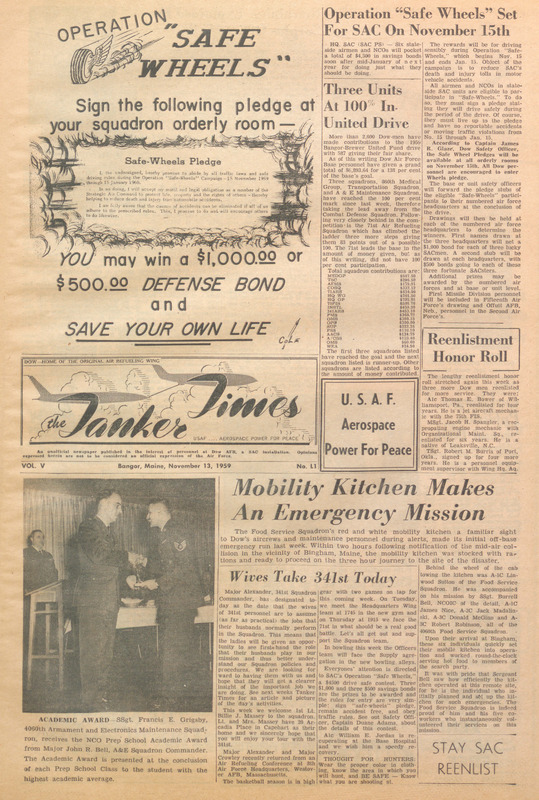
Members of the OJT Administrator Course which graduated last Friday. The classes are conducted by TSgt. Kenneth Balsley, OJT Adntinistrator Supervisor with ATC. A class is graduated every two weeks. Members of this class are (left to right) front row: TSgt. Balsley, instructor, A/1c Ronald Jodon, Kenneth Tauriainen, A/1c William Heffelfinger, SSgt. Joseph Dostie, SSgt. Kenneth Tate, Lt. Guy Bentivenga, presenting officer. Back row (left to right): SSgt. Wayne Jones, SSgt. Ronert McCarthy, TSgt. Archie Fairbrother, MSgt. Joseph Leonard, SSgt. Howard Heino, MSgt. Norbert Warren (photograph). -- A/2c Norman S. Saue selects correct aperture opening for his lens and determines proper focus prior to taking picture of a damaged aircraft part (photograph). -- A/2c Gene Comeau 4060th Transportation Squadron broke the ice for the squadron's hunters last week by bagging this 150 pound deer. He used a 30-30 rifle and downed his deer in Hampden Maine (photograph).