"Victory Book Campaign Opens Nation-Wide Tomorrow ... In anticipation of the Victory Book campaign to gather books for members of the armed forces, which begins tomorrow, a huge box has been placed just inside the entrance of the Bangor Public library. Fine new books have already begun to make their appearance in it ... Types of books wanted in the campaign are popular successes and Book of the Month Club and Literary Guild books issued since 1930; adventure, western detective and mystery stories; funny books, technical books issued since 1935; and books of pocket size of popular titles. Only books that will appeal to young men are wanted. They should be in good, clean, strong condition. Magazines, books from attics, or books discarded by libraries are not wanted. Merle R. Griffeth of Portland, president of the Maine Library association, is state director of the Victory Book campaign. He says, 'Give only books you would really like to keep. If you do that you will know you are giving good books.'" (Source: Bangor Daily News, January 4, 1943)
This book, placed in the Bangor Public Library as a memorial by the City of Bangor, contains the names of the one hundred and thirteen Bangor men who died for victory in World War II. It contains the photographs and biographies of one hundred and ten of these men. A page of the book is turned each day.
Broadcast to the Nation, 9 December 1941: The true goal we seek is far above and beyond the ugly field of battle. When we resort to force, as now we must, we are determined that this force shall be directed toward the ultimate good as well as against immediate evil. We Americans are not destroyers--we are builders. We are now in the midst of a war, not For conquest, not for vengeance, but for a world in which this nation, and all that this nation represents, will be safe for our children. So, we are going to win the war and we are going to win the peace that follows. And in the difficult hours of this day--and through dark days thal may be yet to come--we will know that the vast majority of the members of the human race are on our side. For, in representing our cause, we represent theirs as well--our hope and their hope for liberty under God.
13 May 1940, his first address to the House of Commons after assuming office to conduct the war: I have nothing to offer but blood, toil, tears, and sweat. We have before us an ordeal of the most grievous kind. We have before us many, many long months of struggle and of suffering. You ask, What is our policy? I will say: "It is to wage war, by sea, land and air, with all our might and with all the strength that God can give us; to wage war against a monstrous tyranny, never surpassed in the dark, lamentable catalogue of human crime. That is our policy." You ask, What is our aim? I can answer in one word: Victory--victory at all costs, victory in spite of all terror, victory however long and hard the road may be; for without victory there is no survival. Let that be realized; no survival for the urge and impulse of the ages, that mankind will move torwards its goal. But take I up my task with buoyancy and hope. I feel sure that our cause will not be suffered to fail among men. At this time I feel entitled to claim the aid of all, and I say, "Come, then, let us go forward together with our united strength."
Of the military cemetery at Gettysburg, Pennsylvania 19 November 1863: Fourscore and seven years ago our fathers brought forth on this continent a new nation, conceived in liberty and dedicated to the proposition that all men are created equal. Now we are engaged in a great civil war, testing whether that nation, or any nation so conceived and so dedicated, can long endure. We are met on a great battlefield of that war. We have come to dedicate a portion of that field as a final resting place for those who here gave their lives that that nation might live. It is altogether fitting and proper that we should do this. But, in a larger sense, we cannot dedicate, we cannot consecrate, we cannot hallow this ground. The brave men, living and dead, who struggled here have consecrated it far above our poor power to add or detract. The world will little note, nor long remember, what we say here; but it can never forget what they did here. It is for us, the living, rather to be dedicated here to the unfinished work which they who fought here have thus far so nobly advanced. It is rather for us to be here dedicated to the great task remaining before us, that from these honored dead we take increased devotion to that cause for which they gave the last full measure of devotion; that we here highly resolve that these dead shall not have died in vain; that this nation, under God, shall have a new birth of freedom; and that the government of the people, by the people, for the people, shall not perish from the earth.
Inscription in the Memorial Church, Harvard University, Cabridge, Massachusetts: While a bright future beckoned, they freely gave their lives and fondest hopes for us and our allies, that we might learn from them courage in peace to spend our lives making a better world for others.
Commissioned October, 1944 by the City Council of the City of Bangor, Maine. Henry C. Knowlton, Chairman with the advice of Horace S. Estey, City Manager. Compiled by the Librarian and Staff of the Bangor Public Library. Written by L. Felix Ranlett, Librarian. Engrossed by Irving Bookstein, Boston, Massachusetts. Bound by Frederick W. Young, Harcourt Bindery, Boston, Massachusetts. Photographic copying by Preston M. Williams, Bangor, Maine and Cooper Studio of Photography, Boston, Massachusetts. Finished March, 1947.
An outline history of Bangor by the late Raymond Fellows, one time Chief Justice of the Supreme Court of the State of Maine and President of the Bangor Historical Society, and by the the reference staff of the Bangor Public Library. Twenty-five still visible objects of historic interest. Twenty-five sites of historic objects no longer standing.
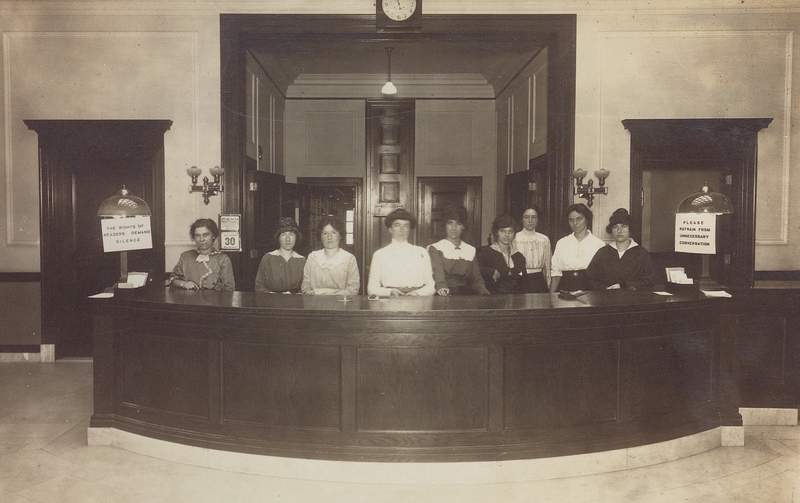
Many more pictures could and perhaps should have been taken to fully show all the varied and diverse activities that go on both in full view of the public and behind the scenes at the Bangor Public Library. However, I have tried to give the viewers of these photos a bird's-eye-view of some of the highlights of the activities carried out in their library. It is my hope that through these pictures the viewer will have a better understanding and appreciation of one of the community's prime sources of educational as well as recreational materials.
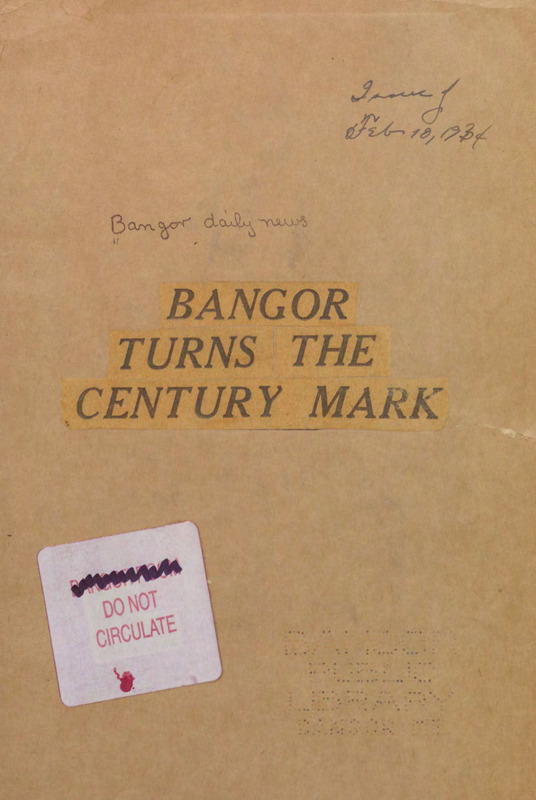
Facts, photographs, and anecdotes about Bangor's first century as a city, including reminiscences of several residents in their late nineties who witnessed Bangor grow from a small city to a logging industry metropolis.
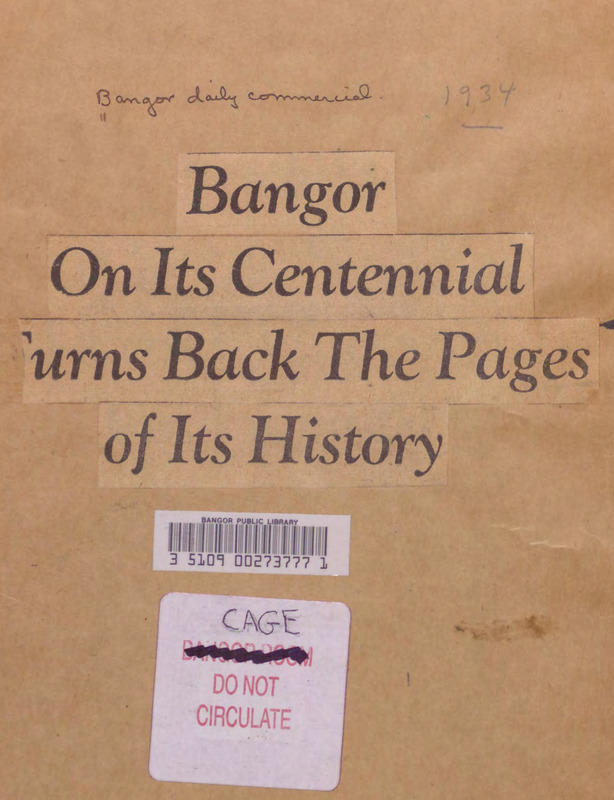
Scrapbook consisting of newspaper clippings from a February 1934 issue of the Bangor Daily Commercial commemorating the first 100 years of Bangor, Maine, as a city. Features many historical narratives and photographs of Bangor sites and citizens.
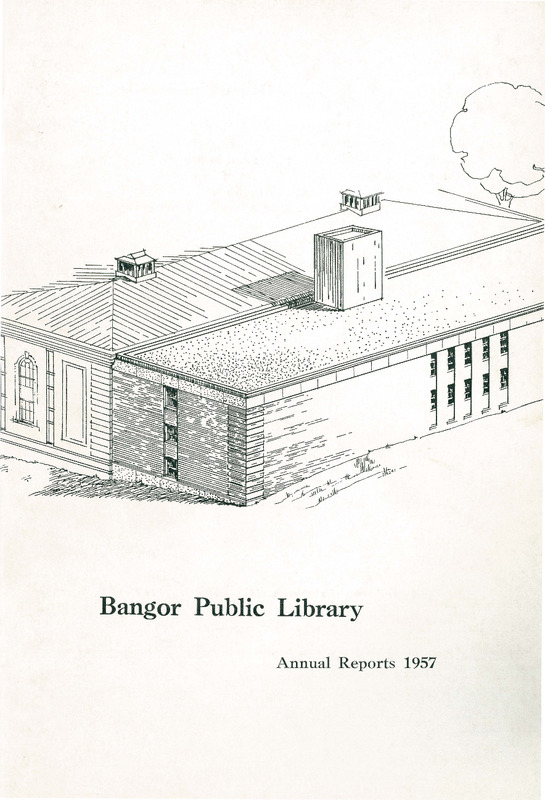
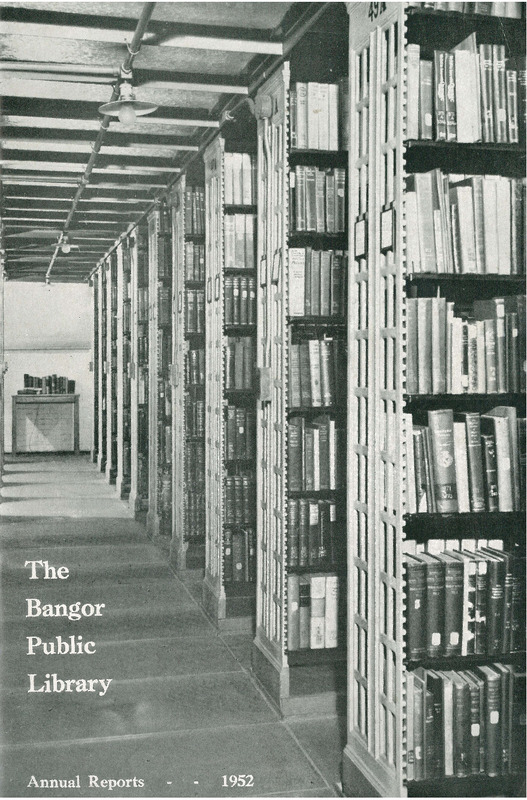
The long necessary book-storage addition to the library building was assured for 1958 by the unanimous action of the City Council on July 22, 1957 whereby was authorized a library bond issue of $100,000 and tax levy therefor...The addition will be a cube 100' x 30' x 30', with flat roof, directly at the rear of the present book-storage section of the library building. But three walls are required, as the fourth will be the rear wall of the present building. To save heat window area will be kept at a minimum. The new construction will provide one complete floor of shelving, at the level of the present main floor, with the necessary supporting columns below. The remaining floors of shelving, for which space is provided, may be added in later years as need requires and means permit. In the new building will be an automatic elevator, 3'6"'x4'8", to serve all levels of both buildings. There has never been any elevator in the present book-storage area of four floors. This has been a conspicuous lack.
It is gratifying to be able to report that the use of the library, as measured by the home use of books, increased 10% as compared with 1955. The total for 1956 was 322,642--for 1955, 292,553. The 1956 figure is the largest annual use in fourteen years. All departments–adult, children's, extension, music-shared in the increase. Obviously public interest, rather than any one thing that may have been done by the library other than meet the demand, is the explanation. The full use of clear plastic covers over the publishers' colorful book jackets may have whetted public interest. In two words, "improved packaging."...The supplying of home reading is far from being the only activity of the library. There is the reference department answering 12,329 questions--there is the job of giving out the Tello-Test answers 13,417 times--there are the book boxes supplied in 175 school rooms and 99 sets of encyclopedias in schools in Bangor. There are the 144 teaching units sent out by the children's department, the 102 story periods, the annual author's tea. There are seventeen exh1bits in the lecture hall and the 266 public meetings held free by 43 organizations in various rooms of the library. There is the intensive use of the reading room by high school students from one o'clock to four o'clock daily. There is the doctors' library at the Eastern Maine General Hospital and the law books in the Penobscot County Bar Library. The list could be extended a long way.
Our number one problem continues to be more space for books. A simple building addition to the book storage area is the answer to our need. When we can obtain $100,000 for construction our difficulty will be solved. On April 18, 1955 we told the City Council of this need. On June 21 we had the privilege of meeting with the council chairman and the city manager to discuss the problem, particularly in its financial aspects. The year 1955 did not bring solution of the problem. Solution in 1956 is, therefore, more than ever urgent...Among innovations in the library service were the opening of the children's room for two evenings weekly--the transfer of the children's story period from Saturday mornings to two afternoons for two different age groups--and the provision by the Junior League of Bangor of a book delivery service for shut-ins.
The library needs more room to put books. That is our principal problem. The process of discarding books no longer as necessary as they once were cannot be stepped up further. The makeshift of constantly moving books in the storage area, as more books are received, has gone as far as it can. The makeshift of adding shelves in the corridors a most inconvenient arrangement is nearly exhausted. The distribution of books to users has developed to a very high level. A simple addition to our book storage area is the answer to our need. This is not news to any of us associated in the management of the library. The approach of the suffocation point in the book storage area has been chronicled in the annual reports for the past nine years. When we can find $100,000 for construction our difficulty will be solved. That figure would give us storage space for thirty-six years.
"How has television affected the use of the library ?" was the question most often asked during 1953 by statistically minded people. The quick answer is, "Very little." The home use of books was 289,062, only 3% less than in 1952, which was the final year without television. It is only 9% less than the highest point in the past ten years. A more careful answer is that television is only one of many forces acting on the use of library books. Among forces are rather full employment, the wjdespread sale of paper-covered books, increasing quantities of periodical subscriptions sold by organizations raising money for their own projects, 3-D movies, and the lack of phenominal best sellers...On December 26 Alice M. Wetherell resigned from the position of children's librarian which she has held since October 23, 1923. To generations of children she has been ''the lady who owns the library." Her influence, extended through her knowledge of books, her delightful story-hours, and, above all, by her gracious personality, has been of immeasurable value. All of us who have been privileged to be associated with he are grateful for that privilege and happy for her in her marriage to Rowland G. Rice.
Our most pressing problem is lack of space for more books. Our net annual growth (additions less removals) for the past seven years has averaged 6,692 items. At this rate the suffocation point will be reached in two years. A new stack building added to the rear of the present one is the desirable solution of the problem, if only funds for building can be obtained. This problem was discussed, previously, in my annual report for 1947 and, recently, in a detailed special report to you...The packing, by our staff, of the museum collection of the Bangor Historical Society, occupied much time from early November to December. The move to the Society's new quarters at 159 Union Street was finished on January 22, 1953. After rehabilitation, the vacated space will be opened for library use. The Society is generously placing with us on permanent loan such of its books and papers as will add value to our collection. There will be many.
In 1951 two major improvements were effected--the re-modelling of the combined lecture and exhibition hall and the opening of the fiction room in the basement. In the lecture hall were installed two windows, museum walls of monkscloth over plywood, an asphalt tile floor, and folding doors. The whole room was refinished in a light color. The fiction room supplied a browsing and lounging area with open-shelf space for 3,000 books, in what was formerly a hallway area occupied, in part, by the military collection of the Bangor Historical Society. By arrangement with the society part of the military collection was packed and stored until such time as the society shall have its own, independent rooms, and part, was placed on display in the historical room on the upper floor of the library.
Our collection of phonograph records of music of enduring worth was put in operation at the music branch on June first. We have 484 dises in 107 albums. The collection is popular. Because of the difficulties of processing records on very tight work schedules it does not grow as fast as we would like. One of our greatest needs is for more shelf space open to the public where many books may be handled and inspected before being borrowed. Our plans for 1950 undertook to correct this, by providing an open-shelf fiction room for 2,500 to 3,000 books in the quiet basement hallway. Easy chairs and a browsing room atmosphere were parts of the plan. In July the shelves were ready for erection. They have had to be stored ever since, at some cost for insurance. The reason for this delay is that the Bangor Historical Society, whose weapons collection, through our courtesy, has for many years occupied the space now needed for the book room in the basement, has not yet succeeded in finding a place to which to move the weapons. The plans for the book room in no way affect the continuance of the Bangor Historical Society collection of pictures and relics on the top floor of the library building.
One of the interesting tasks set this library by the Public Library Inquiry of the Social Science Research Council, which was concluded in 1949 and whose results are now being published in a series of books, was to define the purpose of the library. In abridged form, my definition was as follows: The purpose of the Bangor Public Library is to preserve and disseminate knowledge and thought as recorded in print--to provide recreation through print--and to provide a maximum of assistance to its clients in the use of its collections. We are a general library yet we are also a library of record. We aim to provide printed material on all subjects likely to be of concern or interest either to present or potential users of whatever age or education. We recognize the scholarly resources of our neighbor library of the University of Maine and are interested that each library shall complement the other. The home-use privileges of the Bangor Public Library are free to all residents and to whoever, regardless of place of residence, works, goes to school, or pays taxes in Bangor.
The library operated not merely from its central building, but from a total of 142 different locations: 1 central library, 2 branches, 116 collections in all public and parochial schools, and 23 collections in institutions. Most popular of the library distributing points outside the central library as indicated both by the statistics and the appreciative comments of users was the patients' library at the Eastern Maine General Hospital. There two members of the Bangor Public Library staff each spend ten hours a week lending reading matter throughout all the wards and rooms. They issued 11,119 books in the hospital in 1948.
The library now contains 251,116 books. That is 8.42 books per capita. During the year 11,000 books were added and 3,696 were removed, making a net gain of 7,304 in 1947. Home use of books in 1947 amounted to 308,058. That is 10.33 per capita, or 16.14 per registered borrower. There are 19,087 registered borrowers. The library operated not merely from its central building, but from a total of 141 different locations: 1 central library, 2 branches, 117 collections in schools, and 21 collections in institu-tions. For 41 weeks the central library was open 72 hours a week. For the 11 weeks of summer the central library was open 54 hours a week. Twelve per cent of the cost of running the library in 1947 was supplied by city appropriation and 88% was supplied from other sources, mostly income of trust funds. These percentages were the same as in 1946.
The record of Bangor citizens who served in the armed forces in World War II, begun by the library in 1944 reached near completion in 1946 with 3,325 service records collected. Copy for the Book of Honor of Bangor men killed in the war, which we have been compiling and writing, was finished and sent to the engrosser. The book will contain 110 names. For 101 of these there are separate biographical pages with photographs. Alice M. Wetherell, children's librarian, gave a University of Maine extension course in children's literature. She and her assistants, Charlotte M. Torrey and Eileen B. Parker, gave 65 classes in the use of the library. Isabel R. Carroll, of our staff, gave a course of 12 lessons in the use of books and libraries at John Bapst High School. Olive M. Smythe, reference librarian, gave 14 classes on the use of the library to Bangor High School students. Our constant objective is to make the library useful to all comers.