Explore history through the digital collections of the Bangor Public Library and our community partners in Bangor, Maine
19th Century Bangor, Maine
Title
19th Century Bangor, Maine
Description
Publications containing descriptions and photographs of Bangor in the 19th century. Includes information about businesses, churches, public institutions, and residents.
The present eventful time is restoring their significance to some words and usages. The celebration of this day has been an empty pageant, and Fourth of July oratory but another name for political gasconade. But when this year it seemed likely that there would be no public celebration on account of the obvious propriety of avoiding the customary expense, every one of us felt a hungering of the heart for some patriotic observance of the day ...
Preface: When first asked to write a record of the work of the Crusade during the twenty-two years of its existence, it seemed almost an impossibility, as I had only been connected with the organization for a few years and felt myself utterly incompetent to attempt it; but through the kindness of older members, especially the officers who had been connected with it from its first meeting, and the very excellent annual reports of former secretaries, I trust that I have been enabled to give to my readers a partial idea of the work accomplished by the temperance workers of our city and also of some of the obstacles encountered during that work. May the time speedily come when temperance will hold its proper place in the minds of all citizens having the good of the common wealth at heart, and when our fair city shall no longer be disgraced by over two hundred open rum shops, a stumbling block indeed to our fathers, husbands and sons.
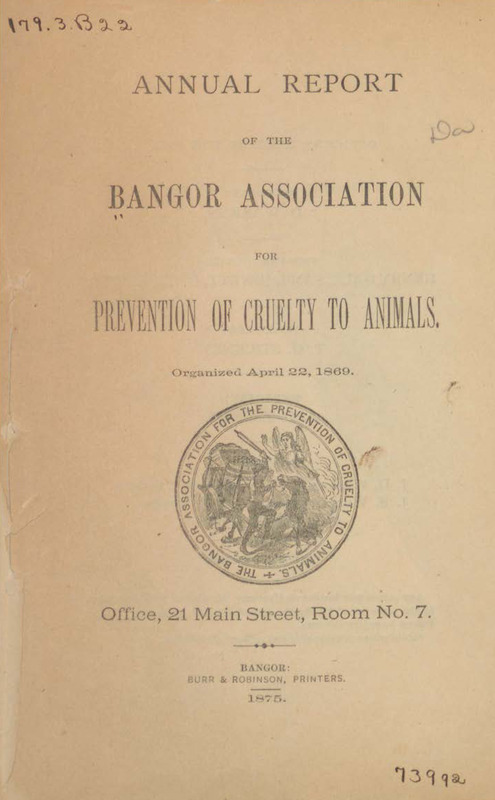
We have entered upon the work of Prevention of Cruelty to Animals, with an earnest desire to alleviate their condition, by seeing that they are better fed, watered, and protected from the inclemency of the winter weather we have in this climate. The moans of the dumb animals in their helpless, miserable condition, have arisen to the ears of the Lord God of Hosts, and He has not been deaf to their appeals. He has put it into the hearts of good men and good women of our State, who use a part of their means and opportunities in the positions in which they are placed for the repeal of all abuses to animals.
The fifth anniversary of this Society dawns with brighter hopes and better auspices than any preceding year of its existence. The reason for this favorable aspect may be found in the fact that the incessant labor of your officers and members has wrought upon the public mind an awakening sense of duty toward the dumb animals, which has been lying dormant for years past, and would still have slept, but for the movement of a few of those restless spirits who are always seeking to do the greatest good to the greatest number.
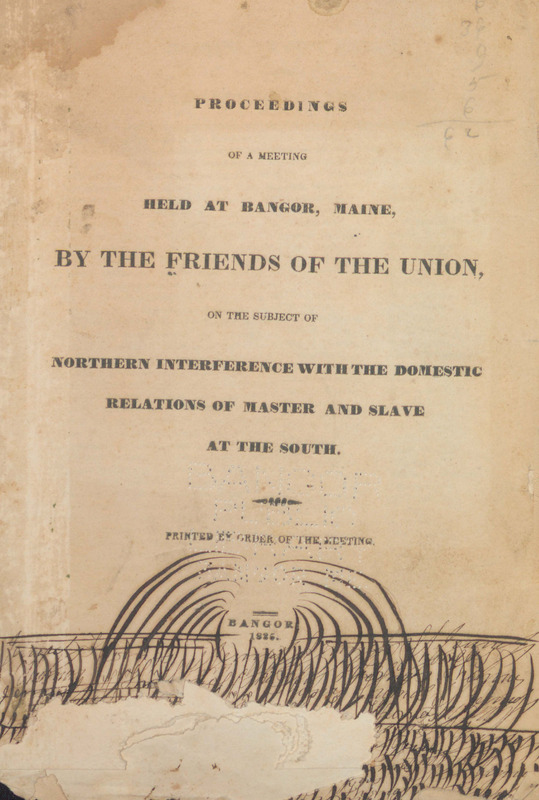
Meeting at City Hall. To the Friends of the Union. The citizens of Bangor, one and all, who are opposed to the measures of the Northern Abolitionists, and who are desirous publicly, and in the language of Washington "indignantly" to "frown upon the first dawning of any attempt to alienate one portion of our country from the rest; or to enfeeble the sacred ties which now link together the various parts;" who hold to the preservation of our national compact, in its original spirit and purity, as a sacred and inviolable duty, and as the only ark of our political salvation;--who disclaiming for themselves, protest against the right of other citizens, of any one State, to interfere, directly or indirectly, in the domestic relations of the citizens of any other State; and who feel pledged by every obligation sacred to men of honor and freemen to support, at all hazards, that fundamental article in our sacred Constitution, that "the United States shall guarantee to every State in this Union, a Republican form of government; and shall protect each of them against invasion, and against domestic violence,"--are requested to meet at the City Hall, on Saturday evening, the 29th August, at 7 o'clock, to take into consideration the measures most proper to be adopted, to counteract the attempts now making by these individuals to create civil discord and to convey to our brethren of the South the most solemn assurance of the public reprobation of their proceedings, and the insignificance of their numbers, and their utter inability to produce any public action among the independent and intelligent citizens of Maine, inconsistent with the rights of the Southern States.
One hundred successful years have gone by since that day in 1852 when eleven public-spirited Bangor citizens met together to incorporate the Bangor Savings Bank; 100 years of peace and war; of good times and bad. And down through these years the bank has followed the same slogan with which it began service to the community--always keeping faith with the community as its needs grew.
Foreword: Eventful times were the early fifties; from the revolution in the mode of women's dress, marked by the introduction of the hoop-skirt, to the reorganization of the national monetary system, brought about by the discovery of gold in California change was rife ... It was at this period in the development of the nation's monetary system that the Merchants National Bank (then the Merchants Bank of Bangor) was formed. Since that time, for three quarters of a century, the Merchants National Bank has been closely identified with the growth of Bangor, and in this year of grace, 1925, it is the bank's pride and pleasure to commemorate the 75th anniversary of its founding by attaining to a new home with increased facilities for continuing its service to the city, with which it has so happily prospered.
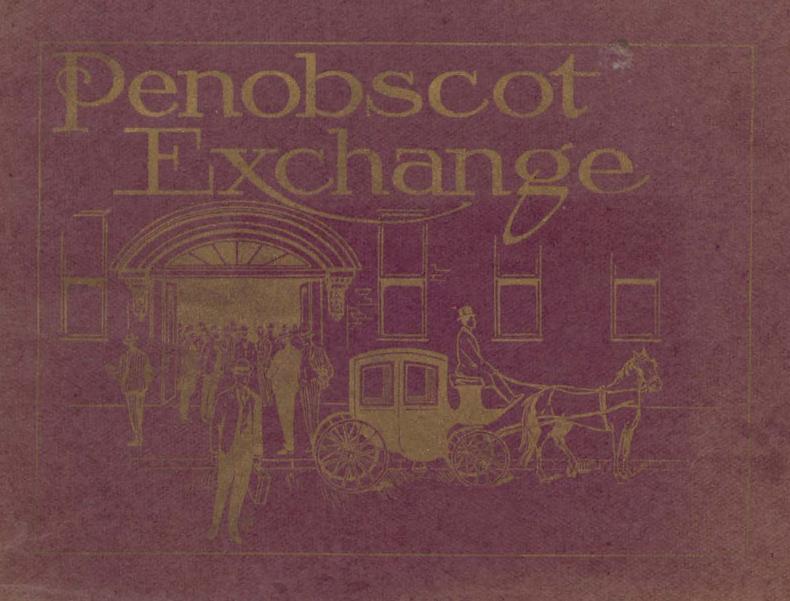
The Penobscot Exchange Hotel on Exchange Street in Bangor, built in 1827 and remodeled a number of times, was a popular hotel in Bangor's history. Its proximity to Eastern Railway Station on the Bangor waterfront appealed to travelers. Fred G. Moon and James W. Cratty were the proprietors beginning in 1897. This pamphlet describes the accommodations offered and includes several pictures of the rooms.
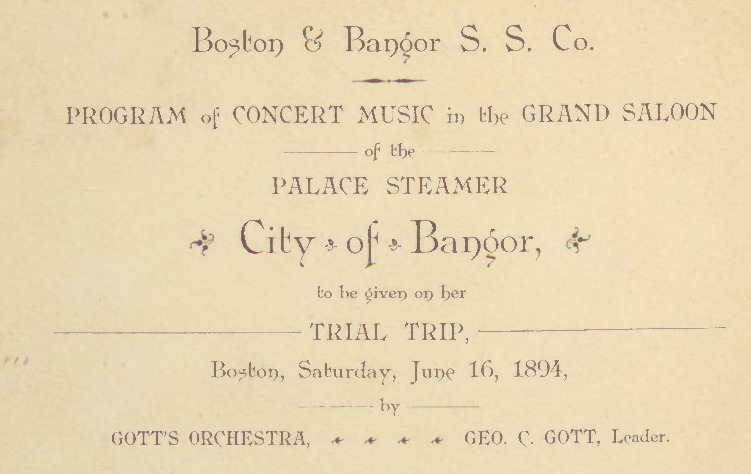
Program of concert music in the grand saloon of the Palace Steamer City of Bangor, to be given on her trial trip, Boston, Saturday, June 16, 1894, by Gott's Orchestra, Geo. C. Gott, Leader.
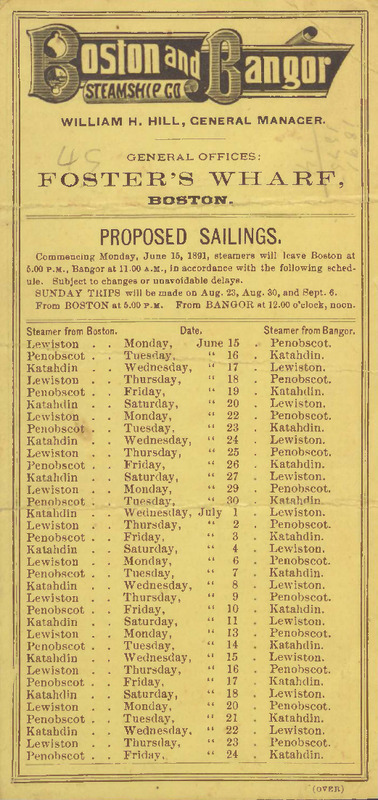
Commencing Monday, June 15, 1891, steamers will leave Boston at 5.00 P.M., Bangor at 11.00 AM., in accordance with the following schedule. Subject to changes or unavoidable delays. SUNDAY TRIPS will be made on Aug. 21, Aug. 30, and Sept. 6. From BOSTON at 4.00 P.M. From BANGOR at 12.00 o'clock, noon.
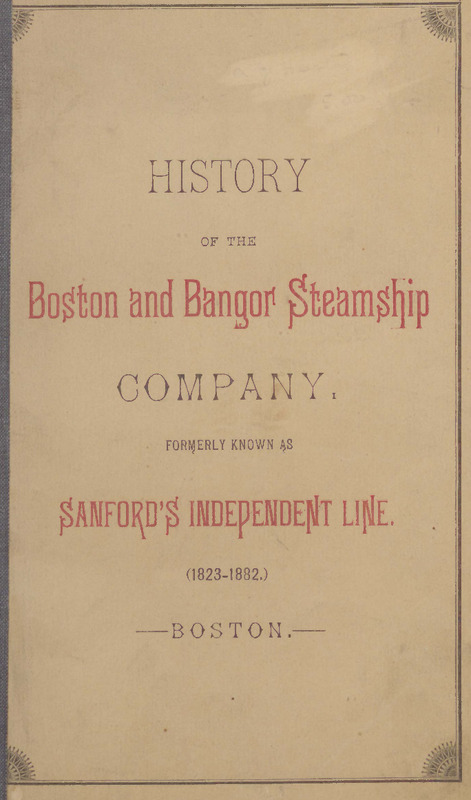
The Sanford Steamship Company was incorporated in 1875; the wharf properties at several landings on the Penobscot River, and the steamer Cambridge and Katahdin having been owned previous to that time by a private association or firm, formed in pursuance of the laws of the State of New York, under the style of the Sanford Company, the line being generally known as Sanford's Independent Line. In 1875, these properties were all transferred to a new corporation, and the Sanford Steamship Company was incorporated and organized under the laws of Massachusetts. In January, 1882, by an enactment of the General Court of the Commonwealth of Massachusetts, the corporate name of the Sanford Steamship Company was changed to the Boston and Bangor Steamship Company.
The Consolidated Hampden Silver Mining Company is composed of two corporations organized under the general laws of Maine: The Dunton Silver Mining Company of Hampden, Maine, and the Hampden Silver Mining Company; whose property and capital stock were united under one management by a special act of the Legislature of Maine, approved February 13th, 1880. Pamphlet contains: 1) Geological Report upon the Dunton Mining Property by W.F. Stewart, Geologist and Mineralogist, Bangor, Maine, November 25th, 1879; 2) W.F. Stewart's letter from March 27th, 1880, to the President and Directors of the Consolidated Hampden Silver Mining Company; 3) The State of Maine's act, which was approved February 13, 1880, to consodiated the Hampden Silver Mining Company and the Dunton Silver Mining Company; and 4) The by-laws of the Consolidated Hampden Silver Mining Company.
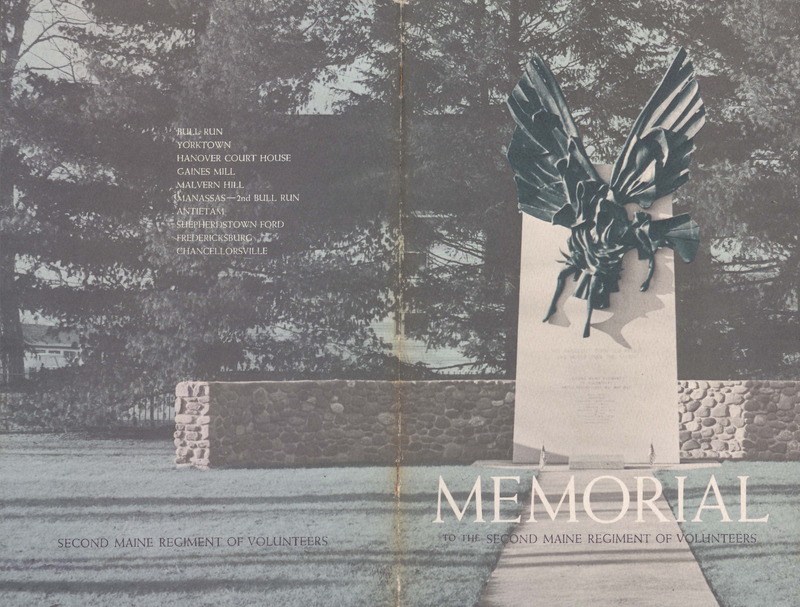
Foreword: The purpose of the publication of this booklet by Mount Hope Cemetery Corporation is to make more widely available the story of the heroic Second Maine Regiment of Volunteers in the Civil War. The memorial structures erected on the cemetery grounds will serve to perpetuate the name and record of the Regiment among those who have occasion to visit the premises. It is hoped that this booklet combining the history of the Regiment with pictures of the memorial will reach a larger audience and thus carry out the intent of the donor Luther H. Peirce, to honor in the highest degree the comrades with whom he shared the fortunes of war. The following account of THE SECOND MAINE REGIMENT is quoted from "Maine in the War for the Union: A History of the Part Borne by Maine Troops in the Suppression of the American Rebellion" by William E. S. Whitman and Charles H. True, Lewiston, Maine, 1865, Nelson Dingley, Jr., & Co., Publisher. The text is the complete chapter 3 of that book.
Foreword: It seems desirable for me to write down that most of my knowledge of the early life of Cliff Cottage has come directly from the letters of my grandfather Godfrey to his sons Frank and Fred whose full names were John Franklin Godfrey and George Frederick Godfrey. Some of my knowledge came directly from my father to me and some of it came to my brother as he had heard it from his parents. My grandfather, my father and my mother all wrote diaries which, together, give a real picture of their periods. Of course my own memories have been called on to a great extent but none of these sources could have produced a connected story if it had not been for the kindness of Mrs. Henry Elliott in helping me read old diaries as well as in copying and helping me reread and correct what I have gathered and tried to put into readable language. For all of her assistance I wish to express my gratitude.--A. G. Clifford
Facts, photographs, and anecdotes about Bangor's first century as a city, including reminiscences of several residents in their late nineties who witnessed Bangor grow from a small city to a logging industry metropolis.
Scrapbook consisting of newspaper clippings from a February 1934 issue of the Bangor Daily Commercial commemorating the first 100 years of Bangor, Maine, as a city. Features many historical narratives and photographs of Bangor sites and citizens.
Preface: Coeval with the existence of Bangor as a City in 1834, or about that time, the prevailing sentiment of its citizens strongly favored the selection of new cemetery grounds for the burial of its dead. This sentiment having been successful in the establishment of Mt. Hope Cemetery as the result, many thousands of its citizens have since found there a resting place for their bodies, including the largest portion of those then alive, besides thousands of others since born or otherwise become inhabitants of the city. The history of the Cemetery has thus become one of great interest to the people generally, and the duty would seem to be imposed upon some one to see that the work of compiling such history should be performed, not only for the present inhabitants, but for those who may succeed the present during the long ages of the future. The undersigned having been one of the very few, now alive, who were present at the dedication of the Cemetery, and for a half century since having been continuously entrusted, as Treasurer, with the collection and disbursement of its funds, and having had a prominent part to perform in the purchase of its premises and in the sale and conveyances of its very numerous lots, which have, during all such half century, been disposed of to citizens and others, the work thus alluded to would seem to be very appropriately chargeable to him. Freely accepting the call, he respectfully submits the following report.--Albert W. Paine
Pamphlet illustrating Bangor buildings and scenery. "Bangor, Maine, the 'Queen City of the East,' a city of surpassing natural beauty and advantages, enhanced by many magnificent buildings, artistic homes, and handsome lawns, is universally recognized as the business center of Eastern Maine, and is rapidly coming to the front as the Metropolis of the Northeast."
During the twenty-seven years the Bangor Board of Trade has been in existence there have been brought out under its auspices several publications setting forth the industries and resources of Bangor, a city universally recognized as the business centre of Eastern Maine, and rapidly coming to the front as the metropolis of the Northeast. The first of these pamphlet publications appeared in 1873 and others were issued in 1883 and 1888. More than a decade of years have elapsed since the appearance of the last of these elaborate business reviews, and as these years have been characterized by a notable advancement in the realms of trade, commerce and industry, especially fitting it is that something now be brought out descriptive of the Bangor of to-day and worthy of the proud city at the head of navigation on the noble Penobscot. The object in view is to set forth in attractive and convenient form the industries, resources, attractions and business life of the City of Bangor and its environs. In the present day illustrations play a prominent part in all of the higher class of publications and these pages are embellished with the finest half-tone engravings obtainable.
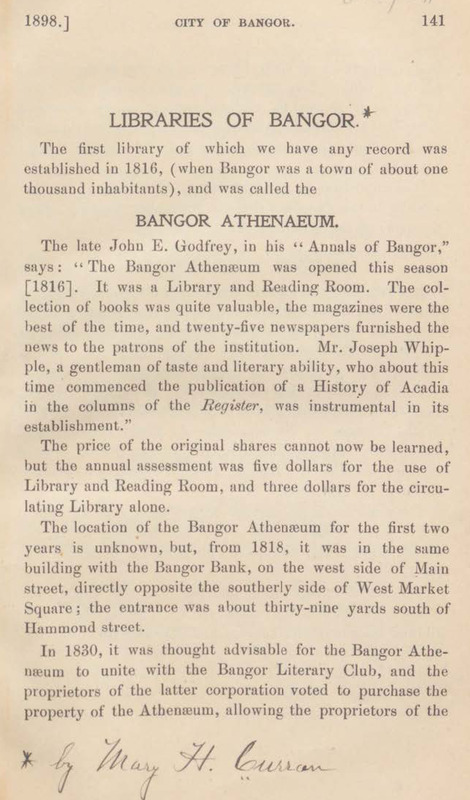
Provides a detailed history of libraries in Bangor, Maine, dating from the Bangor Athenaeum in 1816 to the founding of the Bangor Public Library in 1883. Includes the by-laws and rules of the Bangor Public Library as of 1898.
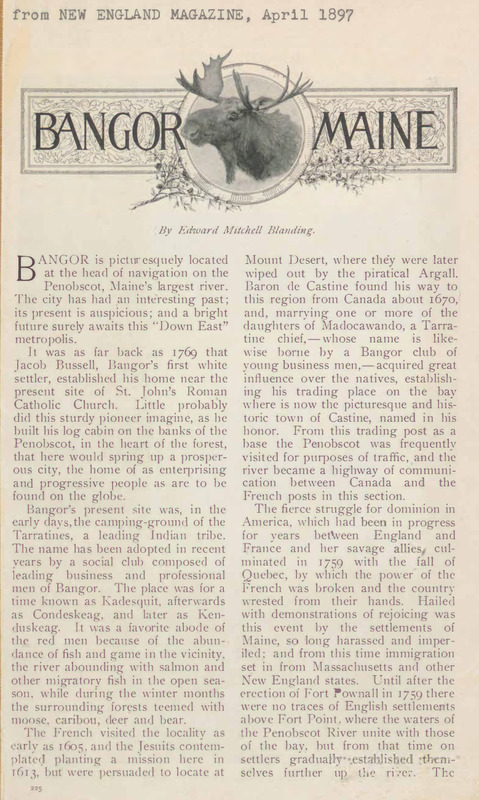
Bangor is picturesquely located at the head of navigation on the Penobscot, Maine's largest river. The city has had an interesting past; its present is auspicious; and a bright future surely awaits this "Down East" metropolis.
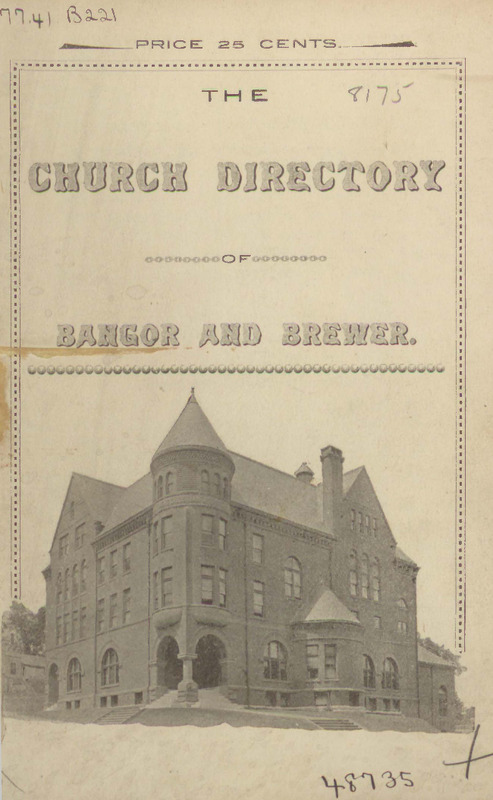
"Containing the names, location, list of officers, order of services, and membership of the different churches." Includes photographs of churches and pastors, and advertisments for local business.
Primarily photographs of Bangor, Hampden, Orono, Brewer, and Veazie. The text of the work is spaced throughout twelve volumes, which are presented here as a continuous work.
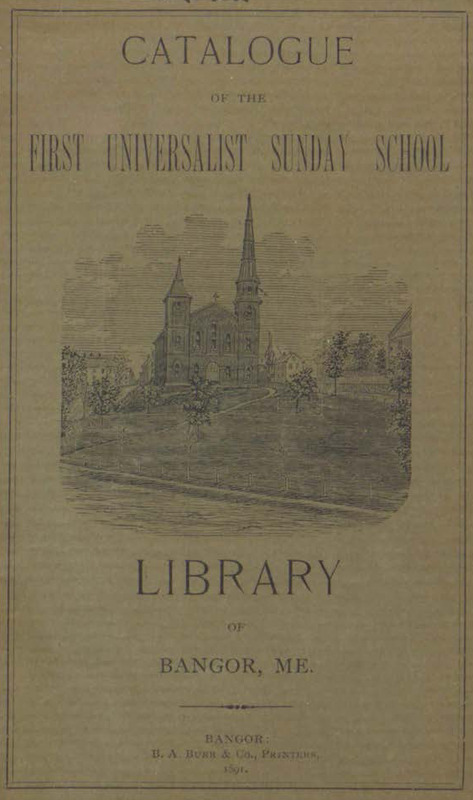
The object of this Library is the cultivation of the mind and heart, in purity, truth and love. Let him, therefore, who handles these books do it reverently, for they contain the song and story, the wit and wisdom, of many generations of men. May the thoughts with which they are filled be as wings to lift our spirits up into better thoughts and deeds, and a truer love.