Explore history through the digital collections of the Bangor Public Library and our community partners in Bangor, Maine
Leyland Whipple Lantern Slides
Title
Leyland Whipple Lantern Slides
Description
Glass lantern slides, many hand-colored, depicting Maine landmarks and landscapes, outdoor recreation, logging operations, the papermaking process, wildlife, agriculture, and historical scenes. Leyland Whipple was a Bangor photographer, composer, and high school band leader who documented the Fire of 1911.
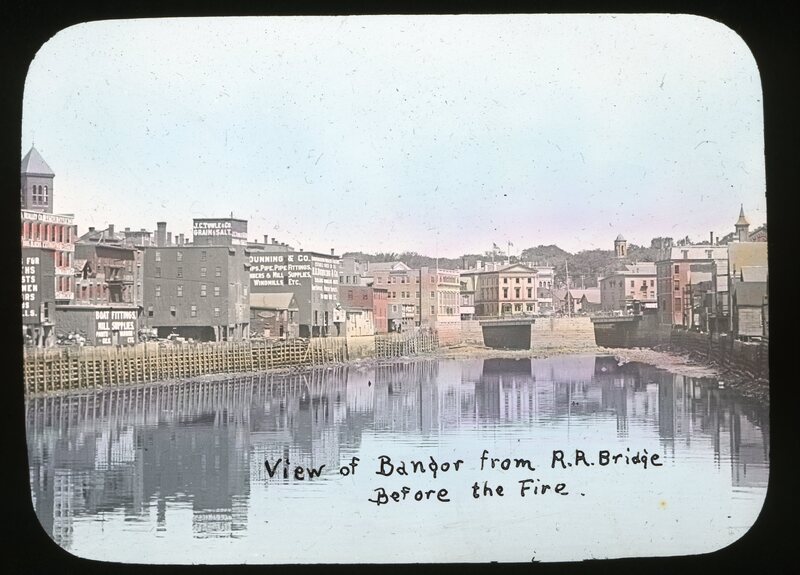
This hand-colored lantern slide shows a view of Bangor taken from the Maine Central Railroad bridge across the Kenduskeag Stream at low tide shortly before the Great Fire of 1911 decimated the commercial and luxurious residential districts on 30 April. The slide features Broad Street on the left side and Exchange Street on the right; the Federal Building containing the Post Office and Customs House sits on the island in the middle. The tower of Union Station lies just inside the frame on the right, and on the left is one of the steeples of the Universalist Church and the dome of the First Baptist Church. Although strong gusts bore the fire across the Kenduskeag without causing much harm to Broad Street, Exchange Street and the surrounding areas suffered heavy damage--the Federal Building and the Universalist Church would be among the victims.
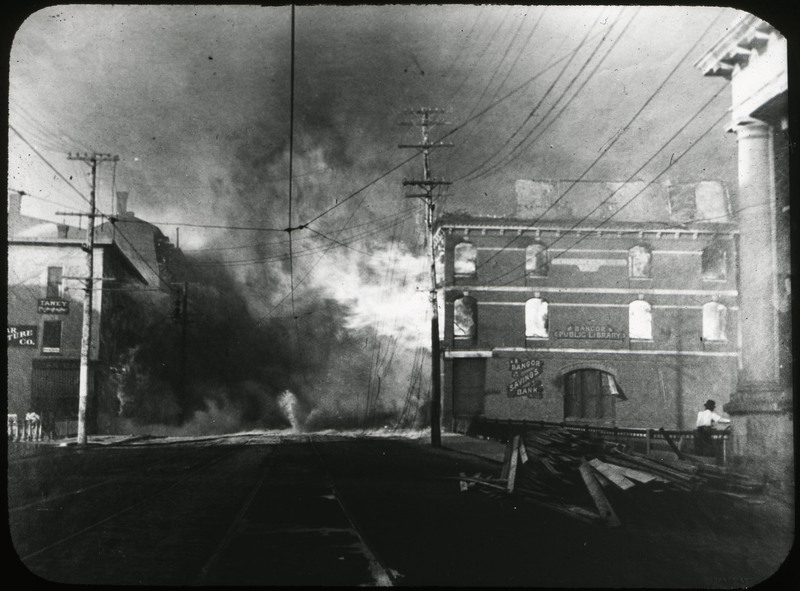
The Fire of 1911 showing the Bangor Public Library, Bangor Savings Bank and Taney Photograph shop on State and Hammond Streets. The ferocity of the blaze and the gusting winds are evident as the flames are leaping nearly across the trolly tracks. The $300,000 of books and the collections of the Bangor Historical Society on the top floor of the library building have been abandoned as the firefighters tried to staunch other flames; lumber has been pulled down and stacked on the right of the image, and only one spectator remains.
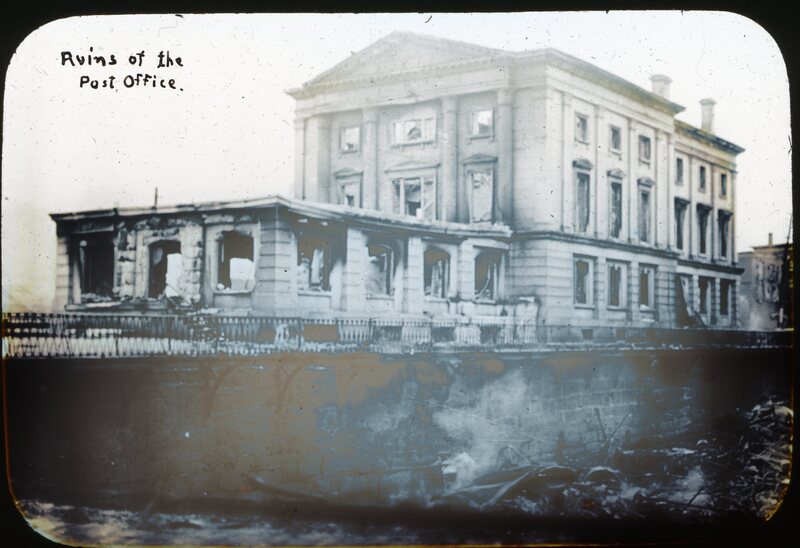
The Bangor Fire destroyed the Federal Building, which housed both the post office and customs building. The metal ruins on the lower right of the image are the remains of a laundry building. The slide is labeled "Ruins of the Post Office."The urgent need for a replacement in a city the size of Bangor lead Congressman Guernsey to ask for a Congressional appropriation of $500,000 during a special session to fund their reconstruction.
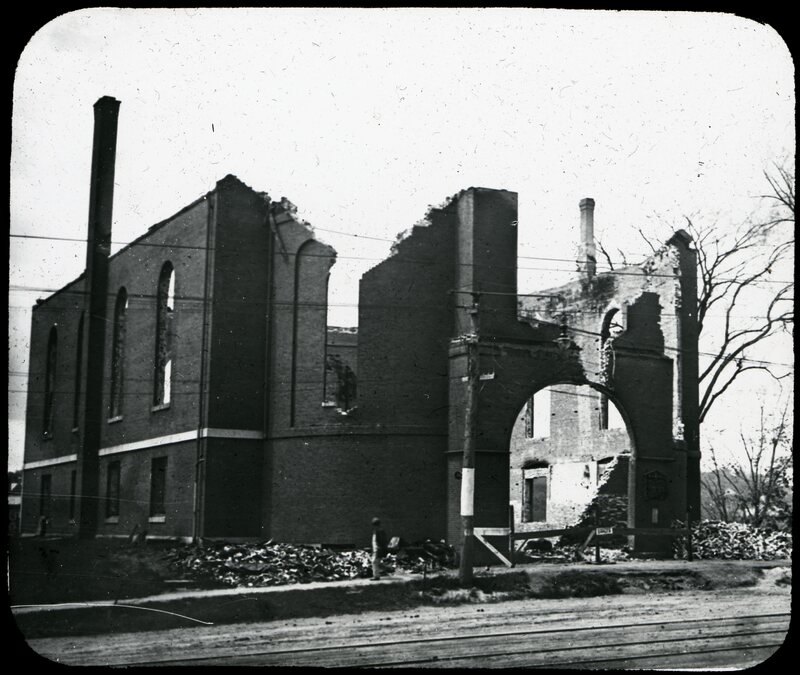
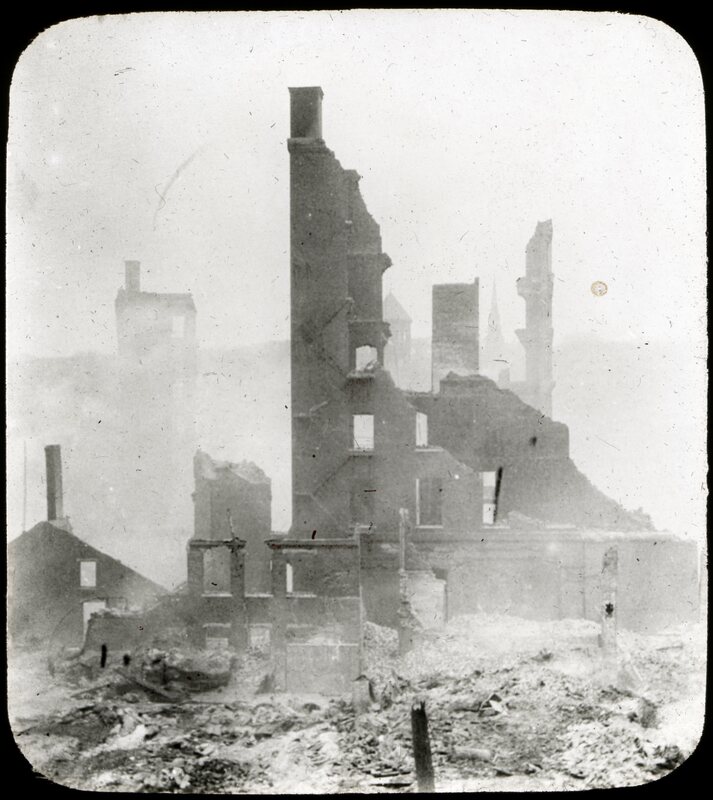
Ruins of the First Congregational Church after the Bangor Fire of April 1911. Located at 14 Broadway, it was organized in November 1811 and built in 1831 of brick with a granite basement. The architecture is attributed to Charles H. Pond, and it was the earliest building in Bangor to feature an applied Gothic style. The slide is labeled "Ruins Great Fire State + Oak Sts" and "Bangor: 1911 First Cong. Church."
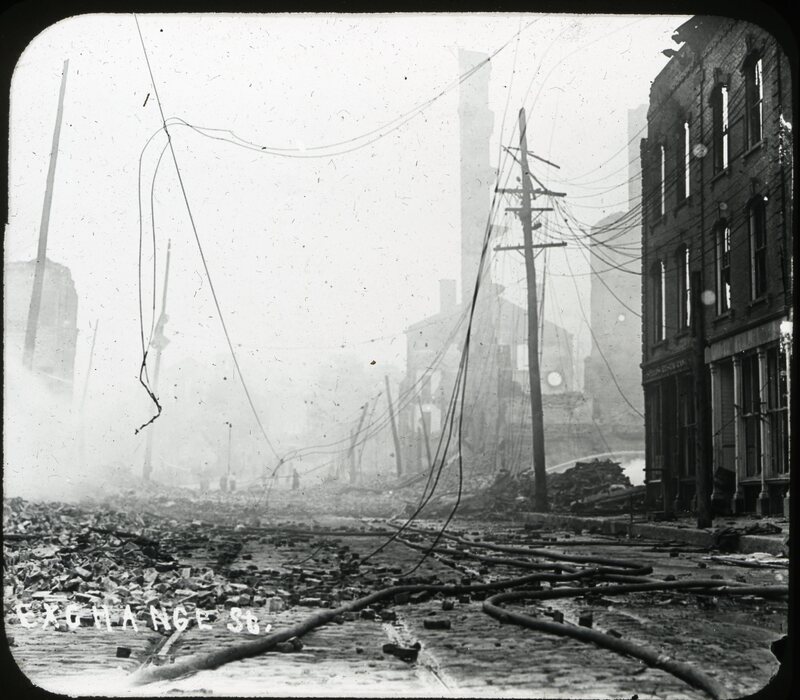
The state of destruction in the wake of the Great Fire is clearly evident in this slide. The street and trolley tracks are blocked by rubble, hoses still snake along the streets, and the tangle of electrical lines is a reminder that the power went out early in the fire and was not restored for a few days. The papers set type by hand and published accounts of Bangorians going to the theatre along darkened streets to see shows performed by lamplight. The building on the right is the home of the First National Bank. Slide is labeled "Bangor Big Fire 1911" on side and "Exchange St. near State" on bottom.
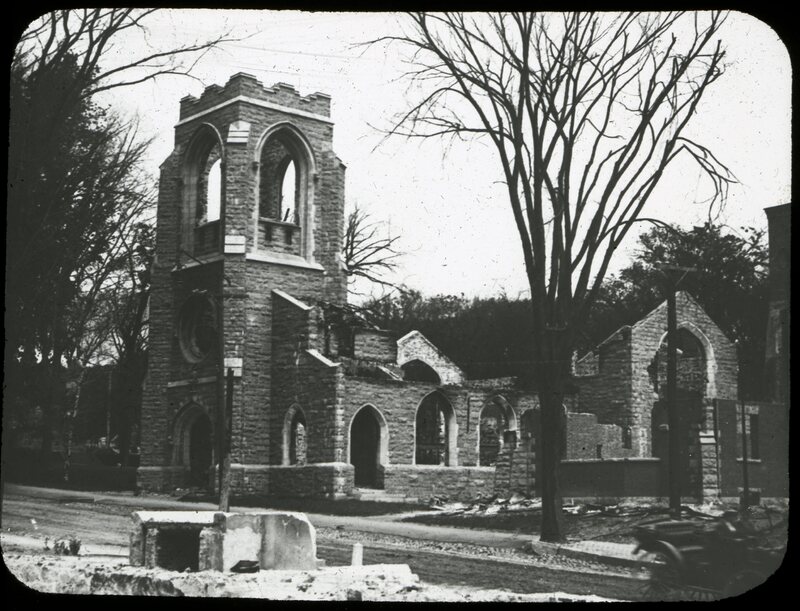
The gutted ruins of the Central Congregational Church of Bangor on French Street after the 1911 fire. The church was built in 1902, with Frank A. Bourne as the architect. The stonework was "pink Bay of Fundy" granite. It was considered one of the finest examples of a Gothic style church in New England.
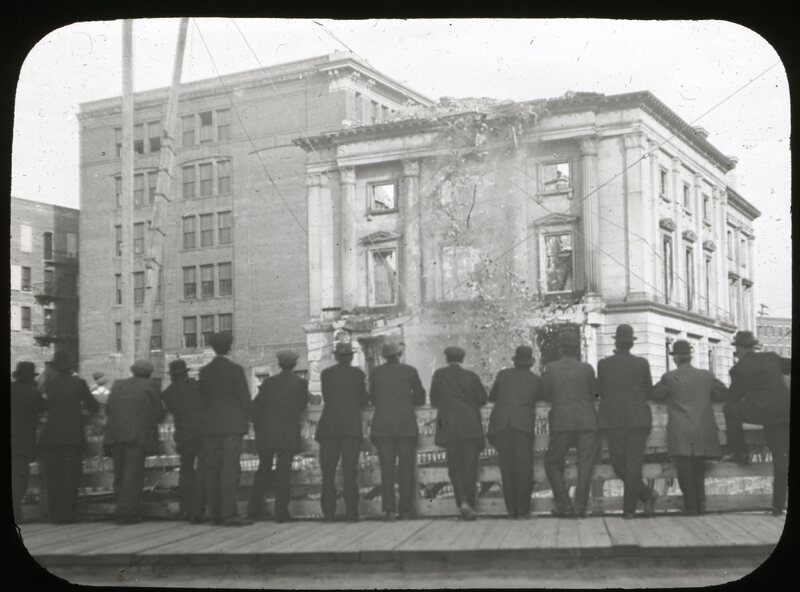
Labeled "Bangor Fire Demolishing ruins of P.O. Bldg. 2 years later" on the slide. Although congressional funds were quickly approved to construct a new Federal Building housing the customs office and post office, there was debate about what to do with the old building that was destroyed during the Bangor fire of 1911. Finally, it was decided to demolish the old shell and create a fireblock with the gap. The area is today the Kenduskeag Park. The spectators are probably members of the fire department, which was also in charge of demolishing the building with dynamite.
After the Great Fire, the ruined remains of the Morse-Oliver Building were dynamited. Although several other buildings incorporated their former structures when they were rebuilt, the city's reorganization and rebuilding plan required broader roads and relocated buildings. After the seven story building was destroyed, no other buildings in the downtown district were built as tall, most confining themselves to four stories.
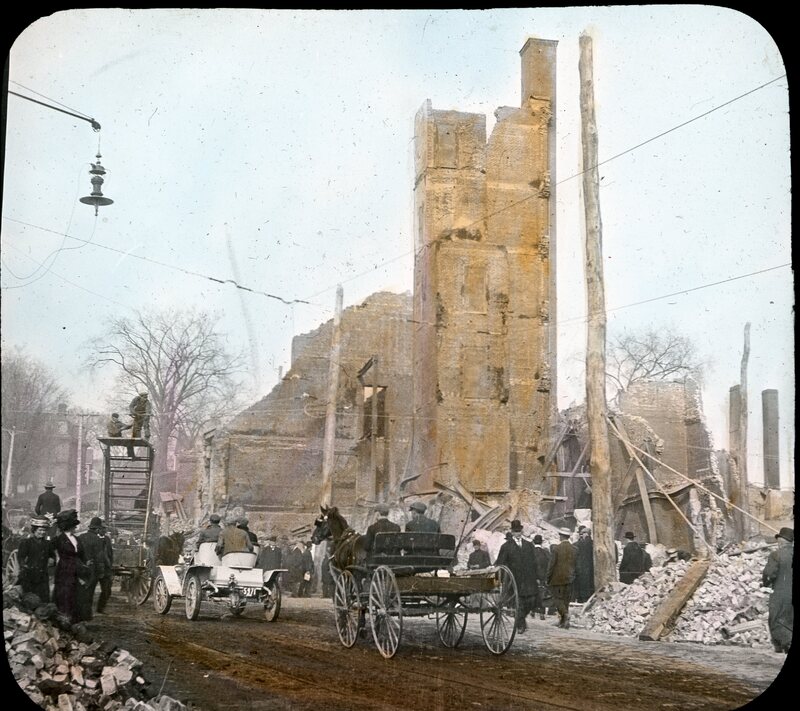
This view after the fire of April 30, 1911, shows the ruins of the Morse-Oliver Building on the corner of Exchange and State streets that have been partially dynamited to permit rebuilding. A wheeled ladder rig, probably owned by Bangor Hydro, is being used to repair downed lines. As the streets were slowly re-opened to traffic, many of the Bangor residents chose to ride instead of walk--an early automobile is bumper-to-bumper with horse-drawn buggies.
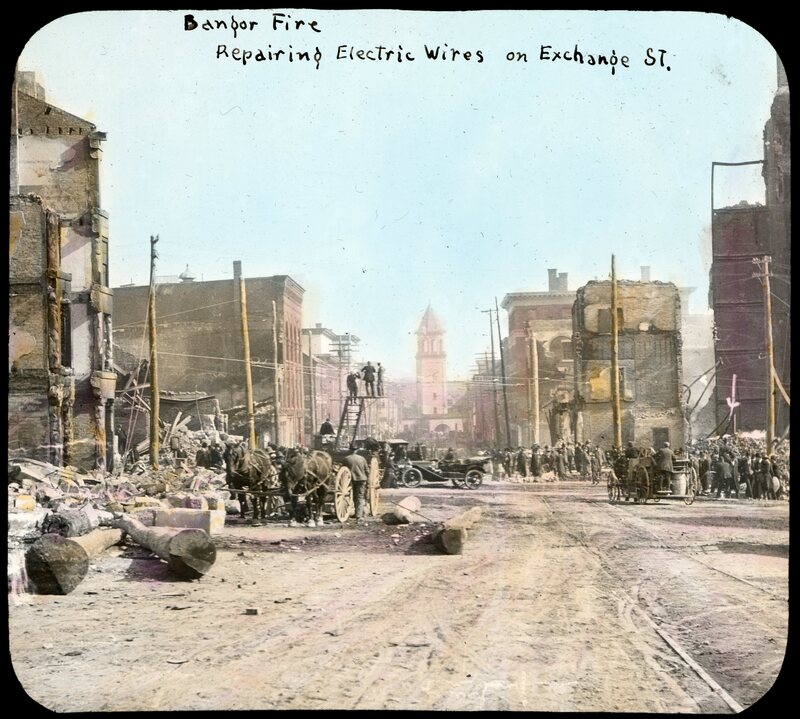
Cleaning up after the fire of 1911 was a lengthy process. This hand-colored slide shows a horse drawn ladder device used by Bangor Hydro as they restrung electrical lines next to the Morse-Oliver building on the left. The gap between buildings on the left had been filled, until the fire, by what was locally known as "Undertaker Row" because of the numerous embalming and funerary houses there. Exchange Street had been mostly cleared of rubble in this image, but not of spectators, who assembled for a better view. An early automobile can be seen as well as a delivery wagon, but gawkers came from further afield en masse: Maine Central Railroad offered a special rate on a same-day return ticket to view the ruins. Travelers would have arrived at Union Station, built in 1907 and distinguished by the tower in the center of the picture.
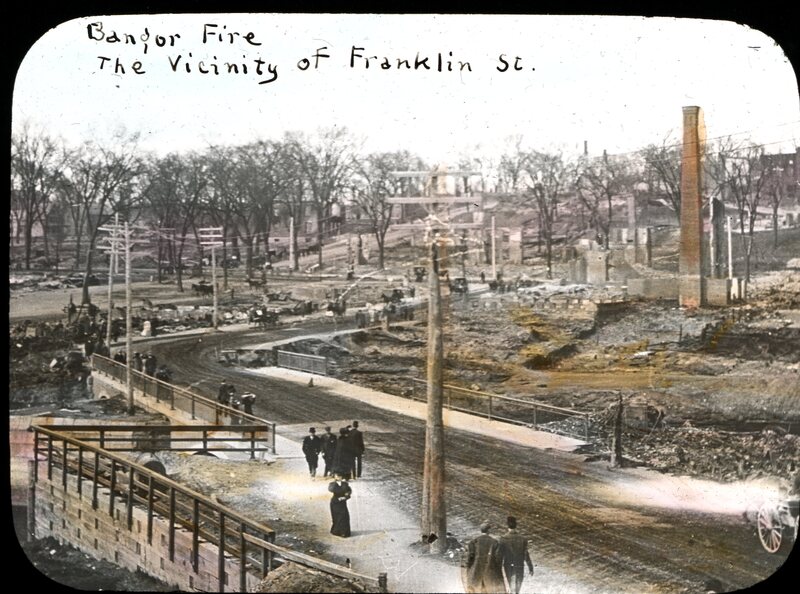
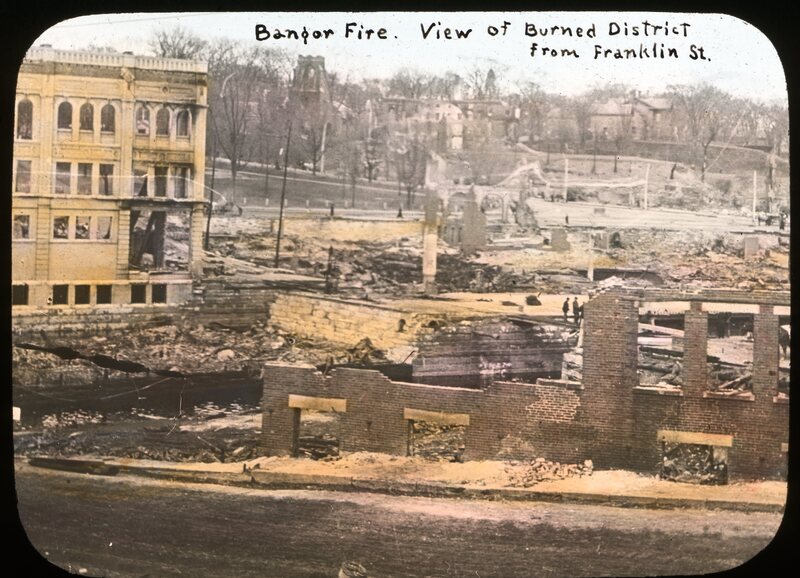
The fire of 1911 left downtown Bangor in ruins. This is Franklin Street which was the only means of passage between the two parts of the city after the fire.
This view of the burned district was photographed from the opposite bank of the Kenduskeag Stream across Franklin Street. The ruins in the foreground are unidentified. The Graham Building is on the left, opposite the ruins of Norombega Hall. The church steeple at the top of the frame belonged to the Center Congregational Church, a prime specimen of New England Gothic architecture.
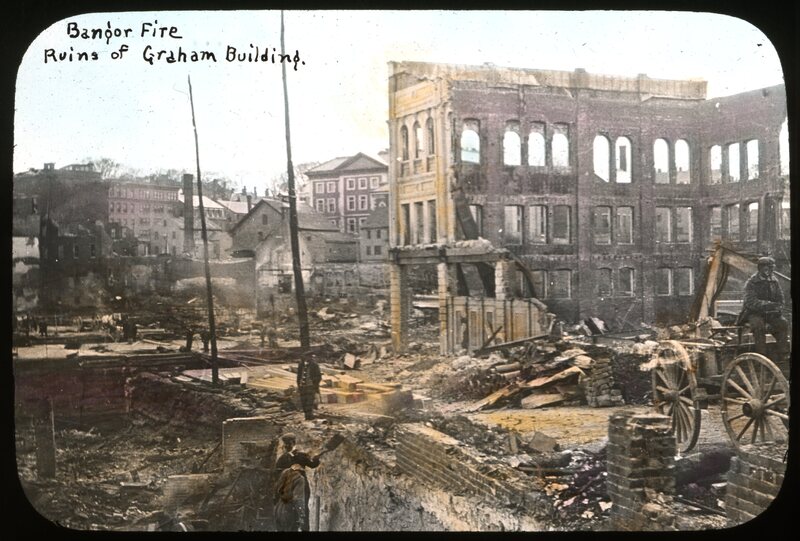
The Graham building housed the Odd Fellows, Knights of Malta, several other secret societies and the Nickle Theatre. Built in 1906 and designed by Wilfred E. Mansur, it was designed to follow a curve in Central Street, had the first concrete foundation of a business building in Bangor, and combined the Chicago Style with Beaux Arts classical details. After the fire, it was torn down and replaced with various single story businesses and the temporary post office. Here, a pair of workers clear rubble, one driving a horse and cart on the right, and another waiting on the left. The picture shows a view down Franklin Street, and the other buildings in the image are unidentified.
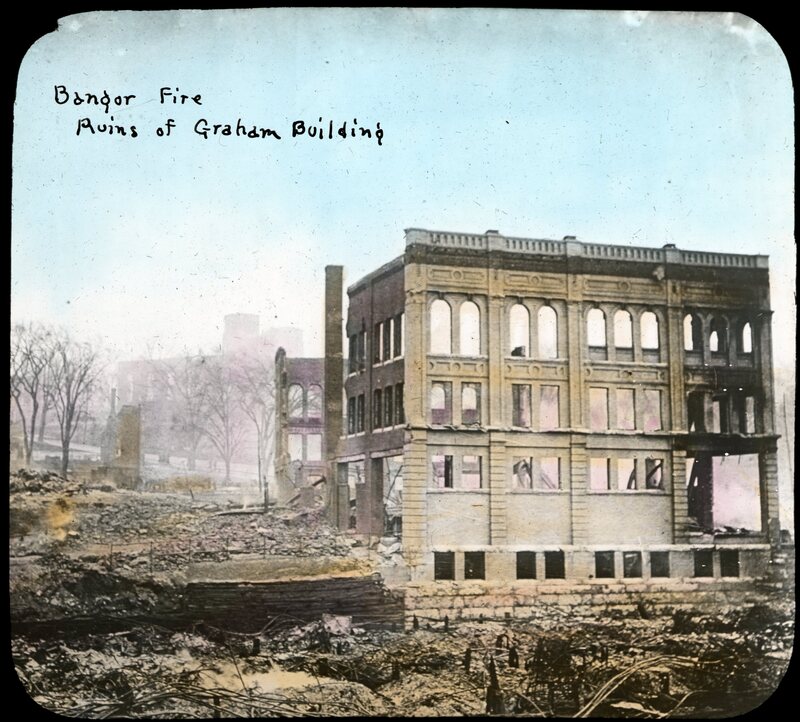
The Graham building housed the Odd Fellows, Knights of Malta, several other secret societies and the Nickle Theatre. Built in 1906 and designed by Wilfred E. Mansur, it was designed to follow a curve in Central Street, had the first concrete foundation of a business building in Bangor, and combined the Chicago Style with Beaux Arts classical details. After the fire, it was torn down and replaced with various single story businesses and the temporary post office.
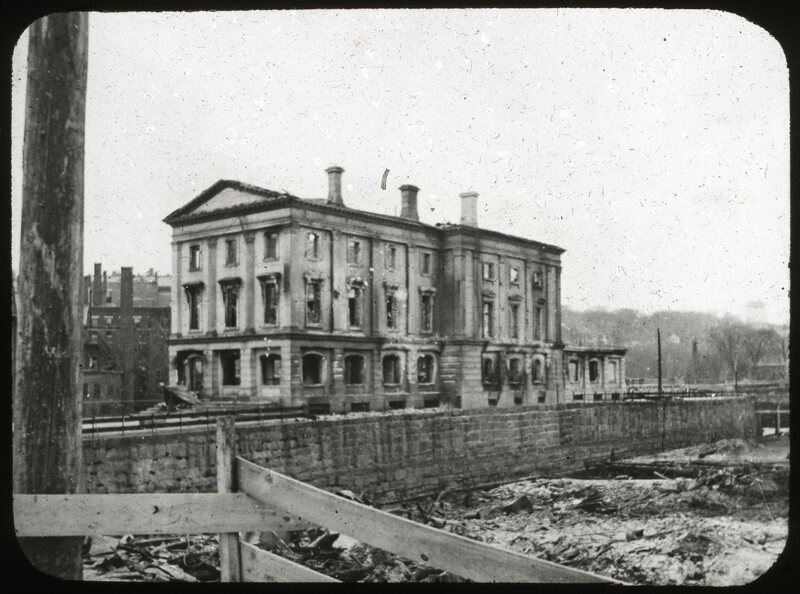
Ruins of the United States Custom House and Post Office after the fire of April 1911. These buildings were built in 1853-55 between State Street and Central Streets. The architect was Ammi B. Young with an addition added on in 1869-1870 by architect Alfred Bult Mullett. This view is taken from the Kenduskeag Stream.
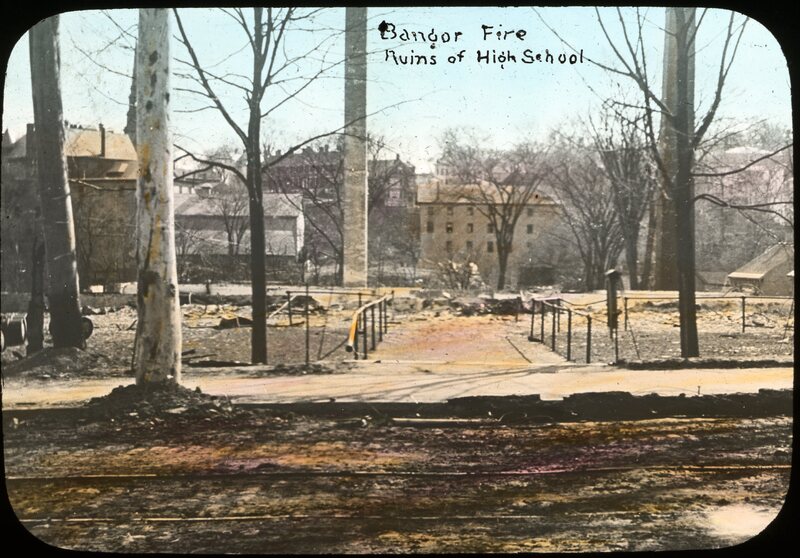
This photograph was taken a few days after the Bangor Fire of April 30, 1911. It shows the ruins of the Bangor High School that was located on the "Bruce lot" now "Abbot Square" on Harlow Street. This High School building was built in 1852. The replacement High School was built across Harlow Street, with the Public Library built next to it.