
World War II Regimental Histories
- Title
- World War II Regimental Histories
- Description
- Photograph-rich publications documenting the history of individual military units during World War II, including the unit's organization, personnel, military campaigns, and casualties. This collection was compiled by World War II-era librarian L. Felix Ranlett, a veteran of World War I.
Items
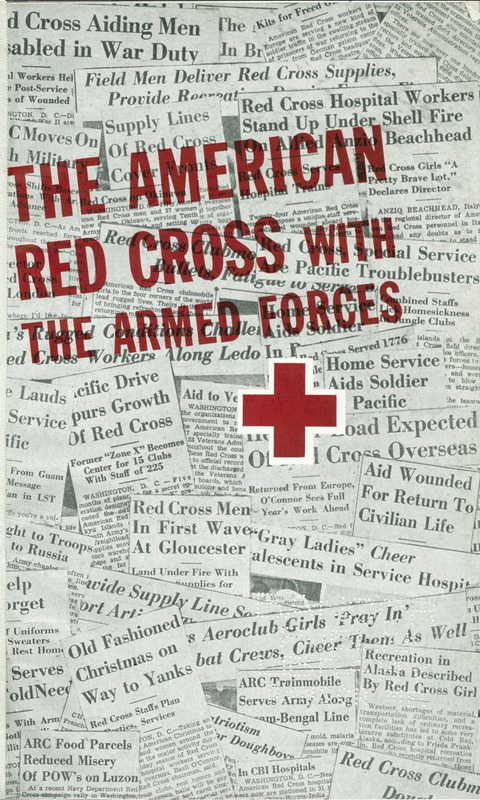
The American Red Cross With the Armed Forces
Foreword: This booklet will confine itself to describing the work done by those American Red Cross men and women who are giving direct, personal services to the members of the armed forces on the military front or to their families on the home front. To isolate this cross section of Red Cross activity from the body of all Red Cross war work is to sacrifice the complete story of the Red Cross war jobs for the Army and Navy. That is a story of many themes--to name only a few: jobs as essential as collecting blood for plasma; or supplying surgical dressings, comfort articles, garments for the hospitalized; or recruiting nurses; or training nurse's aides. Nevertheless, the American families of some 11,300,000 servicemen want to know the answers to particular, personal questions: What is the American Red Cross doing for the serviceman himself? What are its representatives doing for him when he is homesick and worried, bored, restless, sick or wounded? What are they doing for him in the field, the leave area, the hospital? What are they doing when he returns home, discharged, and has problems resulting from his service? The trained men and women who are, we are told, "at his side"--who are they, what facilities do they have to work with, and exactly how do they work? Finally, how do the Red Cross chapters here at home help him and his family? This booklet tries to answer these questions for the millions of deeply interested families and neighbors of men and women in the Army, Navy, Marine Corps, and Coast Guard. In so doing it must stick closely to them and to those personal Red Cross services which are theirs wherever they go, whatever their jobs.

The 86th Chemical Mortar Battalion Presents Its Battle History
Everyone knows of the infantry and the air corps, the tankers and the engineers, the quartermaster and ordnance. And they "know" all about Chemical Warfare: they picture us playing with test tubes in white laboratories, a thousand miles behind the lines, discovering new war gases and atomic bombs. Some within the Chemical Warfare Service do bring new methods of warfare from their labs, but most of us are ordinary soldiers--very like the infantry and all other troops who fight on the ground, for keeps. Originally, our mortar was designed for firing chemical shells. Then one day someone discovered that you could fire a TNT-filled shell from the same muzzle--and that day you said goodbye forever to clean labs and pretty colored chemicals, and became a soldier. So we toted a 4.2" mortar from the beaches of France to the heart of fortress Germany. We went where the infantry had to go, a few times arriving before they did. Our ways of life were alike: same wariness by day. same fear by night, same boredom and despair. And some died in the fight-just as the infantrymen. Neither for the glory nor the medals, the press releases nor the newsreels--but with a vague consciousness we sensed that we had to be part of this mighty juggernaut that was crushing the Nazis. Beneath our blusters and disdain of flighty words we were proud of being soldiers. We originated a favorite maxim that we used as a "wisecrack" all over Europe--"Don't fool with the fighting troops!" Yet there are few--soldiers and civilians alike--who know what a 4.2" chemical mortar is and what it can do. Here is the answer, and it has nothing to do with chemicals or chemists except in a very abstract way. This is the historical account of a fighting odyssey, the simple facts of where and with whom we fought. Everyone knows of the infantry and the engineers. This is about mortar men, who also fought a war.
The 68th Tank Battalion in Combat
This will be the record of the 68th Tank Battalion's participation in successive campaigns from the historic breakthrough in Normandy to "VE" Day in the heart of Germany. Before beginning this narrative, however, there are some remarks we must make. Firstly, this history was made possible by the heroically spent blood and sweat of American men, who gave their best for their country. They did well, these men, and though some of them are no longer with us, their deeds will never be forgotten.

Surf and Sand, the Saga of the 533d Engineer Boat and Shore Regiment and 1461st Engineer Maintenance Company, 1942-1945
Foreword In these pages will be found the story of our own 533d in the greatest of all the wars of the world. It is a story of toil and hardship and danger mixed with happy interludes and comradeships made the dearer thereby, a story of great deeds in the face of great obstacles, of reverses and disappointments but of pride and glory in the end. This book is not written to impress others with our deeds. In the many commendations of high commanders is found the testimony to our success in an unusual and most important role in many landings on enemy-held shores. In our own minds and hearts are the priceless memories of our great adventure and the pride that comes from the knowledge of a job well done. May these pages help to keep them fresh through the years to come. W.S. Moore, Colonel, Corps of Engineers

Supply Front the 16th Port Story
This is the story of the 16th Major Port: its birth and growing pains and the accomplishment of its mission. It has been impossible in the relatively narrow compass of a short history to give full credit to the Navy, to Army Engineers, to the Coast Guard, to British Minesweepers and to others who took part in the gigantic task at Le Havre, but this is by no means meant to detract from the credit due these organizations. The story of the 16th Port is part of the story of the Army Transportation Corps. It is the story of how in the face of overwhelming obstacles, men worked hard together that the combat troops might be fed, that reinforcements might move forward quickly and efficiently, that the multifarious items of supply might flow smoothly to the front, that the guns might fire . "Written by Cpl. Alex Bower, illustrated by Si Mezerow ... and edited by Lt. E.N. Brandt."
Serving Our Armed Forces, a Primary Red Cross Responsibility
Excerpt from the introductory "Why the Red Cross Serves the Armed Forces": During the past 10 years, the Red Cross has expended well over half a billion dollars in service to the armed forces and to veterans--dollars that were voluntarily contributed for that purpose by the people of this country. But even more significant are the millions of hours of volunteer effort that have likewise been freely contributed to that service through the Red Cross--hours that, if paid for at going wage rates, would have multiplied Red Cross expenditures many fold. This volunteer service, symbolic of all that is warm and human and neighborly in American life, is the truest measure of what the Red Cross stands for in its relations with the military establishment. The American Red Cross continues to exist and to carry on its service to the armed forces of this country because there is a vital job to be done and because the American people have accepted the Red Cross as their medium of action in this department. of community responsibility. There can be no doubt that, if the Red Cross did not already exist, the people of this country would see to it that a similar organization, of equal extent and capacity, was promptly established.
Regimental History, 123rd Infantry; A Pictorial History--World War II
YOU'RE IN THE INFANTRY Those of us who can say those words ... let's say them with pride, but softly. Let's not shout them. Let's not stick out our chests. Let's say them with a kind of awe. We can't tell much about it ... and wouldn't if we could. Maybe we'll say it's "rugged." Maybe we'll get across the idea that you have to be quick in the head, as well as quick with your hands, to get along in the infantry. And that, even so, your chances aren't too bright. But that's about all. Few will ever know what it means in a war like this, to be "in the Infantry," the knockout corps, the Army's infighters. But we can make the world remember at least ... that a doughboy has to master a dozen weapons ... that skill and smartness count for as much as muscle; ... That he may have to live for days on end on congealed food, in mud and slop halfway to his waist, where the rain is iron, the wind is cordite and the light is liquid fire ; ... And that, at the end, he comes face to face with a personal enemy ... another Infantryman whose ten inches of cold steel snake out for his belly, and whose gun butt swings in a short quick arc to crumple his skull. Face to face ... that's the Infantry's war. They're out where that thin black line moves forward on the map . . . to kill or be killed.
Pack Up and Move: A Pictorial History of the 348th Engineer Combat Battalion
It was on the 15th of July 1942 that the 348th Engineers were entered on the War Department records, as a General Service Regiment. The Regiment was organized at Camp Crowder, Missouri; and the greatest portion of its cadre was from the 19th Engineer Combat Regiment stationed, at that time, as Pasadena, California. The first group of "fillers" joined the unit early in the morning of August 22nd after traveling many miles by rail from the various induction centers of the Seventh Service Command. These men were followed in succeeding three days by two groups, one from New York, and the other from Michigan. The unit at this time was under the command of Major Clayton Gates, later under Colonel Sylvester Nortner, a West Pointer and then the ranking colonel of the United States Army.
On Target: A History of the 863D AAA-AW-BN in the Second World War
From the Foreword: "The writing of this book began shortly before V~E day. Together with what had been scribbled in the unit history journal and more carefully entered in the more ostentatious records, refreshing notes and photographs submitted by battery representatives were used in the telling and illustrating of this integrated story of the 863d AAA A W Bn. In this presentation, it was impossible to obtain and relate personal anecdotes involving each man in the battalion. Whether or not you are mentioned specifically, it is our hope that you see yourself described, albeit anonymously, in the experiences and sentiments and moods common to all in this memorable adventure of the 863d. We have tried to gather and utilize all suitable information brought to our attention to give a full, cohesive, readable story of the battalion and all its officers and men, its campaigns, its missions, its organizational experiences, its troublous days and gayer times- in a word, its life as a military organization from date of activation on 1 June 1943 at Fort Totten, Long Island to V-J Day, 14 August 1945, in and around Bad Soden, Germany." Sgt. Benjamin Gise, Editor-in-Chief
![History, 643rd Port Company: 1944-1943 [i.e. 1946] by Its Personnel](https://bangorhistory.org/files/large/e804b44ec3fb59c9e50c867ffbdec9ef1c2dc300.jpg)
History, 643rd Port Company: 1944-1943 [i.e. 1946] by Its Personnel
To all men of the 643rd Port Company: Many things have happened to all of us since that cold morning in February, 1944, when you marched in the snow up the hilly military reservation at Indiantown Gap, Pennsylvania. First, we made soldiers of you indifferent citizens, You were taught many things, some of them useful in war, some useful in peace. To some of you, military life has left a bitter taste. To others it was an opportunity to see the world as well as gaining a new and exciting life as a soldier. Remember this, you were taught to think quickly and to act accordingly. Those of you who are making the Army your career, continue with the same spirit and ambition you have shown in the past. The war is over now, and you who are about to become citizens again, go out in the world and fight. Yes, fight for what is right and live up to your belief in GOD.
Foreign War Relief: September 1, 1939-December 31, 1942
Excerpt from the introductory "Why Does the American Red Cross Give Relief Aid?": Under the terms of the charter given it by Congress in 1905, the American Red Cross undertook to help the people of other lands in peacetime calamities. Through the aid which has been carried on under its banner since then to all parts of the world, compassion for suffering and a desire to help have come to be regarded as outstanding national characteristics of the American people. That spirit of helpfulness is not limited to times of peace. When the second world war flamed from country to country, a great wave of sympathy for the innocent and helpless victims swept the United States. From coast to coast, the American people wanted to send aid to the women, children, and old people torn from their comfortable homes and deprived of the necessities of life, and to the fighting men made prisoners of war. The American Red Cross expanded its activities to include relief and service to those suffering from this world-wide conflict. It was possible for the organization to act promptly and effectively because of its more than 6o years of service to suffering humanity, regardless of race, color, or creed, and its extensive experience in giving relief in national and international disasters.
End of Mission, 957th Field-Artillery Battalion
Battalion Adjust "From the cities, villages, hamlets and farms of almost every State in the Union came the "fighting men" of the 957th Field Artillery Battalion--a 155 mm Howitzer unit which contributed "prompt, accurate and devastating fire support" for every major campaign against the German enemy in France, Belgium, Holland, Luxembourg and Germany. The pages of this organization history, pictures and statistics are dedicated to the men and officers who gave unstintingly of their blood, life, time and talents to assure the success of the Continental Campaign and the Cause--the Cause of International Freedom. It is our desire that this volume will be to all who peruse its pages a friendly reminder of the devotion and singleness of purpose which marked the years of Training, Preparation and Combat." THE EDITOR

Eighty Third Field Artillery Battalion
The history of the 83rd Armored Field Artillery Battalion began on June 15th, 1832 when the First Regiment of Cavalry was organized by Act of Congress, as the Battalion of Mounted Rangers. A reorganization on March 21st, 1833, changed the title to, the Regiment of Dragoons. Later in 1836 it was designated as the First Dragoons, and in 1861 was again known as the 1st Cavalry.
Contrails, My War Record: A History of World War Two as Recorded at U. S. Army Air Force Station #139, Thorpe Abbotts, Near Diss, County of Norfolk, England
Foreword "Contrails--My War Record" is a written record of what a number of young Americans did to help win World War II. What does not appear so obviously on the printed page is, perhaps, even more important: the quick, strong indignation of these men, at a powerful menace that threatened their ideals and their American way of living; their day-by-day strength that matched powerful foes and unending hardship; their unflagging courage that mocked incredible danger; their unquenchable faith that met aggressively the ultimate in sacrifice. These things were given freely, as only free men could give. These things definitely assure that free men shall continue to inherit the earth. Officers and men of the 100th Bombardment Group and of the Service Organizations, I salute you! H.H. Arnold, General of the Army

Black Hawks Over the Danube: The History of the 86th Infantry Division in World War II
For eight years, the fighting record of the Black Hawks has been fading into oblivion. The author has attempted in this volume to bring to light for future generations the part played by the Black Hawks in winning the war. In so doing, he requests the indulgence of all of his former comrades, as the length of time that has lapsed since the end of the war has erased many memories and likewise official records of the divisions’ activities. Much of the information in this book originates from the various after action reports, and other official classified documents in the office of the Adjutant General Army Records Center. Without these documents this book would have been impossible. The author also wishes to acknowledge the assistance of all former members of the Division who furnished material when requested. This list would be large, but special recognition must be given to Maj. General Harris M. Melasky, our former Commanding General, who is still heart and soul, a Black Hawk. The author invites correspondence regarding the Black Hawk History, and has indicated a desire to see a permanent Black Hawk Division Association formed, with an annual reunion in some central location in the states each year. The book is dedicated to all former members of the Division who gave their all for the success of its mission in World War II. Composed almost entirely of selective service inductees, the unit became known as the "Kid Division," because of its youth. The average age of the entire division, officers and all, was only 22. In writing a history of an infantry division, far too many noble acts and deeds are overlooked, because the act dropped where some obscure doughboy fell. Many a battle was won when some infantryman fired one last round with his M-1 rifle as he fell in battle. These are the acts that will never be recorded, as they fell with the individual that carried them through. As this book is read, many memories will come to light. Some of them will be pleasant, others will not. The purpose of this book is not fiction, nor is it to glorify any particular unit or individual. It attempts to tell only the story of the Black Hawk Division, as documented from official Army records. The author of this book served as a rifleman in the 86th Infantry Division for over two years. Joining the division at Camp Livingston and remaining with it thru the Philippines. After his discharge from the army in 1946, he studied Journalism at the University of Louisville, and until 1951 was the editor of a Kentucky newspaper. In 1951 he was appointed Postmaster at West Point, Kentucky, and since that time has served in that position.
Battalion Review, Special 34th Battalion, USN, 1944-1945
Throughout the months of war stevedores kept the supplies in constant movement toward the front-transferring them from ship to shiploading, unloading, impelled by the exigency of war, in the days and in the nights at Pearl Harbor, on Hilo, Maui, and Guam--these names signify the dock locations worked by the 34th stevedores. From December 1944 to August 1945 the 34th stevedores handled 410,882 tons of cargo, and at the close of the war the men were waiting, at long last, on Guam--still stevedoring. We present our stevedores who supplied their portion of sweat, blood, and tears, and who kept the hook moving. They performed the rugged, tedious, physical activity that is stevedoring, lived out of their seabags, followed their cargo, and were still smiling, enjoying their beer, their liberties, while in the States, which had become so precious to all of us. They played ball when they had the time, wrote their letters, and in the hours of their days and nights thought about home, and continued to do their job under the tension of the military, and in the heat of the tropics, thousands of miles, and endless months from home.
42nd “Rainbow” Infantry Division: A Combat History of World War II
The first Rainbow Division was composed of National Guard units from 27 states and it was this collection of men which inspired General Douglas MacArthur, its most famous member, to declare. "The 42nd Infantry Division stretches like a Rainbow from one end of America to the other." Major General Harry J. Collins, then Brigadier General, recalled the words of General MacArthur on that activation day when he told the veterans of the old Rainbow and the cadremen of the new: "The Rainbow stretches across the land and represents the people of our country. This Division cannot fail because America cannot fail."