Explore history through the digital collections of the Bangor Public Library and our community partners in Bangor, Maine
World War II Regimental Histories
Title
World War II Regimental Histories
Description
Photograph-rich publications documenting the history of individual military units during World War II, including the unit's organization, personnel, military campaigns, and casualties. This collection was compiled by World War II-era librarian L. Felix Ranlett, a veteran of World War I.
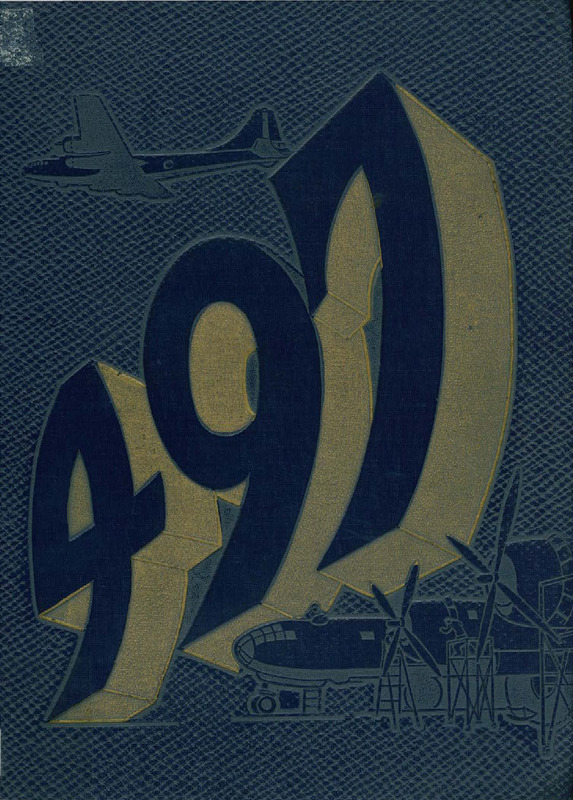
From the Foreword, written by Arnold T. Johnson, Col. A.C., Group Commander: This book has been prepared and published in the belief that every member of the 497th Bomb Group will want to have its glorious combat history preserved and that every member will desire to have a copy. It is hoped, as you browse through this book in future years, it will serve to remind you of your many friends and team-mates with whom you served. It is hoped, as you glance through the "Roll of Honor", it will keep alive your memory of our brave friends who did not return, and of the great sacrifices a war exacts. Because these gallant men made the supreme sacrifice, we are living to enjoy the "Four Freedoms" for which this war was fought. As I think back to those days on Saipan, where we lived, worked and fought together, I think of the smoothest functioning team it has ever been my pleasure to serve with. I think of every man performing his duties with loyalty and cooperation and to the best of his ability. Men in the kitchens, on the maintenance line, in the offices, on board the airplanes; each seemed to take pride in making every mission a little better than the last; each knew that his efforts brought the war to a close just a little sooner. Every-man who fought with the 497th Bomb Group deserves the highest praise and commendation. To each of you I extend my sincere appreciation and congratulations for the job you did so well. Preparation of this book did not begin until five months after the group had returned to the States. The group was then stationed at MacDill Field, Tampa, Florida. Very few of the enlisted personnel had returned, many of the officers had returned but there were also many new ones assigned. Many staff positions were filled by personnel who were new to the group. The records of the group, including the squadron records, arrived home in a thoroughly disorganized fashion and a considerable amount of the records were never found. These facts together with the difficulties in obtaining the correct status of missing personnel and present locations of all former personnel have made the task of preparing this book very difficult. It is desired to acknowledge that this book will contain many imperfections and perhaps many errors. The errors are regrettable but everything has been done to avoid them, insofar as has been possible. In spite of this, it is believed that this book is well worth while and will be thoroughly enjoyable to all former personnel of the group.
Headquarters and Headquarters Battery 108th Antiaircraft Artillery Group, a new organization in the annals of United States military history, has had a rich and important part in the successful prosecution of this Second Great War just ended. Activated 1 March 1942 at Camp Davis, North Carolina, as Headquarters and Headquarters Battery 514th Coast Artillery (Antiaircraft) the Group had had the responsibility for providing demonstration, instruction and maintenance personnel for the Antiaircraft School and Antiaircraft Board until October 1943.
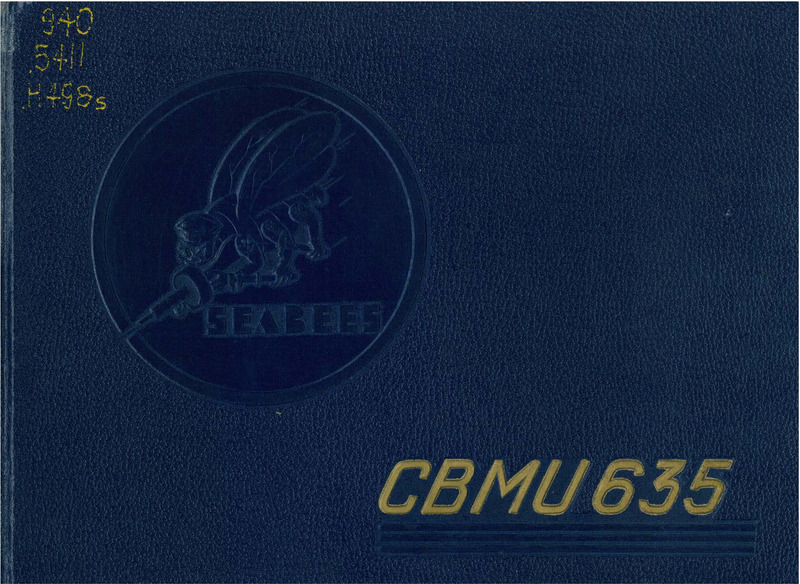
In this book of words and pictures is a compilation of the work, accomplishments, and activities of the Twenty-Sixth United States Naval Construction Battalion (Second Section) which on July 15, 1945, was redesignated Construction Battalion Maintenance Unit Six Hundred Thirty-Five. It is dedicated to each officer and man who gave his' best for the one and only cause, and each can be justly proud of the part he played. The Staff wishes to extend its appreciation to each and every member of this Battalion who helped in procuring and compiling the necessary information, for without your moral support. interest. and actual aid this book would have been impossible. We sincerely hope that in years to come you will refer to this book often in remembrance of the part you and your comrades played in the achievement of the final victory.
The enlistment centers throughout the country were opened to volunteers for the Seabee branch in the latter part of December, 1941, just after the Pearl Harbor incident. In order to induce skilled construction workers to give up highly paid civilian jobs and volunteer for Seabee service, Navy rates were offered. From the ranks of some sixty different building trades, men began to answer the call. The age range was wide, seventeen to fifty years, and the preponderance of older men, many of them veterans of the last war, soon caused the Bees to become known as "grandpops" among the men of the regular Navy.
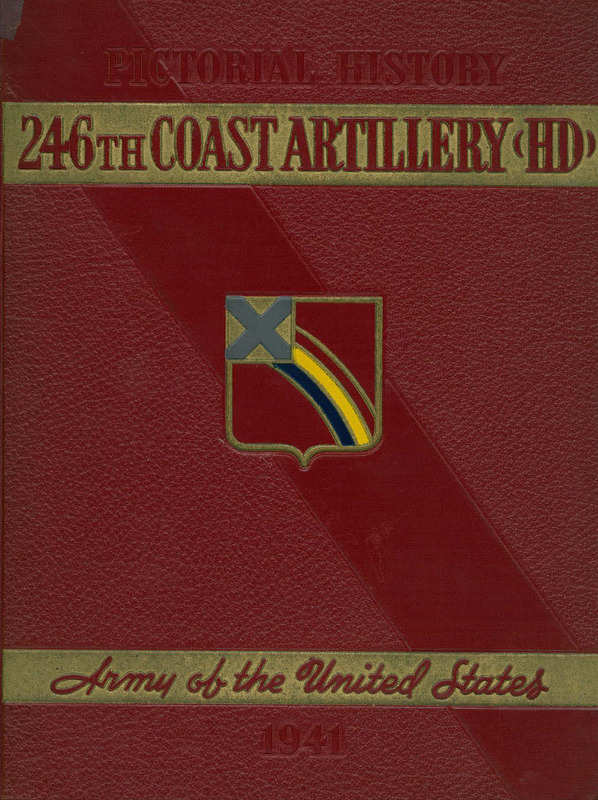
As uncertainty marks the course of world events and Democracy stands on a threshold of unrest and threats of aggressor nations, citizen soldiers of the 246th Coast Artillery again have calmly adjusted themselves to another unlimited national emergency. While many of the great nations of the world are in a state of undeclared war and their peoples enslaved to a dictatorial tyranny, guardians of the Mother State--many of them reminiscent of their 1917-18 struggle to save the freedom handed down to them from courageous ancestors--are preparing for any eventuality that may threaten the American way of life. Just as the first European government crumbled under the heel of a monstrous conqueror in this World War lI--the Army of the United States signaled for strength. We, of the 246th Coast Artillery (Harbor Defense), are proud to be a part of this vast bulwark between a free, peace-loving nation and a force so destructive that the entire world fears for its safety.
This is the story of an artillery outfit in World War II. Most of it had to be written after that war was over and the outfit scattered over the land. It very likely has as many "bugs" in it as the post-war auto. Only two sources of information were available from which to piece this story together. One was the official history of the 91st Division Artillery which bristled with facts and figures, but told little about men and their lives. Whatever was missing, I tried to supply from my memory.
An account of the 10th Mountain Division in the Italian campaign; edited by Theodore Lockwood with the assistance of other members of the division. "It was Washington, D.C., July 15, 1943. At the War Department it was noted that a new division was being activated as of that date--the 1Oth Light Division. Out in Colorado the usual afternoon cloudburst broke loose as the journal clerk recorded the fact that the division had been officially activated. A month later there was a formal occasion; Pando, Colorado witnessed the parade and ceremonies honoring the birth of the Tenth. Major General Lloyd E. Jones reviewed the troops."
This is the story, the history, of a group of men; organized out of all walks of life; from the hills and the mountains; the valleys and the plains; from the farms and the cities; from the rich and the poor organized for war. This is a tale that lives deep in in the hearts of these men; their wives, their mothers, sisters and brothers; their children. Written out of toil and sweat; oils and grease; nuts and bolts--engines, wheels and axles; the things that made modern war possible and hastened its end.
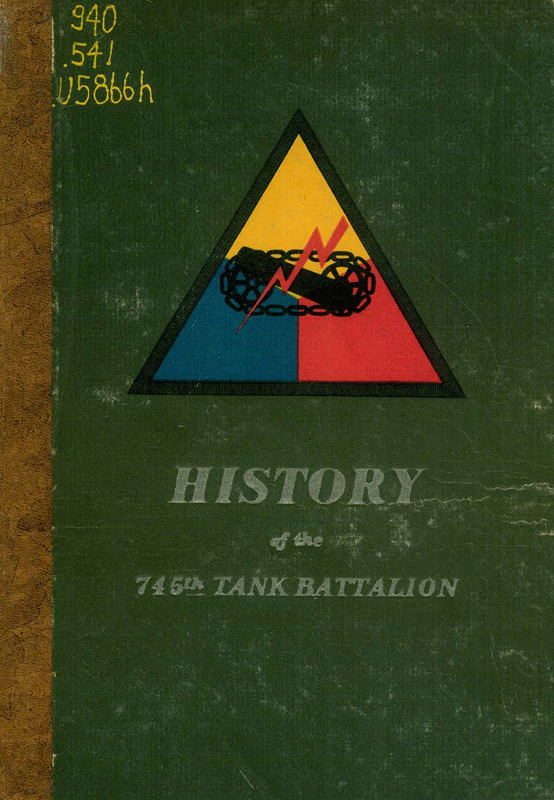
If perchance in the post-war world you encounter a man who says that he fought in Europe with the 745th Tank Battalion, salute him and offer him a drink--for you have encountered one of the best soldiers in the world. You have encountered a man who has contributed a great deal toward ending the conquests of the Nazis and bringing peace to the world. You have encountered a man of whom the entire army is proud.
Greetings To the Military Forces of the State of Maine: It is with a feeling of satisfaction and pride that we present you herewith this history of the military forces of the State of Maine, and in the years to come, whether you are separated from the service or not, it is felt that you may read it from time to time with some degree of satisfaction knowing that you have contributed your part in its preparation and to the accomplishments of the military forces of our State. The men from Maine have always borne a conspicuous and highly honorable part not only in the up-building of the State since early Colonial times but in the various conflicts in which this country has been engaged, and some of the most outstanding leaders in our past wars have been from the State of Maine. The traditions and noble records achieved by our people have been outstanding and it is felt that you will carry on these traditions should you be called upon to face the same conditions as our glorious ancestors have had to contend with.--J.W. Hanson, Brigadier General, The Adjutant General
The American Third Army is the cockiest of all the armies and the fastest-moving. Long on armor, it is led by Lieut. General George S. Patton Jr. and, like him, it is colorful, proud and bold. Its motto is speed and more speed. Its record is the best possible evidence that Marshall and Eisenhower were right when they refused to fire Patton after the face-slapping incident in Sicily.
The story of the Hellbirds is the story of the B-29 Superfort, its debut and development as the most efficient strategic weapon to be employed by any military organization in the world. The chapters of this history tell a story, not only of the lives, the travels and the activities of men drawn from the comfortable surroundings of civilian life into the turmoil of war, but also of the many problems solved by these men and of their untiring efforts to prove the Superfort the most powerful weapon of the American Armed Forces. The B-29 project, launched at a time when a Superfort was still a novelty and gratifying success in two simultaneous accomplishments: the "de-bugging" of the Superfort and the proving of its power and effectiveness as a combat weapon.
To the Officers and Men of the 308th Bombardment Wing and all Tactical Air Units which took part in the Wing's Operations: The long list or 308th Bombardment Wing combat operations, to which this Year Book is eloquent testimony, reflects a degree of loyalty, teamwork, and unselfish devotion to duty or such high order, it is a deep personal satisfaction to me to have been privileged to serve as its commanding officer. During the Wing's operations there were many grim days when our planes were obliged to take the air repeatedly outnumbered by enemy aircraft. The men in the planes and the men on the ground met tests of endurance and fortitude which tried their patience and courage to the breaking point. Yet, they met those tests unfalteringly, refused to be daunted by a numerically superior foe. The fighting spirit and combat know-how which the Wing developed set a standard for operational effectiveness that won the respect and admiration or the entire AAF, a standard that was splendidly maintained throughout the long combat history of the Wing. Air-ground operations were brought to a new high in efficiency. Enemy shipping was smothered and sunk with a speed which exceeded the most optimistic estimates. Japan's extensive network of air bases was progressively rendered impotent. Nip airplanes were driven from the air over every target until their only tactic was the sporadic, ineffectual Kamikaze strike. In the final phase of the war, the intensity of American air power rose to such a terrific pitch the Japanese were pounded beyond human endurance, their capitulation constituting the supreme achievement of AAF men and the planes they flew. Thus, of our gallant airmen who did not come back, we may say, the time they bought with their lives saved thousands of fellow soldiers who would have been lost in the final great invasion of Japan. Because of them and their comrades in the air who carried on, the enemy was forced to surrender before the huge invasion force was launched. Their deeds in speeding the final defeat of the world's last despot nation will never be forgotten, their record will forever remain bright on the historic walls or American Democracy. D.W. Hutchison, Brigadier General, U.S.A., Commanding
While the title "355th AAA Searchlight Battalion" dates back to May of 1942, the actual history of the unit, and the personnel in it, dates back to fifteen months before that--February, 1941. At this time there were four coast artillery regiments in training at Camp Stewart, Georgia. The 207th and 212th were from New York City, the 209th from Western New York State, and the 214th from Georgia. These units had been sent to Camp Stewart for one year of basic training. The A batteries, or searchlight batteries, of these regiments were the units which later formed the First Provisional Searchlight Battalion. Such terms as "DEC," "azimuth," "elevation," "orientation," and "slant range," soon became familiar to the men of these batteries. In addition to their specialized training in searchlights and searchlight tactics, the men received regular basic military training. The study of subjects, such as convoy discipline, first aid, communications, map reading and aircraft recognition, became a part of the daily routine. The men were also given calisthenics, infantry drill and manual of arms to build their bodies.
The Seventy Fourth Field Artillery Battalion, when activated, was the Second Battalion of the Eighteenth Field Artillery Regiment 75 mm. gun horse-drawn. Its parent unit was the Fifth Field Artillery Regiment. Place of activation of this battalion was Fort Bliss, Texas. Date of activation June 1, 1917 and it was first commanded by Colonel A. J. Bowley. Shortly after activation it was ordered to Fort Sill, Oklahoma, where it served as school troops for the Field Artillery School until July 1, 1940. As you well remember, 1940 found the world in a very unsettled condition. Italy was on the march, Germany had occupied, by force, the greater part of Europe and Japan was frantically preparing for a war with our country. Uncle Sam decided it was high time to make a few preparations of his own.
Patrol Bombing Squadron One Hundred Nine was reformed on 5 October 1944 at Naval Auxiliary Air Station Camp Kearney, San Diego, California, as a streamlined Patrol Bombing Squadron with fifteen PB4Y-2 planes (Privateers), and a normal complement of eighteen flight crews of twelve men each. On 6 December 1944 command of the squadron was assumed by Lieutenant Commander George L. Hicks, USNR, former Executive Officer of old Bombing Squadron 109, with Lieutenant Commander John F. Bundy, USN, as Executive Officer. The squadron trained initially under Fleet Air Wing Fourteen at Camp Kearney, flying its planes to Naval Air Station, Kaneohe, T. H., in February for an advanced training period under Fleet Air Wing Two. On 10 April 1945 the squadron moved into the combat area, and active operations against the enemy were begun on 20 April 1945 with a special reconnaissance of PAT ANI Roads, Gulf of Siam, flown from Pala Wan, Philippine Islands. The primary mission of the squadron was long range search, patrol, and armed reconnaissance, but special patrols, strikes and assorted duties often engaged all the squadron's attention.
From History of the 28th Regiment, page 22: On July I, 1944, a convoy of four troop ships and twelve motor transports steamed out of Belfast Harbor carrying the 8th Division to the continent of Europe. On July 4, twenty-eight days after D-Day of the Allied invasion of Normandy, the Regiment began debarking at Utah Beach on the Cherbourg peninsula. Next day it had assembled in the vicinity of Montbourg where final preparations for battle were completed. Allied invasion armies at this time held only a few square miles of the territory of France. The city of Cherbourg had recently been taken, and the Germans had been driven from the northern tip of the peninsula to a point just north of La Haye du Puits. From there the enemy line extended through Carentan and St. Lo eastward to Caen and Orne River estuary. German resistance in most sectors was heavy even against already achieved air superiority. On July 6 the Regiment moved to an assembly area near the town of St. Sauveur Le Vicomte, the following morning orders were received to take over a section of the line, one kilometer south of La Haye du Puits. The plan for the Division, was to attack to the south, passing through the 82nd Airborne Division, taking over the center of the Corps front. The main effort of the drive was to be made in this sector.
The 180th Infantry Regiment was organized as the Third Oklahoma Infantry during May, 1918, and was federally recognized as a National Guard unit on September 3, 1918. The unit was redesignated as the 180th Infantry on October 14, 1921. Units of the regiment were called into state service many times since its organization. In civil disturbances, flood disasters, and other emergencies they performed their ordered duty with credit, thus demonstrating the living reality of part of the regiment's motto, "Ready in Peace or War". It is interesting to note that the year 1938 found Hitler taking his first toll from the 180th Infantry of the 45th Division. Up to that time the insignia had been an Indian swastika. This close resemblance to the symbol of Nazi Germany constituted a source of embarrassment on several occasions. The Thunderbird was substituted for the swastika.
Foreword: "This book is a record of the part the 446th Bombardment Group played in World War II--it is a record of the period that witnessed the growth of the Group from a handful of men who left Tucson, Arizona in April 1943, to the force of over three thousand men who helped end the war in Europe on May 8, 1945. During that time we trained for and participated in the softening up and final smashing of Hitler's Fortress Europe.We saw our Group reach the greatest heights in bombing accuracy, morale and air and ground efficiency--the things necessary in winning the war. The pictures and story show the conditions under which the ground and air echelons lived, worked and died. We watched a number of crews fly their missions, complete their tours and return to the states-- some, not so fortunate, are buried in foreign soil. They flew and fought hoping that their efforts would shorten the war, save lives and aid their country's cause. The men on the ground--the men behind the planes--also showed great resourcefulness, loyalty and devotion to duty. For every plane our Group put in the sky over Europe there were the cooks, clerks, photographers and a score of others on the ground working to put it there. These men did not receive any of the honor or glory, but the work they did was essential for the success of the Group. As a member of the 446th from the time of its organization until it was deactivated in Sioux Falls, it is my desire to say that the cooperation and devotion of these men to their tasks was exemplary. My association with the men of my command will always remain an unforgettable highlight in my life. This photographic log of the Group is a book to be treasured always. As we look through it in the years ahead it will help revive memories of our eventful days at Denver, the journey overseas, the first mission to Berlin, D-Day, V-E Day and a host of other memorable events that played so vital a part in our lives." William A. Schmidt, Lt. Col. A.C., Commanding Officer
The 310th Infantry Regiment has fought in more than one war. This history is primarily an account of the present 310th Infantry Regiment in World War II, but there is a story to tell of an earlier 310th Regiment which carried the same Regimental Colors into battle against the German enemy in World War I.
"The Sky Lancers have established an enviable record in combat against the Japanese in the Southwest Pacific Theatre of Operations. We have advanced twenty-five hundred miles since debarking at Cape Sudest, New Guinea; we have delivered destruction to the enemy over every mile of it and part of our great task still lies ahead on the road to Tokyo. Our gains have not been made easily and the price has been paid in both men and equipment. It is to our gallant comrades who made their last flight with our organization that The SKY LANCER is dedicated, for it was they who contributed so greatly to our success and to the ultimate peace we are to gain through their courageous efforts." Milton W. Johnson, Lt. Col., Air Corps, Commanding
"In this book, the author has not attempted to give a complete history of the Military Railway Service. And in a sense, the task of the author has been a painful one. Limitations of space have precluded the inclusion of many episodes, vignettes, descriptions and analyses. Consequently, most of the personnel concerned have had to remain anonymous. War is not only a matter of facts and statistics. It is experience, and no others can quite understand that experience. The author has tried to tell the story of the war as it came to our organization how it looked and felt, and what our activities were during the fighting. The splendid performance of the 708th reflected credit on all of our personnel rather than on any individual or small group of individuals. This book is intended primarily for personnel of our immediate headquarters, and I trust they will understand and forgive me for not including their individual chapters." --Page 60
Foreword: "No book this size could ever hope to record completely, day by day, mission by mission, the history of the 445th Bombardment Group. Since various limitations did exist and handicap the publication of our Group History, the only alternative was to select such material as would most emphatically demonstrate how superior our Group really was. The photographs selected for use in the book were chosen because they were the most representative of those available. Every attempt was made to provide at least token representation of the few activities and sections not included; however, the fact that some parts of our Group organization have not been included indicates that these attempts were unsuccessful. Because of many changes in Squadron Staff personnel throughout the life of the Group, it was not thought advisable to list the many persons involved. Instead, it was left to various photographs to tell about these men. I sincerely hope that in the years to come this book will recall dimming memories, and that it will always serve as convincing evidence that ours was one of the best Groups in the Army Air Forces. · Rudolph J. Birsic, July, 1947
The "Battle of the Ruhr Pocket" actually took place during the period from April 1 (when the pocket was closed by the junction of the First and Ninth Armies), until about April 19, 1945, when the last resistance took place near the Ruhr River. During this period over 825,000 men were locked in deadly combat. When it was all over some 325,000 Germans were in the Prisoner of War stockades. The author, in order to give the reader more of the background and preparation for the battle, actually takes the reader back to the seizure of the Remagan Bridge, and traces each division as it crosses the Rhine and encountered the enemy in what later turned into the greatest pincer movement the world has ever known. Many books have been published on World War II, but probably none touch on a battle or campaign which was so different from the others than does this book. As you read this volume the publisher hopes you are able to secure a better knowledge of the "Battle of the Ruhr Pocket" as it unfolds before you in the peace and contentment of your home and office. The author of this book remembers the Ruhr well. He served as a combat infantryman throughout the entire engagement and when asked today what he remembers most about the Ruhr replies; "Three thing--88's', 88's, and more 88's.