
World War II Regimental Histories
- Title
- World War II Regimental Histories
- Description
- Photograph-rich publications documenting the history of individual military units during World War II, including the unit's organization, personnel, military campaigns, and casualties. This collection was compiled by World War II-era librarian L. Felix Ranlett, a veteran of World War I.
Items
Eighty-Second U.S. Naval Construction Battalion, 1943-1945
Foreword: The primary purpose of our book is to provide a pictorial record in time sequence of the journey of conquest, work projects, and related activities of our battalion in the Pacific Ocean Area. In no other way is it possible for us to have a true and compiled portrayal of our proud accomplishments, notable achievements, and fine associates. The past two years have cost immeasurable energy. We have forgone many civilian pleasures and activities. Accordingly, all this has greatly delayed the progress of our life's planned work. It is our sincere hope that this record be as complete and accurate as possible. We trust that it will give you many fine, complete, and proud recollections of true and sincere fellowship. With this goes a great satisfaction. The contributions of our battalion have enabled the armed forces to successfully travel the road to complete victory. We cannot measure our accomplishments in personal sacrifices or monetary gains or losses, great as they might have been. Rather it is for each of us to accept proudly the responsibility of our work and be humble in our acceptance of the glory in a great achievement. Let us proceed to use wisely the long and costly victory.
Earthmover: A Chronicle of 87th Seabee Battalion in World War II
This book is divided into two parts to accommodate quicker download speed. Foreword This volume is essentially the overall story, in log form, of the 87th U. S. Naval Construction Battalion--a hard-working Seabee outfit, which did everything asked and expected of it from the Solomons through war's sudden end on Okinawa. It is, of course, no better or worse than the approximately 1,300 officers and men who carved out its multiple achievements with their sweat, blood and, at times, even tears. This trip book has been designed to cover the period between 20 February 1943 and 9 October 1945--a span of approximately 31 1/2 months. Unfortunately, no pictures were taken between 9 October and 7 November when the remaining 361 men finally embarked for the States in their twenty-seventh month overseas. The photographer and assisants had all gone home. The story of the tour has been purposely kept vague or general so that each man might be free to relate his version of the sequence of events as he saw them. This publication has been prepared for the men of the 87th, their families and friends and is not intended for general publication or circulation. Moreover, the opinions expressed in this volume are those of the editors and their staff and are not intended to reflect those of the Navy Department or the service at large. Every reasonable effort has been made to keep the written portions of this trip book as objective as possible. And an honest effort has been exerted throughout to make the book as factually accurate as existing facilities for assembling and checking information would permit. However, conceived and launched just prior to leaving New Caledonia and finished in foxholes and amid post-war confusion on Okinawa, the job, a spare-time project until 12 August 1945 , was accomplished under just the worst circumstances imaginable. At its best, THE EARTHMOVER could never hope to depict the overall impact inflicted on each man during the several years spent on these far-flung Pacific islands. but the editors herewith submit it as a fair resume of the 87th's role in World War II.
D + 106 to V-E: The Story of the 2nd Division
From the Introduction: "This booklet is designed to give a general picture of the Second Infantry Division in its operations from the time it reached the Siegfried Line in Germany on October 4, 1944, until it arrived in Pilsen, Czechoslovakia, its location on V-E Day, May 8, 1945. A preceding booklet told how the Second, which was activated in France in 1917 and which probably gained more renown in World War I than any other division, opened its campaign in World War II when it came ashore on Omaha Beach in France, D plus 1, June 7. The story described the manner in which the wearers of the Indianhead patch fought their way through Treviers, Cerisy La Foret, and then, in one mighty effort, crushed the powerful Nazi defenses on Hill 192, grassy slope holding up the advance on St. Lo. In the speedy breakthrough South that followed, the Second stepped out in front and pushed through St. Jean des Baisants, Vire, and Tinchebray in victorious but hard fighting. It was next ordered along with two other divisions to take Brest, heavily defended seaport which the Germans had used as a submarine base. After a bitter four-week struggle, in which the Nazis fought desperately to prevent the port from passing into U. S. hands, the garrison formally surrendered to Major General Walter M. Robertson, Division Commander, from Nelson County, Virginia, on September 18, 1944. The division then moved by truck and train across France and Belgium to the Siegfried Line, where this story begins.

Contrast: The Story of the the Fifth Special Naval Construction Battalion
This is the story of a Seabee Special Battalion, a rigger or stevedoring battalion, whose principal function in the Navy of World War II was the working of the vital cargo and materiel necessary for the prosecution of the War. Special battalions were not permanently employed on Stateside duty; that was a job for civilians. Like all Seabee units, the Specials were rigidly trained and indoctrinated for overseas duty and the inevitable hazards of war. They became the life blood, the dominating force of the supply lines, radiating from Allied ports of loading to the front lines of the farthest theaters of war. Participating in actual invasions, they helped conquer new territory for their supply line, then maintained those extensions as our forces pushed forward toward the enemies' homelands. Ships and craft of every size and denomination, flying the flags of every Allied nation, were worked by the Seabee stevedores, the Special battalions. This, then, is the story of one of those stevedoring battalions, and it chronicles its wanderings from its birthplace in Virginia across the United States; its duty in the frozen wastelands of the Aleutian Islands and the farthest Arctic outpost at Point Barrow; its return to the States for rehabilitation and re-assignment; and finally, its tour of duty in the South and Central Pacific. From Point Barrow to New Guinea, from Virginia to the Philippines-thousands of miles, months that stretched into years, are written into this history, a story not only of the battalion but of the men, the individuals themselves, who loaned that part of their lives to the service of their country that this history might be written. It is to them, then, the men of the Fifth Special Naval Construction Battalion, that this history of their outfit is dedicated. Frank L. Holland, Lieutenant-Commander, USNR, Officer-in-Charge
Cargo Soundings Album: April 1944 to November 1945
Prologue: Soon after the treacherous attack on Pearl Harbor, the idea was conceived by the Navy Department of forming construction units which would do all construction work overseas that would arise from the exigencies of war. Less than a year later a bottle-neck developed in the unloading of ships which made it obvious that the Navy needed not only experienced builders but capable stevedores, as well. Hurriedly the "Special" Battalions were formed. Their personnel consisting of some life-long stevedores, but in great part, of men who had never before been on a dock for a purpose other than boarding a ship or fishing. These battalions came through in the best traditions of the Seabees and the U.S. Naval Service. From Port Hueneme, California, to the Philippines, from Davisville, R. I., to Burma. The "Steve-bees" have, in full battalions, detachments and units, performed miracles in speed of loading and unloading supply ships. The 28th Special Naval Construction Battalion is typical of the fast-working, efficient, stevedoring outfits that have done so much to facilitate the logistic angle of the war effort. At Pearl Harbor it received commendations for its speed and capability, for its record-breaking handling of all possible manner of cargo. In the Philippines it continued its excellent work. Soon after V-J Day the battalion moved to Japan, where it was decommissioned. When the 28th Special landed at the Philippine Islands, it found nothing in the form of living quarters waiting for them. A camp had to be built from scratch and there was no one around to do it but the stevedores themselves. The men fell to the job with a vengeance, determined to prove their versatility. Following in the footsteps of a Construction Battalion, they built a camp that was generally conceded to be among the best on the island. It is to these men who have sweated on the docks through all hours of the day and night; who have outdone themselves in an unaccustomed construction job that this book, the story of their lives in the 28th SI'ecial, is respectfully dedicated.
Can Do: The Story of the 571th Naval Construction Battalion Maintenance Unit
The story of an outfit is often a story of the individual experiences of its men, but this narrative is a chronology of the collective achievements and adventures of men working in unison, primarily the men who formed the original complement of Construction Battalion Maintenance Unit 571. The charter members of this Seabee crew hailed from all walks of life and went on to carve out a bright record of attainment on lonely tropical islands unheard of and unimportant until war made their possession and exploitation necessary. The final, complete story of CBMU 571 is not over, because CBMU 571 is, at this writing, still commissioned, still doing a job, still adding to a record. But to the men who formed it, who carried the knowledge, the brawn, the guts, and the equipment into the islands of the Pacific, this chapter of their careers as Seabees is completed. These men may go on to other naval organizations or they may already be civilians again, but their first love as servicemen will be CBMU 571.
Boom-Dozer: 30th Special Naval Construction Battalion
"This is a pictorial review of the overseas activities of the men who helped deliver the goods for the Navy. This may be interpreted as the story of your own Bill or Joe or Eddie, for within these covers we have endeavored to display the living story, in pictures, of individual personalities. How better could a Seabee Battalion be defined than " ... a sizeable group of individuals, each of whom possesses a knowledge of some specific trade or profession, is able to think for himself, to perform his duties under pressure, working together as a highly synchronized unit and willing to fight together if need be to preserve the freedom and personal right for which our great country stands."
Blackjack, 1944-1945: A Story About and Published by 21st U.S. Naval Construction Battalion
Foreword: For three years these men have adjusted their individual characters, their own ways of doing things, their very natures to that vague method of procedure called "The Navy Way." It is at once the most efficient and most bungling method of getting things done. It is a conglomerate of logical procedure mixed with hopeless muddling, sound economy with profligate waste, rank incompetency with expert performance, nonsensical methods of operation with excellent results. Men exposed to the Navy Way for three years have drunk the dregs of despair and tasted the wine of life at its fullest. They have seen life at its worst and at its best. Men so exposed will never be the same. Such are the men of the Twenty-First. This is our story. This is the story of the 21st U. S. Naval Construction Battalion, the 21st Seabees, the Blackjacks--one of those groups of a thousand-odd men who helped to build and fight the way to the defeat of Japan. We were just one battalion, and thousands of battalions and millions of men and women made up our armed forces. Maybe our part was small in the whole history of the war, but we saw to it that this part was done with a let's-get-it-over-with-quickly, "Can Do" energy. These words and pictures are mostly about our second tour of overseas duty--our work in the Central and Western Pacific. Before this came our first "cruise" in the Aleutians.
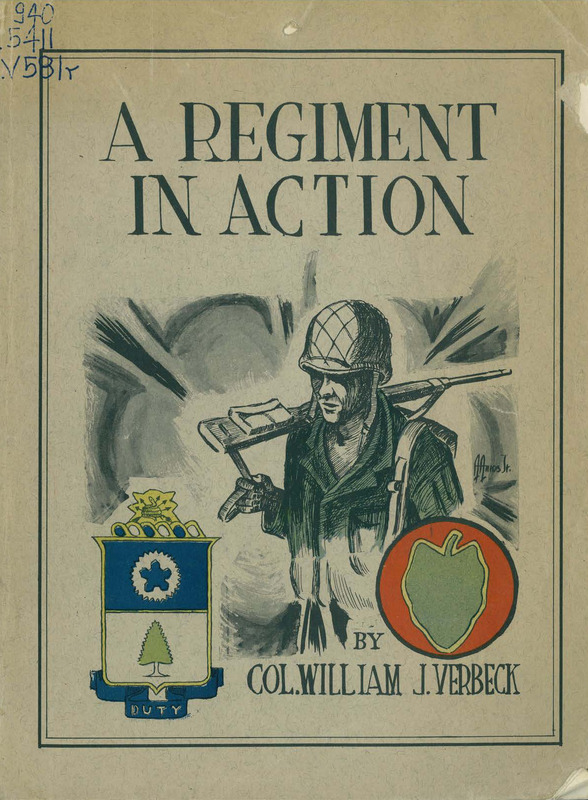
A Regiment in Action
"The work which follows is by no means a thorough or complete history of the Twenty First Infantry Regiment in World War II. To my knowledge no such history has yet been written. I have, however, a number of official accounts of some of our actions. These I have edited and put together with whatever other information available in order to have at least some form of published record. I am publishing this work in response to numerous requests from members and former members of the 21st Infantry as a chronicle of our days together in combat. Most of the description concerning the Hollandia Operation was submitted by Lieut. Colonel Roy W. Marcy. The sketches after Page 37 and Page 52 were drawn by Mr. Lawrence E. Hickman another former 21st Infantryman. Great thanks are due to Lieut. Colonel Judson MacIvor Smith for the material on Pages 3, 4, 5 and 6 which were taken from his book "The Story of a Regiment"--a history of the 21st Infantry. Thanks are also due to Mr. Arthur Amos, Jr. for the cover, Miss Ruth Middleton for typing the manuscript and to Mr. T. L. Tuggle for supervising the multilith operations of reproduction. I would be glad to receive information from anyone who can furnish more complete data for inclusion in a future, more complete work. Also any corrections or suggested changes will be very welcome."--William J. Verbeck, Colonel, Infantry, Commanding Officer of Troops, U.S.M.A., West Point, N.Y.
A History of the 334th Infantry, 84th Division
Two Years of Preparation: The 334th Infantry Regiment was activated 15 October 1942 at Camp Howze, Texas. For a regiment which was later to grind its way through the Siegfried Line, disorganize three of Germany's finest divisions in the Ardennes, and spearhead the Ninth Army's drive across the Roer and into the German heartland, the beginnings were not sensational. In 1942 Selective Service began to look more carefully into the manpower pool, and the Army began to develop a reservoir of Infantry. Many original men of the regiment had been classified 4F by lenient draft boards who subsequently reclassified them when the quotas were made more stringent. In October 1942 the War was nine months old, and while many men were convinced it should be fought, few were volunteering for the Army, and fewer for the Infantry. The Air Forces were called the Air Corps, a place for gentlemen and adventurers, and the Infantry was coolie labor, a tutored mob. The first men to join the regiment had a "raw deal" they told themselves around the beer tables in the PX. First, they didn't like the Army; second, they weren't physically fit; third, their talents were not being used. As the men looked around and listened, they invented a satisfying rumor, compensation for their "raw deal," a rumor that was going to last until we heard the first sounds of Long Toms and 240's outside Gulpen and Waalwiller, Holland: "We're a replacement outfit. The 334th isn't going anywhere. If it does, we're Army of Occupation. Man, they can't send this outfit into combat!"
96th Seabeeography
At the Naval Construction Training Center, Camp Peary, Williamsburg, Virginia, on the first day of June, 1943, E. H. Honnen, then a Lieutenant Commander, on orders from the base Executive Officer, set up headquarters in Area B-8, and began the formation of the 96th Naval Construction Battalion. In a few days, officers and drafts of men, most of them recently out of basic training, began arriving in the area. Those were busy days.
90th USN Construction Battalion; Its History and Accomplishments, 1943-1945
The 90th U. S. Naval Construction Battalion was born at Camp Peary, Virginia on the twenty-fifth day of July, nineteen hundred forty-three, in the blistering hot sun, as those who were there will well remember. As an indication of what was to come later the sun, in all its glory, was appropriate; for the battalion, on its tour of duty in the Asiatic-Pacific Theatre, has scarcely ever found the smallest amount of shade! From Peary to lwo Jima and V-J Day our stirring saga runs. The inevitable triumph of Allied arms found us deep within the shattered inner perimeter of the Land of the Setting Sun. This, The History and Achievements of the 90th United States Naval Construction Battalion, is our LOG.

649th Engineer Battalion
From the Introduction: Activitated 15 December 1941 at Fort Belvoir, Virginia, the 649th Engineer Battalion was assigned to the First Army and placed under the technical direction of the Chief of Engineers. In an Army the size of ours the activation of a battalion causes only the slightest ripple on the pool of available manpower. It's just another battalion with a number and that's as far as it goes. But this book isn't about numbers; you can find numbers in an arithmetic book. This is the story of a group of men and we'd like to tell you from whence they came. At its inception, the battalion comprised three companies, viz: Headquarters and Service, including Photomapping; B, the Reproduction company; A, the Survey company ... Though the majority of us came from New York, New Jersey or Pennsylvania, all sections of the country are represented in our ranks, and practically all the states. What better beginning can a battalion in this man's army have?
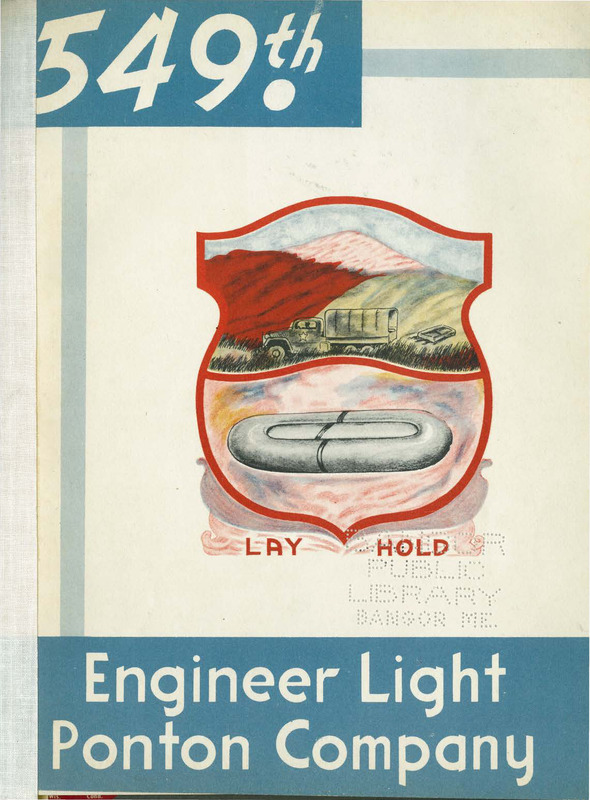
549th Engineer Light Ponton Company
One of the war's famed Engineer Light Ponton Companies was born on paper in Washington, D. C. on 14 January 1943, a full five months before its first soldier opened the door of the orderly room at Camp Hood, Texas. Never then realizing what a great part he would play in World War II the 549th Engineer knocked the dirt from his spikes and got ready for the great race across the States and half way 'round the world. It was indeed to be history · and now the curtain opens on the big show ...
42nd General Hospital in World War II
It is with the hope that your book will aid you in appreciating the part played by the 42nd General Hospital in this War that it is presented to you. A scarcely less important purpose is that of familiarizing each section with the work of other sections and of the unit as a whole. In after years, its value will increase to each one of us, and it will come to form a tangible link with the comradeship we shared in working toward a common end--the alleviation of suffering. Wherever possible, the record is presented pictorially. If some group or department feels itself slighted, the editors can only plead pressure of time and the shortage of film and photographic service, trusting that any shortcomings will be graciously overlooked. To all those whose kind cooperation made your book possible, we extend our sincere thanks, and to the Signal Corps of the United States Army we are indebted both for many of the pictures and much of the general photographic work.--The Editors. The Staff: Major Theodore A. Schwartz, Major Walter E. Karfgin, Sgt. Clarence G. Luther, Sgt. Charles E. Church, Pvt. 1Cl. Julius Goldstein, Pvt. Burton V. Doyle.

233d Engineer Combat Battalion, 1943-1945
From the Introduction: That is the purpose of this book--to tell a story, the story of the men of the 233d Engineer Combat Battalion ... their combat experiences, the story they want to be told. It comprises the better part of the history, and in its writing it is fully realized that at its best this book will be only a brief summary of the full story. Each act of heroism or determination, each recording of skill and self-sacrifice, and each feat of bravery depicted will be only one of many. Throughout the entire writing of this book I have had to be content with the telling of a few incidents with the full certainty of neglecting many. The only records of many acts of courage are still being held in the hearts of the doers, and only because they were seen by someone else did those related here become known. For it was the spirit of the Battalion that to sacrifice, to go beyond the call of duty and to accomplish the job at any cost was merely doing the job well. If this book tells the story they want told, if it brings a feeling of pride to the members of the Battalion, if it brings enjoyment to its readers, it will have fulfilled its purpose, and it is further hoped that in its recording I have brought forth the spirit of undying cooperation that so successfully carried the 233d Engineers across the many beaches in the Pacific Theater and made the accomplishment of their every mission possible.--Victor E. Weaver, 2nd Lt, 233rd Engineer Combat Battalion, Adjutant
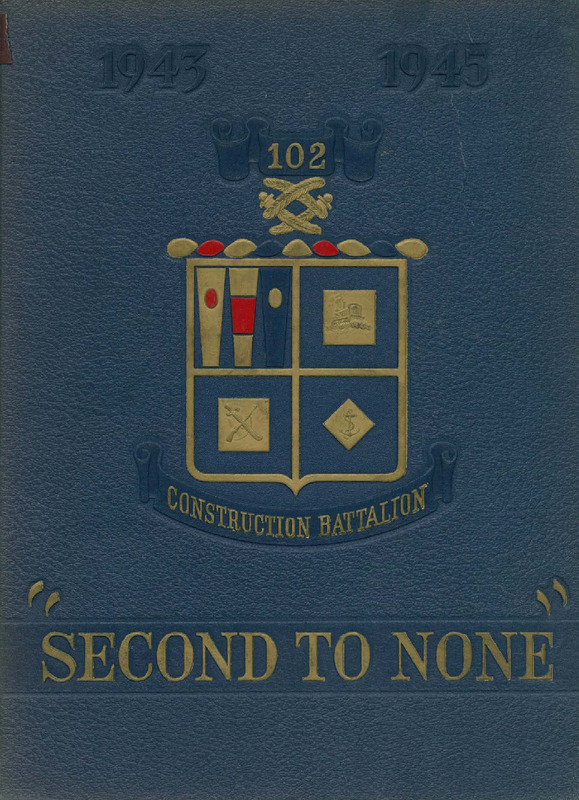
102 Construction Battalion: "Second to None"
"From February to December 1945, the 102nd Construction Battalion was engaged in the building of the Submarine Base, Subic Bay, Philippine Islands. Their nucleus planning group came in with the assault in February and immediately started work at the selected site which at that time was mostly rice paddies, swamps, and bare hillside. Under great difficulties of lack of adequate personneL materials and equipment, together with adverse weather conditions, the Battalion cheerfully and efficiently improvised and established essential elements of the base which were extremely useful to our submarines in fighting the last few months of the Jap war. Although uncompleted at the termination of hostilities, many members of the Battalion voluntarily stayed on long after with the avowed intention of completing the base which they had started. For their future memories, the members of the 102nd Construction Battalion have left a monument to themselves which will serve their Navy and their Nation for many years to come. It is a base which we did not have before World War II started and which is now available to us should any future aggressor nation decide to to interfere with our rights and liberties. I salute the 102nd Construction Battalion for their excellent spirit and achievements." James Fife, Rear Admiral U.S. Navy, Commander Submarines, Philippine Sea Frontier

“We Did”: the Story of the 62nd NCB, December 7, 1942 to September 15, 1945
Foreword: The battalion arrived at Pearl Harbor on March 29, 1943. "Remember Pearl Harbor" had become a battle cry for all Americans in the Pacific War. Our Marines had turned the tide of the Japanese offensive at Guadalcanal and the enemy had begun to feel the blows struck from Henderson Field built by the Seabees. The Navy was beginning to marshal her fast growing forces at Pearl Harbor. Men, material, and ships required new barracks, warehouses and ship-repair facilities. The 62nd Battalion was the first to take over work from the contractors at Pearl Harbor and our officers and men carried through their jobs with the true Seabee spirit and ingenuity. Among the vital and urgent projects completed were the Submarine Base Extension, the Waipio Point Amphibious repair facilities and housing at the Advance Base Reshipment Depot. As the Pacific War moved in to full scale offensive, our battalion was assigned to the Western Pacific on the assault eschelon at lwo Jima. Our battalion arrived on " Bloody lwo" soon after the Marines and started to work immediately on the Southern Airfield. As soon as the Southern Field was operational, the 62nd Battalion was ordered to the Central Airfield. Both jobs were started under enemy mortar and sniper fire and the courage and the spirit of the battalion can never be forgotten. This book is a history of your battalion, a battalion in which you can take well-earned pride. It is a record of your experiences, both the hardships and pleasures which have made up your part in the winning of the war in the Pacific.--F.B. Campbell, Comdr. USNR (CEC), Commanding Officer
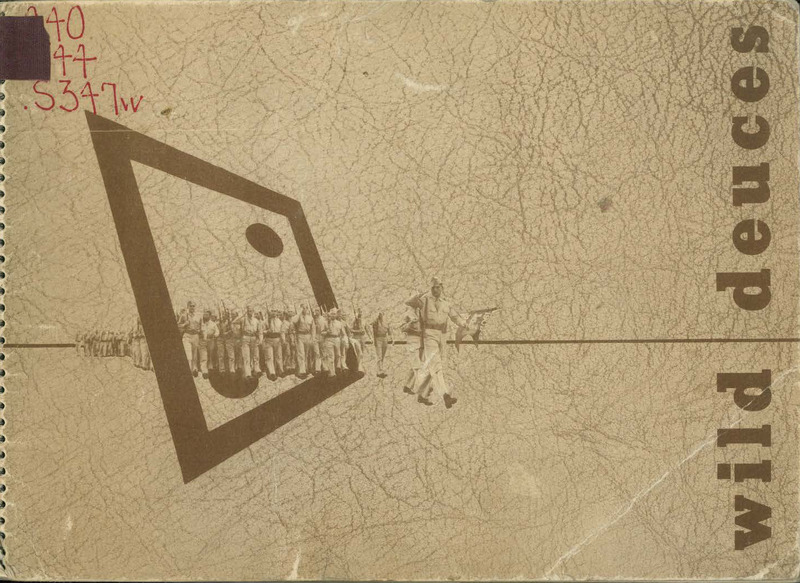
Wild Deuces: 1902 Engineer Aviation Battalion
"Here is our story -- to the everlasting memory of associations with men of courage, ability and determination in time of our greatest national emergency, a job well done." --Robert E. Fonger, Lt. Col. C.E., Commanding
![What's the Story? [49th Armored Infantry Battalion]](https://bangorhistory.org/files/large/7f0e01df50ae7058cdcd7d3a8f41b71bf3fe3eed.jpg)
What's the Story? [49th Armored Infantry Battalion]
6-7 January 1945: We made the most of our opportunity to get acquainted with the French. Phrase book in hand we went determinedly after the population, and soon large clusters of Gls were seen around tolerantly amused little kids, asking any sort of question they could think of. For the most part the kids waited until the boys were just about talked out, and then asked for ''Chocolate, chewing gum, or cigarette pour papa." Others didn't wait for them to talk themselves out. No matter how the conversation started, it always ended with the request for cigarettes and chocolate. In an alley down the street a still was found that transformed apple juice into a product for which many uses were found, including lighter fluid . And the "Vive Ia France!" sentiment gained in intensity. Our vocabulary was soon increased by such valuable terms as "Cognac, Calvados, No compree, Couchez avec moi, etc."
We Did: The Story of the 77th Naval Construction Battalion
From the unofficial introduction: "And Seabee ingenuity, what of that? We made bull fiddles out of oil drums, violins out of native mahogany on Guadalcanal, sight-seeing boats out of sunken barges; drove piles without pile drivers, built bridges before our equipment could get to us. On Bougainville, although bombed 60 times by the Japs, Seabees on their own time rigged up an ice cream factory which supplied 30 gallons of the world's best ice cream to these fighting builders. Perhaps these examples seem trivial in the light of the substantial contributions to total victory which the Seabees have made, but they reveal the spirit of the men. How are you going to discount men who can go through 60 bombings and come out making ice cream? We are famous now, this group begun so few years ago--famous for our work, famous for our fights, famous for our ability to make something out of nothing, but we are famous for other things, too, not the least of which is our chow. Many are the Marines and soldiers who have come to Seabee mess halls for a hot meal. The 77th never sat down to a meal without at least one guest. Some of these were famous, many more were just GI's on the line who could do with something hot inside. The 77th Welcome Mat was always out, not one meal chit was ever issued to one of these guests. So it went for four long arduous years, move up, move in, build up, roll down, clear out, haul dirt, tamp strips, lay mats, move out, start again. The pattern has been set, the die cast. The Seabees are in, in to stay, in as a part of the fighting team of the United States. Construction men in uniform, trained to build by years of experience, trained to fight by Uncle Sam, ready to turn Can Do into We Did whenever and wherever the need for construction engineers is greatest. And now for the story of the 77th, one of the best of the many which fought and built in World War II."
U.S. Marine Corps, Women's Reserve: Camp Lejeune, N.C
It was World War II that brought to women their first opportunity to serve as an integral part of the Corps. The challenge came on February 13, 1943, with the announcement that the Marines had once more opened their ranks to women and now offered them full membership, including the chance for promotion to non-commissioned and commissioned grades and the privilege of serving in a wide variety of posts. Thus, scientific developments in war-making equipment, the global proportions of World War II, and the desperate need for a never-before-dreamed-of number of Marines, had made women's role in the Corps the most vital and important in history. In response to the challenging ''Free a Marine to Fight'' women began to flock to the procurement offices. Mrs. Ruth Cheney Streeter, of Morristown, New Jersey was appointed director of the new Women's Reserve and commissioned a major in the Marine Corps. Long active in public affairs, a member of the New Jersey State Relief Council, New Jersey Commission on Interstate Cooperation, and New Jersey Board of Children's Guardians, as well as former chairman of the Fort Dix, New Jersey, Citizens' Committee for Army and Navy, she was eminently qualified to take up her new tasks.
The Story of the 73rd: The Unofficial History of the 73rd Bomb Wing
From the Introduction: Before leaving Saipan a number of men with the 73rd Wing and its units expressed a hope that some sort of a history of our organization would be published and made available to all Wing personnel. The Wing historical officer seemed the logical person to do this since he had handled the official history of the Wing which is now on file in Washington. In response to this demand, as well as to other requests received since returning to the States, this volume is prepared. While material in the book is partly borrowed from the official history, it is mostly written and collected now after a few months in the States have mellowed our memories of the Marianas. The 73rd Wing, as a whole, was a homogeneous, hard-working organization. Its personnel were cooperative with one another and did a tremendous piece of work on and from Saipan. The Wing was not only the first 20th Air Force organization to hit Tokyo but it also dropped the largest number of bombs on the Japanese Empire and flew the most missions of any of the 20th's five wings. To the 15,000 men who went through the months on Saipan, those months were long and hard. While these men may not have actually been in the front lines, the Wing's casualty list of both men and airplanes show that we were a fighting organization. Also our living conditions were far from comfortable most of the time. Our food was sometimes inferior and our quarters were not too good. We were subject to Japanese raids during the early part of the period. Nevertheless, our memories of Saipan will always be close to us. While this volume is written primarily from the point of view of the Wing Headquarters itself it should be of interest to all personnel of the Wing's organizations. After all, the Wing did operate as a single unit from Saipan and the groups never did operate independently. The statistics and figures included have to do with the Wing operation as a whole rather than any particular organization. This history will necessarily lack the personal touch that the story of a smaller unit might have. Personalities are pretty much lost in the over-all picture. These 73rd Wing organizations included the four tactical groups-the 497th, the 498th, the 499th and the 500th Bombardment Groups. Also there were the four Air Service Groups--the 65th, 91st, 303rd and 330th. Without these maintenance and engineering specialists and the Service Centers they manned, the Wing would surely have failed.
The Soldier-Railroaders’ Story of the 716th Railway Operating Battalion
December 21st, 1943 marked the day of activation of the 716th Railway Operating Battalion. The outfit, sponsored by the Southern Pacific-Railroad, began its life at Fort Sam Houston (San Antonio), Texas with officer personnel drawn chiefly from the sponsor and a cadre made up of "veterans" of the 726th, the unit that had recently completed its technical training on the Santa Fe at Clovis, New Mexico. For the most part, both the officer personnel and the cadre were former railroad men.