Explore history through the digital collections of the Bangor Public Library and our community partners in Bangor, Maine
City of Bangor, Maine, Annual Reports, 1933-1965
Title
City of Bangor, Maine, Annual Reports, 1933-1965
Description
Reports of the city council, manager, and departments providing an overview of the past year's accomplishments. The reports include photographs and financial statements. Additional reports are available to view in the Local History Room.
The old auditorium at Bass Park was demolished to make room for the first stage of a multi-phase improvement project to convert this area into a landscaped park and parking area. An architect will be selected to renovate the Post Office into new municipal office facilities and the renovation project itself should be well underway by the end of 1966. A substantial amount of time and effort will be expended in assisting various higher educational facilities to get under construction within the City. At the Hogan Road exit of Route 95 it is anticipated that the new state vocational school will be under construction and Husson College will also begin the development of its area on Outer Broadway. To both projects, the City of Bangor has pledged assistance in the construction of access roads and sewer facilities.
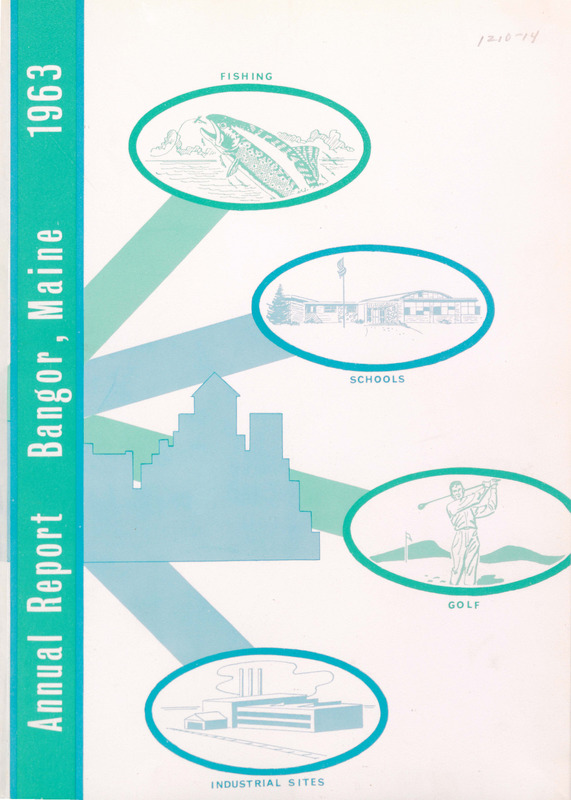
The new Municipal Golf Course was completed in time to open the second nine holes on September 19 (the first nine had opened on July 9) and play on the course exceeded all expectations. The maintenance building was completed in September, and the clubhouse was completed in October, so that the Recreation Department will be ready for a full season in 1965. The announcement by the Air Force of the proposed deactivation of the Bomarc Missile Installation and Dow Air Force Base required a considerable planning effort for the future use of these facilities. This will constitute a major portion of the administration's activities in the coming year. Probably the single most pressing problem in 1965 and for the next two years to come, will be the planning for the smooth and orderly transition of the use of the facilities at Dow Air Force Base from military to civilian. An excellent start has been made on establishing procedures for this project, and the community has taken a positive approach since the proposed deactivation was announced. However, many months of hard work and tireless effort on the part of many of our citizens as well as municipal staff people will be required to achieve the desired objectives.
Bids were opened and contracts let on a Capehart Junior High School for 330 pupils and a Capehart Elementary School for 450 students. These will be ready for occupancy in February of 1965. The Kenduskeag Stream Parking Plaza was completed and dedicated in July of 1963. This provides an additional 313 parking spaces in the center of the downtown business district. Twenty spaces were also added with the construction of the parking lot at the corner of High and Middle Streets. The Stillwater Park Urban Renewal project has proceeded smoothly and rapidly. As of the end of the year, 103 parcels of land had either been acquired or were under option, 40 families have been successfully relocated and the construction of the public improvements in the form of streets and sewers has been started by the Public Works Department.
Plans were developed during 1962 for the complete renovation of the downtown area through Urban Renewal where it appears that the city could execute a five million dollar project at no additional cost to the city (since its share would be made up of the Kenduskeag Stream Parking Project already nearing completion). A considerable amount of new highway construction was completed in the city during 1962. This included Washington and Hancock Streets, the reconstruction of the Church Road and the Hogan Road, the reconstruction of another section of Harlow Street, the reconstruction of the intersections at Broadway and Center Street, and Broadway and Somerset Street for improved traffic flow, and the construction of $25,000 worth of sidewalks. Also there was a considerable amount of state and federal highway construction in the city, with the Capehart area $400,000 project started in the summer of 1962, as well as the reconstruction of a section of Hogan Road from Mt. Hope A venue to State Street. Engineering work began on the relocation of Route 1A, and the improvement of the Bangor end of the old Bangor-Brewer Bridge.
A Council Chairman is the leader selected by the City Council membership at the beginning of the Council year. He directs its regular and special meetings, officiates at formal occasions and represents the city in other ways as its mayor. It is an honor and one to which any Bangor citizen can aspire. As a Bangor native, it is with pride that I represented your City in 1961. As one becomes better acquainted with the Oueen City and its workings, he gains more pride in it. Most of its 32.9 square miles have seen changes in the year and many more are now in the building stages. As elected officials, your councillors are charged with the responsibility of seeing that these changes are always toward the objective of a better Bangor. Most changes, however, are disruptive in one way or another. But, just as grandfather hates to have the location of his favorite chair moved, so we know that a "status quo" would be much preferred by some. Yet when the changes have been made and the strangeness wears off, it quickly becomes evident that there was a need for the change and it does look better and is an improvement. So it is with Bangor. The times are taking us forward whether all of us relish it or not. --Carl E. Delano, Council Chairman
1960 Progress: The year 1960 saw continuing progress in many areas of municipal activity. 1. Schools. Major activity was in the completion of the Fourteenth Street and Capehart Elementary Schools. Less substantial progress was made in the construction of the high school… 2. Parking. Very substantial progress was made in solving some of the city's parking problems during 1960. In Abbott Square, the new annex was completely paved and new meter islands installed providing an additional eleven one-hour, fifty-eight two-hour and 271 all-day parking spaces in the area. The Pickering Square lot was completed with paving and installation of meter islands and modern lighting with an additional 104 shopper parking spaces… 3. Streets and Traffic. On November 18th, the Interstate Highway within the City of Bangor was completed and dedicated with traffic to proceed from Main Street via the Industrial Spur to the Interstate at the bulge and then northerly to the Hogan Road completely circumventing the downtown shopping area.
The year 1959 will long be remembered as one of outstanding achievements in our city. It was a year of firsts, a year of celebration, and a year marked by the sincere hard work of your City Council and its associated boards and agencies. We celebrated 1959 as our Anniversary Year, our 125th as a chartered city, and a year-long program of superlative events was staged by an energetic and tireless Anniversary Committee of industrious citizens. "Building a Better and Busier Bangor" was the byword, and your City Council cooperated to the fullest in every respect. After several months of strenuous effort the Council, for the first time in seven years, held the line on the tax rate, and there was no increase, despite an upward adjustment on all City employee wages, and a final budget of $4,752,552.
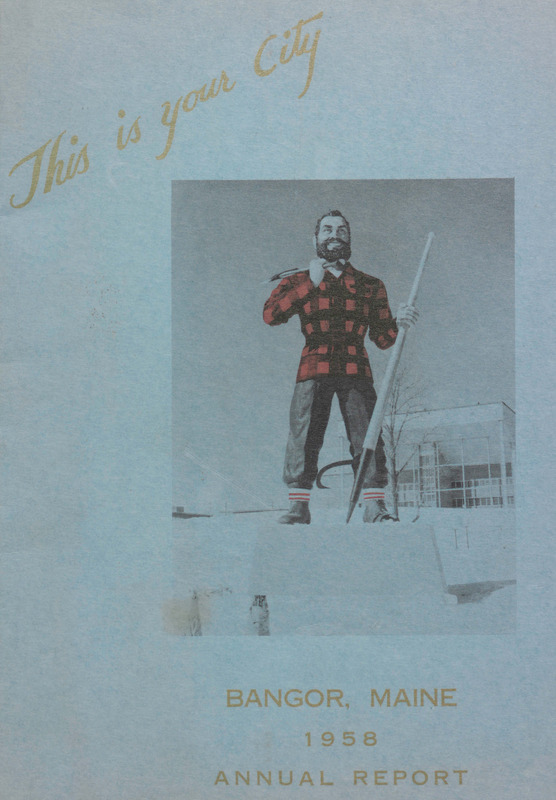
The year 1958 saw more outward changes take piece in Bangor than ever before in its history. Construction on the Interstate Highway was well underway as Bangor received the first contract in the State because of a progressive Planning Department, which had a proposed plan ready when Federal and State money became available; the Capehart housing consisting of 530 units was under construction; the Bomarc Missile site; the completion of the new multi-million dollar runway at Dow Field; new modern buildings replacing dilapidated frame structures in downtown Bangor; as well as many new warehouses in our Industrial Park; and the virtual completion of the Main Street Interstate Bypass. All of these projects required close cooperation between the Federal, State and local government. The construction of a new upland water supply was started during the year. The city disposed of various surplus property with the purpose of returning to the tax rolls idle property, which if continued over the years, will help broaden the tax base. The Kenduskeag Stream parking project was voted down by the citizens but a serious parking need still exists, and something must be done soon to alleviate this problem to insure Bangor's continued prosperity.
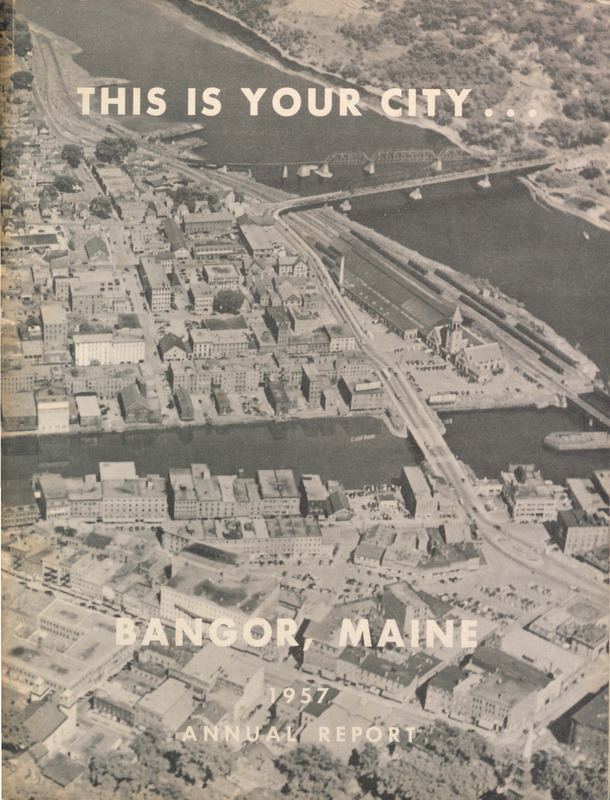
1957--A Year of Progress for Bangor: Increased Surplus $120,000. Established New Industrial Park and Began Construction of Industrial Park Sewer. Approved $100,000 Bond Issue for Library Expansion. Completed Property Revaluation Program. Conducted Engineering Survey of Kenduskeag Stream Parking Project. Completed Second Phase of Hospital Expansion Program. 15 Additional Beds. Completed Reconstruction--Hancock Street. Began Reconstruction--Thirteenth Street. Paved Hammond and State Street Hills and Court Street. Built 20,000 feet of New Sidewalk. Completed Fern Street Sewer and Grand View Avenue Sewer. Added New Playground at Fruit Street.
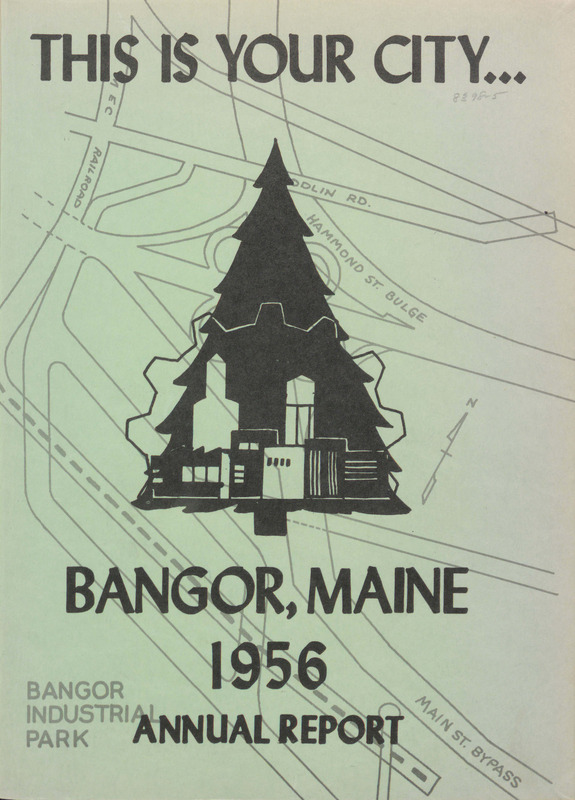
Progress is a continuing thing. Rarely can a single year provide both the beginning and the completion of any sizable project which has long-range aspects; and 1956 was no exception. 1956 witnessed the completion of several important projects begun earlier. Some of the most outstanding were the final decision that the so-called "Industrial Spur"--the by-pass from the Hammond Street bulge--would be built, and actual surveys have been made and plans have been drawn so that construction can be well started and possibly completed in 1957 or early 1958. 1956 saw a successful opening of the new swimming pool on the east side of the city, and while continued experience will improve the operation, many hours of pleasure were afforded to both children and adults by this long needed facility. The year 1956 saw the adoption of a municipal housing code and the creation and successful beginning of an Industrial Development Department within our city government. The adoption of a plan providing group life insurance for city employees will provide protection to families of employees who die prior to retirement before pension benefits can become operative.
One of the items which gave the City Council much concern was the establishment of a new department within the City government for the operation of Bangor's new auditorium. A problem of particular complexity was presented to the Council in the matter of the establishment of a proposed rate schedule for the operation of the auditorium. A compilation of ordinances in auditoriums of comparable size in other areas was made and studied. It was felt by the Council that although the initial cost of the building, which was funded through a bond issue, and interest charges in connection therewith, should be borne by the general taxpayers, the annual cost of operation and maintenance should be borne by those who used the auditorium. The rate schedule adopted by the Council was calculated to provide such an amount and it has, in the operation of the auditorium to date, proven satisfactory.
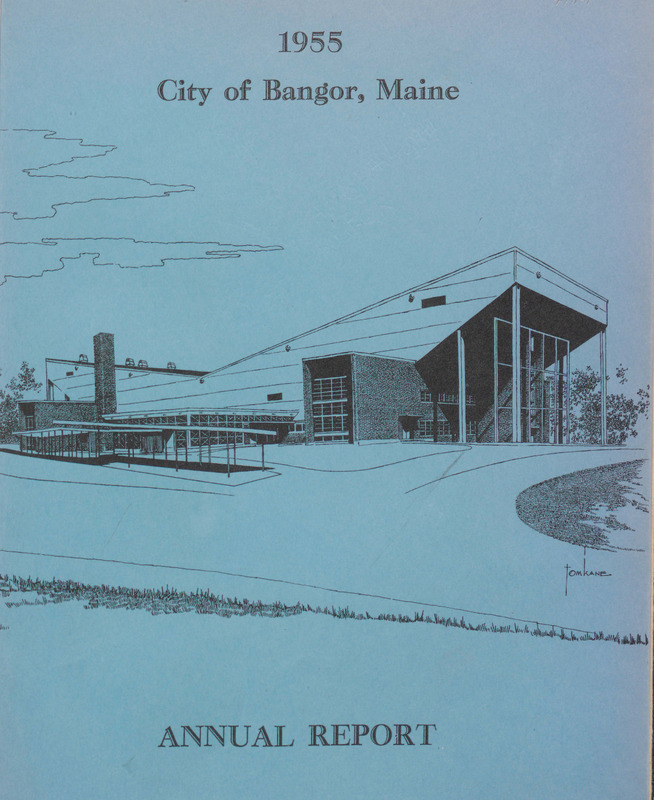
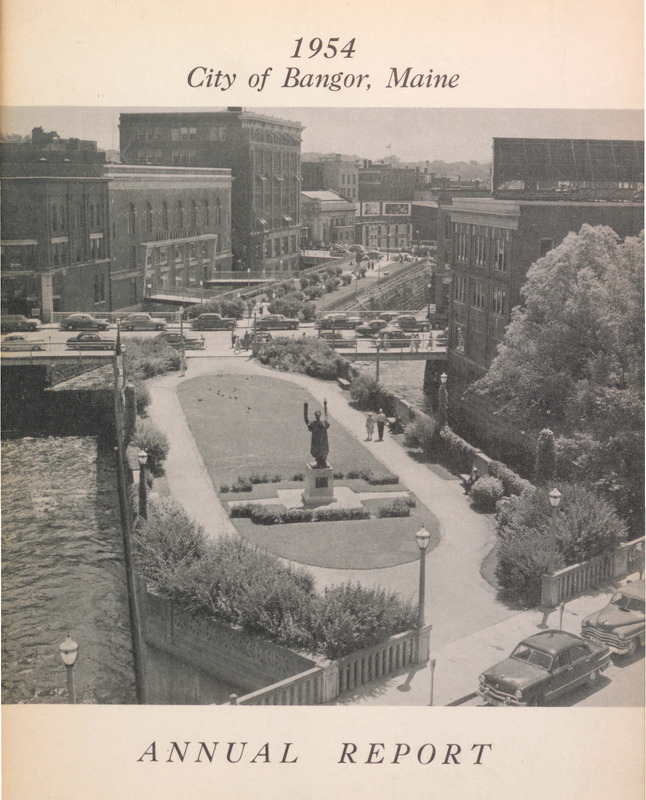
As 1954 draws to a close and we look forward to 1955, the city is working vigorously to solve some of its major problems. Parking and traffic continue to be two of these. Plans have been made to clear the Harlow Street property owned by the city in early 1956 in order to increase the size of the Abbott Square Parking lot. Plans are also in a formulative stage for the construction of a multilevel parking structure on th west side of the city. The Air Force, the Bureau of Public Roads, and the State Highway Commission together with the city, have arrived at a solution to the problem of the relocation of Hammond Street around the expanded Dow Air Fore Base and it is expected that construction will be started in 1955. It is hoped that at the same time, a by-pass road can be constructed to connect with Main Street to route east-west traffic around the center of the city. The operation of the new auditorium will be a major problem in 1955. An auditorium ordinance must be drafted for the regulation of this new department and a new department head chosen to supervise the operations.
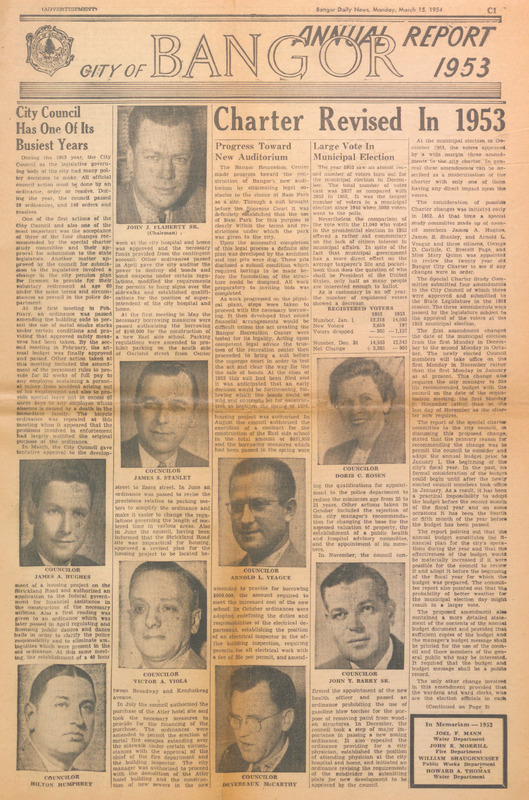
Charter Revised in 1953: At the municipal election in December 1953, the voters approved by a wide margin three amendments to the city charter. In general these amendments can be described as a modernization of the charter with only one of them having any direct impact upon the voters.
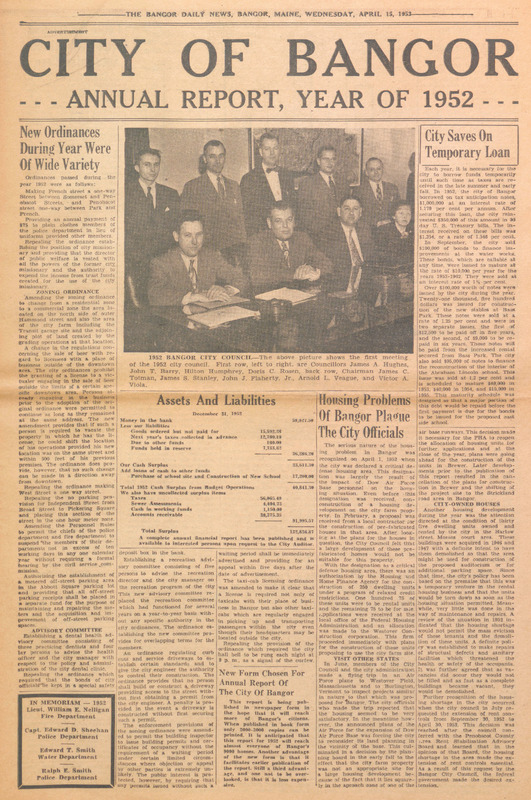
Housing Problems of Bangor Plague the City Officials: The serious nature of the housing problem in Bangor was recognized on April 1, 1952 when the city was declared a critical defense housing area. This designation was largely the result of the impact of Dow Air Force Base personnel on the housing situation. Even before this designation was received, construction of a housing development on the city farm property. In February, a proposal was received from a local contractor for the construction of prefabricated houses in that area. After looking at the plans for the houses in question, the City Council felt that a large development of these prefabricated homes would not be suitable for this property.
During 1951, much progress was made toward the construction of a new highway connecting Hammond Street and Main Street. If it had not been for questions raised by the possible expansion of Dow Field, contracts would have been let in October and the highway would have been opened for traffic in the summer of 1952. This proposed by-pass highway has as its major purpose the elimination of truck traffic from the residential section of the west side of the city. At present, the major portion of the truck traffic coming from or going to outer Hammond Street and points west follows a route along Silver Road, Webster Avenue and Buck Street. The first purpose of the by-pass highway is to provide an alternate route for this truck traffic between Hammond Street and Main Street. A second purpose which is also important is to open up a new section of the city for residential and com mercial development. As shown in the sketch on the opposite page, it is planned to zone the area inside the by-pass highway for future residential development and to zone the area on the outside of the highway for commercial development. The highway itself will serve as an effective buffer between the two districts.
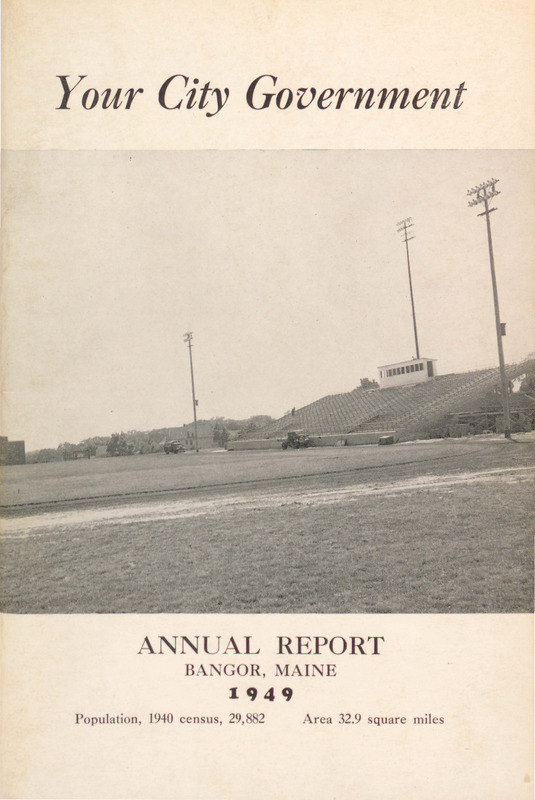
Public Works Highlights of 1950: The construction at Bass Park of the new reinforced concrete grandstand with a structural steel frame roof is probably the outstanding project of the year. The plans, specifications, and contract forms were prepared by the department. The grandstand was completed in time for the Bangor Fair. In addition to preparing the plans for the grandstand, the engineering division also established street lines and prepared plans for five new streets. Plans were prepared for a dental clinic at the Pine Street School and a fire station at Lane and Allen Streets. The construction of the dental clinic by a private contractor has been completed, but the City Council rejected the bids for construction of the fire station. The highway division carried on an extensive program of street paving. Two sections of Main Street, totaling 4,320 feet, were resurfaced with hot asphalt. With the completion of this work, the entire surface of Main Street has been covered with a modern type paving. Hot asphalt. paving was also placed on Pine and Hancock Streets. New construction of city streets was completed on Middle and Columbia Streets and a length of Doane Street. An extensive tarring program was carried out during 1950, with the result that nearly every street in the city was treated. A total of 275,365 gallons of tar was applied.
Foreword: During 1949 various improvements were made in civic operations andl services but there are still many more improvements left as a future challenge to all of us that we know are needed in order to see our city grow. In 1949 plans were made for future school building; new facilities were provided for both study and recreation. The next step in the Wilson report was taken when employment of architects to start the new school project for the West side was authorized but we still have unanswered the need for an expanded school budget that will give an amount sufficient for adequate maintenance and a budget that will enable Bangor to be competitive in the procurement of school teachers. During 1949 improvements were made to our existing sewer system and additional new sewer lines constructed. But here again we still have areas that need improvement and also areas with no service. We also have not answered the request of many of our people for water service in our outlying districts. These problems cannot be answered in any one year but rather call gor long range planning. We also recognized in 1949 that we must make further study in the problem of financing a municipal auditorium and steps were made in this direction by the formation of a committee to engage in such a study. We trust that you feel the year was brought to a successful close as indicated by a substantial cash surplus and by the improvements and the services which were given. The success of operation is due entirely to each employee of the City of Bangor and to each member of the various committees who have given utmost of their cooperation lo help make the successful year.
A few of the major policy decisions reached during the year, in addition to day-to-day business and routine changes in the laws and ordinances, are as follows: Decision to rebuild and construction begun on the fire destroyed City Farm Hospital. Appropriation for and work continued on tax equalization program for all property in the city. Decision to build and construction begun on addition to Fairmount School. City planning ordinance passed and Planning Board appointed. Plans made for construction of permanent steel stands and lights at Garland Street Athletic Field. Tax rate not increased from previous year. I believe our city is very well run, but would like to point out that it is the duty of all responsible citizens who are able to do so, to consider running for the City Council--a good sensible Council is the fundamental for good government.
During 1947, the city experienced 20 snowstorms varying from 1 inch to 12 inches and the total snowfall for the year amounted to approximately 63 inches. No particular difficulties were encountered in handling these storms and traffic was maintained at all times, with snow removal work being carried out promptly. Twice during January, the city experienced freezing rain storms which coated the streets and sidewalks with a sheet of ice making traffic conditions extremely dangerous. Prompt action on the part of the department by applying salt and sand prevented any serious tie-ups of traffic and greatly reduced the danger of accidents. To combat these slippery conditions, the department used 1493 cubic yards of sand and peastone on the streets, and approximately 500 cubic yards of sand on the sidewalks and 130 tons of salt on the hills and main traffic arteries in the downtown areas.
By ordinance enacted late in 1945, the City Council provided for the first time in our history for a full-time Building Inspector. This ordinance established a long needed provision for building regulations that will assure us of a better built city for the future and eliminate, over a long period of time, the many wooden structures now found in the congested area. While we would ordinarily welcome such a demolition program in the interest of commercial expansion and area improvement, it is regrettable that we were not in a position to further increase the available dwelling units by any residential construction. During the year several meetings were held in the interest of housing, and ways and means were sought to provide new dwelling units. At each meeting it was definitely concluded that building programs are primarily the function of private capital and of private interests, and that building controls, building supplies, and the labor market permitting the private interests would move quickly to supply the deficiency.
On August 11, 1945, forty-four months and seven days after it had started on December 7, 1941, the war which had engaged the full productive capacity of this nation for the past four years ground slowly to an end. The successful conclusion of this war, the outcome of which was never in doubt, was assured when the war in Europe ended with the complete capitulation of Germany on May 8, three months before the startling announcement that atomic energy had been employed to hasten the end of the conflict. Thus, on August 14, 1945, this country had passed through the first stage of its greatest crisis and had emerged with its courage undimmed, its hope for the future still high, and with unbounded faith in its ability to meet the problems of the future and to turn them into golden opportunities. Your City of Bangor has emerged from this period saddened beyond measure by the loss of 101 of its citizens who gave their lives in its defense, and today stands in full acknowledgement of its debt to them and to the 4,349 others who offered all they had in our behalf and who, in some cases, suffered irreparable physical and mental damage. It is the avowed intention of your city to erect a memorial that will, for a long time yet to come, suitably commemorate the unselfish devotion of these citizens to their fellowman.
During the past three years, a new problem has come to Bangor in the form of a lack of suitable housing. Altogether too many of Bangor's people are residing under improper conditions, conditions which are only tending to undermine the health of the community and to increase our deliquency problems. Some step must be taken to make better quarters available to these people and to compel the maintenance of standards thus established. While your management recognizes this problem, and is frank to bring it up for discussion, it does not as yet bave the answer to it. We recognize only that provisions for new and better quarters must be made at a cost within the means of these people before the present housing can be condemned.
The great war and its demands on manpower and materials has influenced the operation of your city to the same extent that it has controlled the policies of other corporate bodies. We have not found it possible, due to these shortages, to carry out our normal peacetime program and, as a result, we are rapidly accumulating a list of deferred maintenance work which will be taken care of when men and materials are again available. It is the established policy of the city to defer all maintenance work that can, with safety, be delayed until after the war. In pursuing this policy, we are not making further demands on an already limited labor market, nor are we using materials that are badly needed in the furtherance of the war effort. However, what is most important because of this deferred maintenance we are building a work program that will furnish employment to many of the men who will most certainly return to this city when the war is over, and who, by virtue of their service to their country, have every right to expect gainful employment.
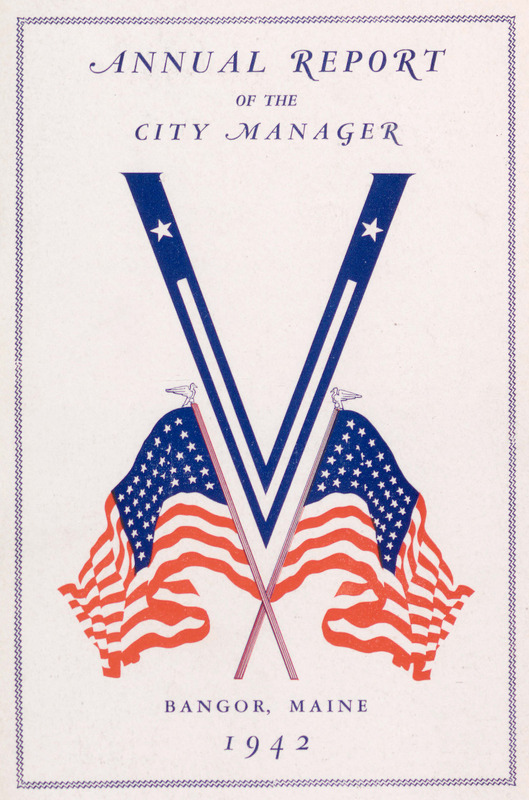
Review of 1942: Equipped Civilian Defense Control Center, and completed organization of city departments as integral parts of Civilian Defense Corps. Invested $21,500 surplus cash in United States War Bonds, replacing trust funds formerly used by city. Invested $25,000 cemetery trust funds in United States War Bonds. Installed Police Radio in transmitting station, police headquarters and four police automobiles. Appointed a full time Juvenile Officer. Appointed an Inspector of Eating and Drinking Places. Built new reinforced concrete Retaining Wall in Davenport Park. Built a new reinforced concrete bridge on Finson Road. Installed new Drag Line Bucket gravel loading equipment. Passed ordinances Establishing Bus Stations; Regulating Storage of Flammable Liquids: Prohibiting Fireworks; Providing for Appointment of Provisional Police; Creating the Office of Police Woman; and Establishing Taxi Stands.