Explore history through the digital collections of the Bangor Public Library and our community partners in Bangor, Maine
Bangor Public Library Annual Reports, 1937-1957
Title
Bangor Public Library Annual Reports, 1937-1957
Description
Account of library activities and accomplishments including a narrative Report of the Librarian, financial statements, list of board members and library personnel, statistics, and photographs.
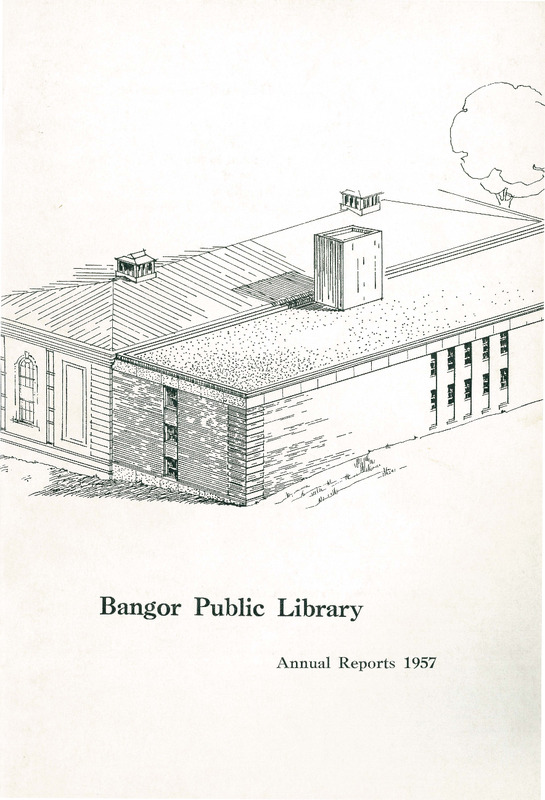
The long necessary book-storage addition to the library building was assured for 1958 by the unanimous action of the City Council on July 22, 1957 whereby was authorized a library bond issue of $100,000 and tax levy therefor...The addition will be a cube 100' x 30' x 30', with flat roof, directly at the rear of the present book-storage section of the library building. But three walls are required, as the fourth will be the rear wall of the present building. To save heat window area will be kept at a minimum. The new construction will provide one complete floor of shelving, at the level of the present main floor, with the necessary supporting columns below. The remaining floors of shelving, for which space is provided, may be added in later years as need requires and means permit. In the new building will be an automatic elevator, 3'6"'x4'8", to serve all levels of both buildings. There has never been any elevator in the present book-storage area of four floors. This has been a conspicuous lack.
It is gratifying to be able to report that the use of the library, as measured by the home use of books, increased 10% as compared with 1955. The total for 1956 was 322,642--for 1955, 292,553. The 1956 figure is the largest annual use in fourteen years. All departments–adult, children's, extension, music-shared in the increase. Obviously public interest, rather than any one thing that may have been done by the library other than meet the demand, is the explanation. The full use of clear plastic covers over the publishers' colorful book jackets may have whetted public interest. In two words, "improved packaging."...The supplying of home reading is far from being the only activity of the library. There is the reference department answering 12,329 questions--there is the job of giving out the Tello-Test answers 13,417 times--there are the book boxes supplied in 175 school rooms and 99 sets of encyclopedias in schools in Bangor. There are the 144 teaching units sent out by the children's department, the 102 story periods, the annual author's tea. There are seventeen exh1bits in the lecture hall and the 266 public meetings held free by 43 organizations in various rooms of the library. There is the intensive use of the reading room by high school students from one o'clock to four o'clock daily. There is the doctors' library at the Eastern Maine General Hospital and the law books in the Penobscot County Bar Library. The list could be extended a long way.
Our number one problem continues to be more space for books. A simple building addition to the book storage area is the answer to our need. When we can obtain $100,000 for construction our difficulty will be solved. On April 18, 1955 we told the City Council of this need. On June 21 we had the privilege of meeting with the council chairman and the city manager to discuss the problem, particularly in its financial aspects. The year 1955 did not bring solution of the problem. Solution in 1956 is, therefore, more than ever urgent...Among innovations in the library service were the opening of the children's room for two evenings weekly--the transfer of the children's story period from Saturday mornings to two afternoons for two different age groups--and the provision by the Junior League of Bangor of a book delivery service for shut-ins.
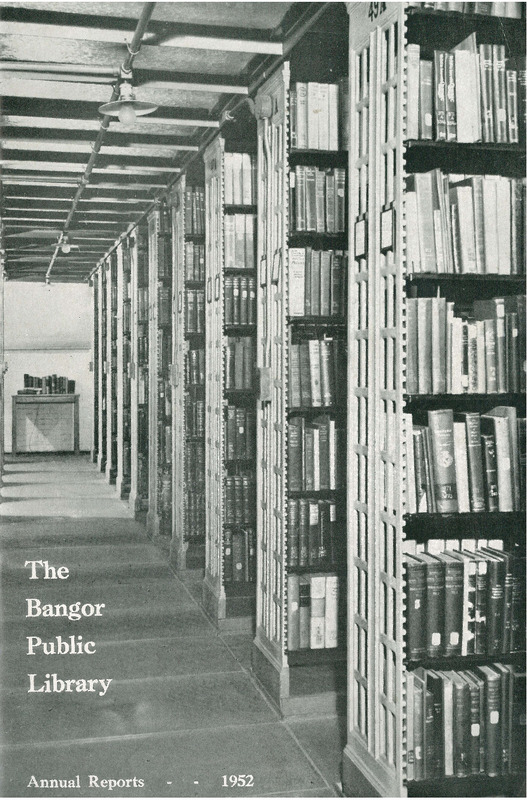
The library needs more room to put books. That is our principal problem. The process of discarding books no longer as necessary as they once were cannot be stepped up further. The makeshift of constantly moving books in the storage area, as more books are received, has gone as far as it can. The makeshift of adding shelves in the corridors a most inconvenient arrangement is nearly exhausted. The distribution of books to users has developed to a very high level. A simple addition to our book storage area is the answer to our need. This is not news to any of us associated in the management of the library. The approach of the suffocation point in the book storage area has been chronicled in the annual reports for the past nine years. When we can find $100,000 for construction our difficulty will be solved. That figure would give us storage space for thirty-six years.
"How has television affected the use of the library ?" was the question most often asked during 1953 by statistically minded people. The quick answer is, "Very little." The home use of books was 289,062, only 3% less than in 1952, which was the final year without television. It is only 9% less than the highest point in the past ten years. A more careful answer is that television is only one of many forces acting on the use of library books. Among forces are rather full employment, the wjdespread sale of paper-covered books, increasing quantities of periodical subscriptions sold by organizations raising money for their own projects, 3-D movies, and the lack of phenominal best sellers...On December 26 Alice M. Wetherell resigned from the position of children's librarian which she has held since October 23, 1923. To generations of children she has been ''the lady who owns the library." Her influence, extended through her knowledge of books, her delightful story-hours, and, above all, by her gracious personality, has been of immeasurable value. All of us who have been privileged to be associated with he are grateful for that privilege and happy for her in her marriage to Rowland G. Rice.
Our most pressing problem is lack of space for more books. Our net annual growth (additions less removals) for the past seven years has averaged 6,692 items. At this rate the suffocation point will be reached in two years. A new stack building added to the rear of the present one is the desirable solution of the problem, if only funds for building can be obtained. This problem was discussed, previously, in my annual report for 1947 and, recently, in a detailed special report to you...The packing, by our staff, of the museum collection of the Bangor Historical Society, occupied much time from early November to December. The move to the Society's new quarters at 159 Union Street was finished on January 22, 1953. After rehabilitation, the vacated space will be opened for library use. The Society is generously placing with us on permanent loan such of its books and papers as will add value to our collection. There will be many.
In 1951 two major improvements were effected--the re-modelling of the combined lecture and exhibition hall and the opening of the fiction room in the basement. In the lecture hall were installed two windows, museum walls of monkscloth over plywood, an asphalt tile floor, and folding doors. The whole room was refinished in a light color. The fiction room supplied a browsing and lounging area with open-shelf space for 3,000 books, in what was formerly a hallway area occupied, in part, by the military collection of the Bangor Historical Society. By arrangement with the society part of the military collection was packed and stored until such time as the society shall have its own, independent rooms, and part, was placed on display in the historical room on the upper floor of the library.
Our collection of phonograph records of music of enduring worth was put in operation at the music branch on June first. We have 484 dises in 107 albums. The collection is popular. Because of the difficulties of processing records on very tight work schedules it does not grow as fast as we would like. One of our greatest needs is for more shelf space open to the public where many books may be handled and inspected before being borrowed. Our plans for 1950 undertook to correct this, by providing an open-shelf fiction room for 2,500 to 3,000 books in the quiet basement hallway. Easy chairs and a browsing room atmosphere were parts of the plan. In July the shelves were ready for erection. They have had to be stored ever since, at some cost for insurance. The reason for this delay is that the Bangor Historical Society, whose weapons collection, through our courtesy, has for many years occupied the space now needed for the book room in the basement, has not yet succeeded in finding a place to which to move the weapons. The plans for the book room in no way affect the continuance of the Bangor Historical Society collection of pictures and relics on the top floor of the library building.
One of the interesting tasks set this library by the Public Library Inquiry of the Social Science Research Council, which was concluded in 1949 and whose results are now being published in a series of books, was to define the purpose of the library. In abridged form, my definition was as follows: The purpose of the Bangor Public Library is to preserve and disseminate knowledge and thought as recorded in print--to provide recreation through print--and to provide a maximum of assistance to its clients in the use of its collections. We are a general library yet we are also a library of record. We aim to provide printed material on all subjects likely to be of concern or interest either to present or potential users of whatever age or education. We recognize the scholarly resources of our neighbor library of the University of Maine and are interested that each library shall complement the other. The home-use privileges of the Bangor Public Library are free to all residents and to whoever, regardless of place of residence, works, goes to school, or pays taxes in Bangor.
The library operated not merely from its central building, but from a total of 142 different locations: 1 central library, 2 branches, 116 collections in all public and parochial schools, and 23 collections in institutions. Most popular of the library distributing points outside the central library as indicated both by the statistics and the appreciative comments of users was the patients' library at the Eastern Maine General Hospital. There two members of the Bangor Public Library staff each spend ten hours a week lending reading matter throughout all the wards and rooms. They issued 11,119 books in the hospital in 1948.
The library now contains 251,116 books. That is 8.42 books per capita. During the year 11,000 books were added and 3,696 were removed, making a net gain of 7,304 in 1947. Home use of books in 1947 amounted to 308,058. That is 10.33 per capita, or 16.14 per registered borrower. There are 19,087 registered borrowers. The library operated not merely from its central building, but from a total of 141 different locations: 1 central library, 2 branches, 117 collections in schools, and 21 collections in institu-tions. For 41 weeks the central library was open 72 hours a week. For the 11 weeks of summer the central library was open 54 hours a week. Twelve per cent of the cost of running the library in 1947 was supplied by city appropriation and 88% was supplied from other sources, mostly income of trust funds. These percentages were the same as in 1946.
The record of Bangor citizens who served in the armed forces in World War II, begun by the library in 1944 reached near completion in 1946 with 3,325 service records collected. Copy for the Book of Honor of Bangor men killed in the war, which we have been compiling and writing, was finished and sent to the engrosser. The book will contain 110 names. For 101 of these there are separate biographical pages with photographs. Alice M. Wetherell, children's librarian, gave a University of Maine extension course in children's literature. She and her assistants, Charlotte M. Torrey and Eileen B. Parker, gave 65 classes in the use of the library. Isabel R. Carroll, of our staff, gave a course of 12 lessons in the use of books and libraries at John Bapst High School. Olive M. Smythe, reference librarian, gave 14 classes on the use of the library to Bangor High School students. Our constant objective is to make the library useful to all comers.
During 1945 we distributed books at 148 locations throughout Bangor: school rooms, hospitals, residential institutions, other libraries, and our own central library and two branches. In our information department, work, as measured by questions requiring research, increased 15% over the year before. Reserves of books for home use increased 12%. The gain here was principally in the months since the end of the war. These are straws which may indicate that as Bangor's soldiers and sailors continue to return and now that there is gasoline in every auto, the use of the library is likely to rise rapidly to the level of the pre-war years.
Overseas every day some Bangor soldier will write to his mother something like this, "Do you remember that jelly I used to like so much?" or, "There's a little bird here that sings only in the hour just after sunset. You won't see him anywhere else in the world," or, "The time here is six hours ahead of your time," or, "I just saw the original of the statue we used to have on the piano." These are all devices for telling mother, without aiding the enemy, where the soldier is. Perhaps mother reads the message all right. Perhaps not. If she does not, she will phone or call at the library to find out what jelly is named after a city, or what bird sings just after sunset, or for the answer to the time question, or for the location of the original of the Winged Victory. And many times, but not always, the library can answer.
Elmar Trickey Boyd: On October 27, 1942 died our beloved former librarian, Elmar Trickey Boyd. His life is here remembered in a resolution adopted by the Board of Managers of the Bangor Public Library at its regular quarterly meeting, held on the day of his passing: Resolved: The Board of Managers of the Bangor Public Library holds in honor the memory of Elmar Trickey Boyd who served this institution as librarian for sixteen years, from 1921 to 1937, and as consulting librarian for six years, from 1937 until his death in 1942. It hereby records its appreciation of his many contributions to the advancement of the purposes of the library. His mind not simply open to the best ideas, but seeking them actively and creating them, brought to Bangor and employed the finest methods that library science has developed. Under his regime the public use of the library increased fourfold to a degree rarely equalled elsewhere. His kindly personality established an atmosphere of riendliness in the institution that made and still makes it better able to perform its mission, the wide dissemination of knowledge.
It is normal for the Bangor Public Library, in its field of books and information services, to keep abreast of public interest or to anticipate it. In 1941 it was normal for us to do something to help meet abnormal conditions. For business men we added or went on with such continuously up-to-date services as the Research Institute of America's "Business and Defense Co-ordinator," Prentice-Hall's "Federal Tax Service" and "Internal Revenue Code," and Moody's "Investors Service." For air raid wardens we supplied current pamphlets and such authoritative books as Col. A. M. Prentiss' "Civil Air Defense." For Red Cross first aid students we had the "First Aid Text-book." We gave the use of our lecture hall for many Red Cross classes. For aviators we supplied books on aeronautical meteorology, mathematics, and air navigation. When our 152nd Field Artillery went to Camp Blanding we offered to mail books to Bangor soldiers not only in that unit, but also in any other and to sailors. That very few have yet used this service does not spoil the idea. The offer still stands. When the U. S. Army Engineers began the construction of the Bangor Air Base and, later, when the base was manned by the Air Corps, we extended the full use of the library free to all military new-comers and their families. A total of 405 Air Base men have become borrowers. We have lent a library of 1000 volumes to the morale department for recreation hall T-6 at the base and a library of 300 volumes to the hospital at the base. These are unusual activities, but simply a part of our normal job of keeping up with the times.
During 1940 the Bangor Public Library operated not merely from its fine central building on Harlow Street, but from 190 other locations. This wide distribution of its work, which has been the rule for many years, deserves to be better known. Bangor's total home use of library books in 1940 was 416,029, a record figure, yet only 306 higher than the total in 1939, its previous record year. Nineteen percent of this use was from collections of ours located elsewhere than in the central building. From collections in 157 public or private school rooms or school libraries 38,213 items were lent--from the Music Branch in Symphony House, 11,939--from the patients' book truck at the Eastern Maine General Hospital, 11,138--from the public sub-branch at the Forest Avenue Congregational Church, 10,050. BOOKS EVERYWHERE. From 23 collections in such places as the Home for Aged Women in Bangor, the Eastern Corporation, St. Michael's Orphanage, the Bangor Osteopathic Hospital, and Camp Jordan 8,762 books were lent. Seven considerable collections are in locations such as the Penobscot Bar Library Association and the Doctors' Library at the Eastern Maine General Hospital where the books are consulted on the premises and not lent for home use.
More copies than ever of the most popular novels were bought. The number of children's story periods was increased from 51 to 60. Saturday evening hours were added for the children's room. Thirty-two broadcasts over WABI and 39 other book talks were given by the librarian and six other staff members. Newspaper articles, both by members of our staff and by the editors and staff writers of the "Bangor Daily Commercial" and "Bangor Daily News" to whom, with WABI, we are most grateful, kept the public informed of every activity of the Library. It is a fact first realized by many citizens in 1939, though it has long been so, that the Library maintains collections not only in its Harlow Street building, Music Branch, and Forest Avenue Church Deposit, but also in 186 other locations. We told more clubs that our lecture hall and historical room are free for free public meetings of an educational, literary, or scientific nature. More clubs made use of that knowledge, holding 146 public meetings in one or another of our rooms. We encouraged organizations to hold or sponsor exhibits here. Four exhibits were arranged by the Library--ten, by other organizations. We conducted 92 classes, with a total attendance of 2,505, in the use of the Library. We lent books not only over the desk in Bangor, but by mail to 142 individuals and 33 libraries in 109 other cities and towns. All this makes Bangor more favorably known.
The average annual growth of the number of volumes in the Library for the ten years from 1929 through 1938 has been 6,728. At this rate, which is not excessive considering the large use made of our books, we shall in 1941 have to erect new shelves in the last space now remaining in our stack section. The shelves that can be installed in 1941 will, if the rate of growth is not increased, accommodate our additions until 1946, but not beyond. Before 1946 we shall have to seek funds for the erection of an addition. It is not too soon for us to begin to consider ways and means of obtaining them.
In submitting the 55th annual report of the Bangor Public Library I bring to your attention, first of all, that Bangor people are reading more and more works of fact. The per cent of adult nonfiction in the total circulation rose from 24 in 1936 to 26 in 1937. The per cent of adult fiction declined from 51 to 50. The per cent of juvenile circulation went down from 25 to 24...Seventeen public addresses and. 34 radio broadcasts in our series, "Books People Like," were made by the Librarian. Three addresses were made by the Children's Librarian. Single broadcasts in the radio series were made by Olive M. Smythe, Helen Washburn Yost, and Roberta E. Smith...The Library has many friends. Conspicuous among these are radio station WABI, which has made possible our weekly broadcast --the Bangor Daily Commercial, which has produced our book column, "At the Library Tonight" in most attractive form and published it three times a week--and the Bangor Daily News, which describes our bookish doings on its home page.