Features a photograph and short article about the installation of cement ties for the street railway system on College Avenue in Orono, a picture of and story about the dam at Gilman Falls, and an extensive article about long-time employee, Elmer C. Cole.
Provides biographical and work history profiles for over two dozen employees of the Bangor Hydro-Electric Company. Also includes photographs and a lengthy description of a canoe trip along the East Machias River by employees of the company.
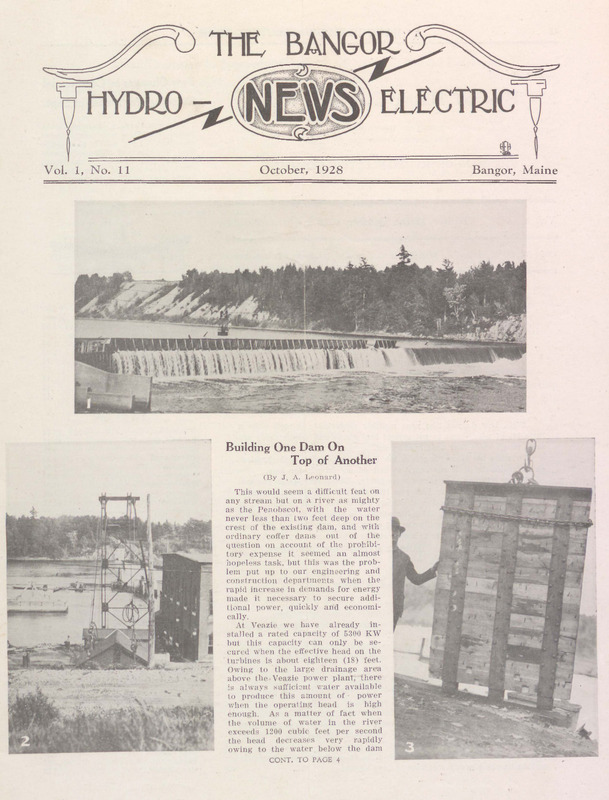
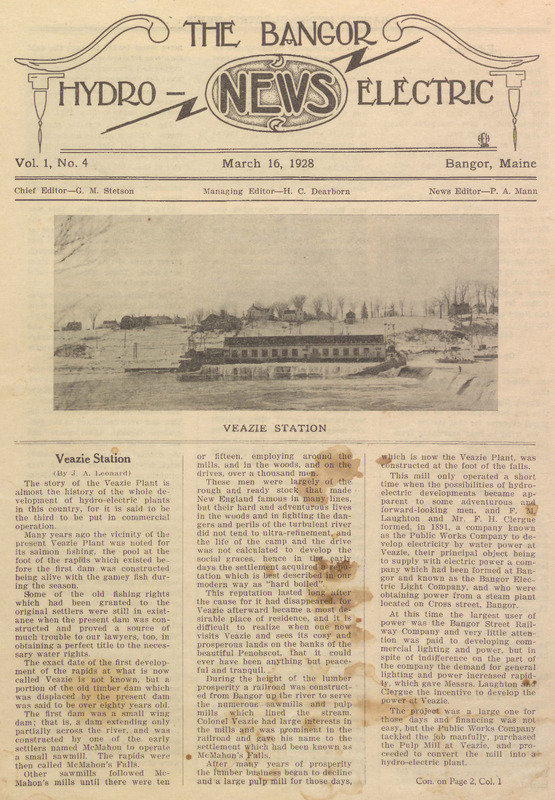
Details the efforts of the engineering and construction departments of the Bangor Hydro-Electric Company in improving the Veazie dam to accommodate the increasing demand for hydroelectric power. Also includes a profile of W. E. Bagley, a freight agent and substation operator for the company, who had worked for the company for 26 years.
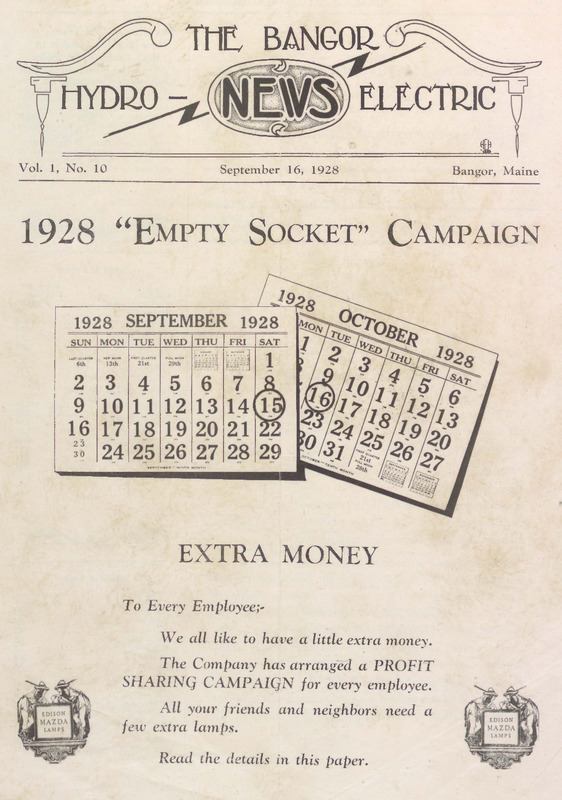
Endorses employee participation in the "Empty Socket" campaign, a competition to sell cartons of 60-watt lamps. " A very large portion of the profits of the lamp sales are handed on to our employees but the Company will benefit by the increased load that will be derived if the campaign successfully fills every empty socket in every home that the Company serves." Also reports on the wedding of employees Grace Ethel Cotton and Harvard Edgar Moor, and ends with a memorial to Alvin R. Mann.
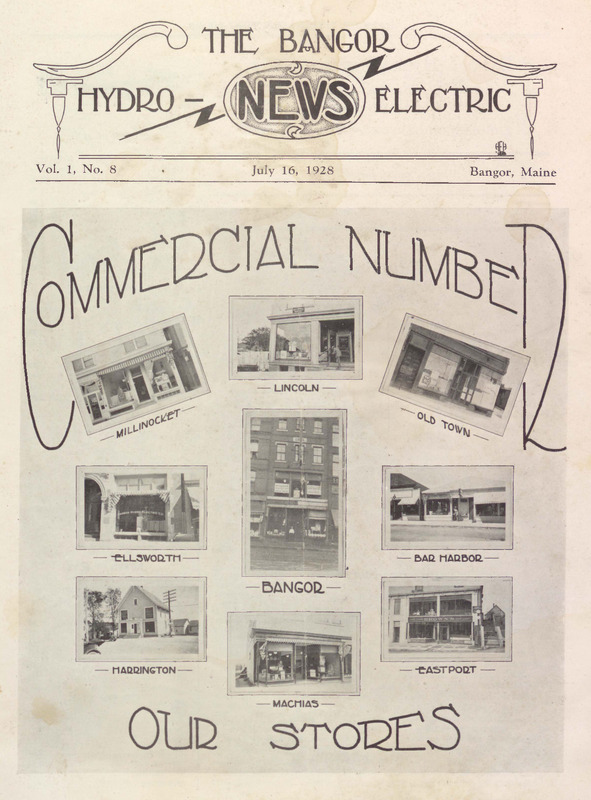
Profiles salesmen for Bangor Hydro-Electric Company in offices from Millinocket to Eastport. Honors long-time employees George W. Austin and Allen P. Royal.
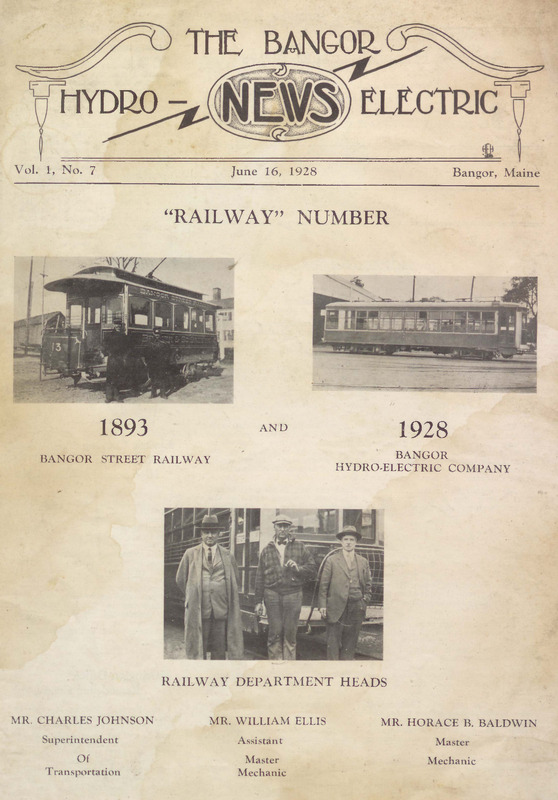
Covers the history of the street railway business in Bangor, Maine and surrounding areas, from 1893 to 1928, as it transitioned from the Bangor Street Railway to being operated by Bangor Hydro-Electric Company. Profiles employees Edson E. Comins, Assistant Superintendent of Transportation in the Bangor office, and Mortimer D. Wentworth, a 30-year veteran trolley car operator.
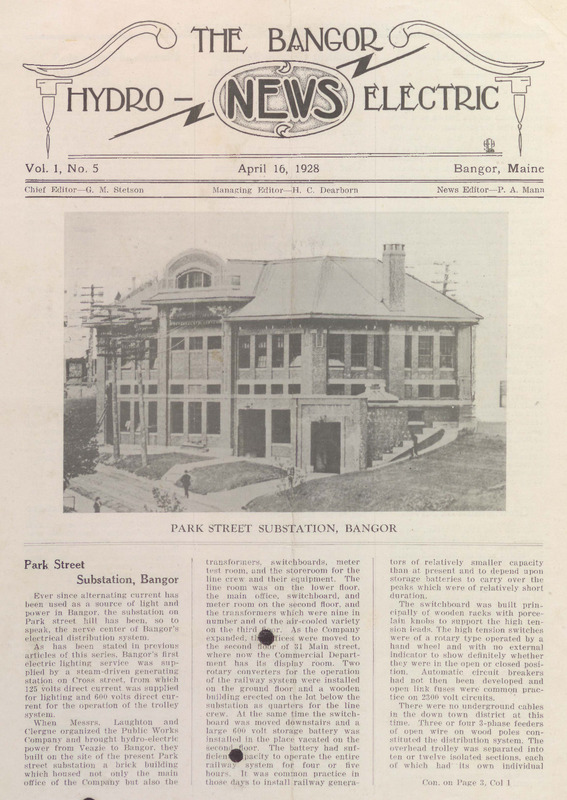
Provides an extensive description of the Park Street Substation for the Bangor Hydro-Electric Company. At the time, the substation controlled all the lighting power and railway service in the cities of Bangor and Brewer and the towns of Hampden, Orrington, Newburg, Dixmont, Hermon, Levant, Etna, Carmel, Kenduskeag, Glenburn, Corinth, and Charleston. These services were to be in the near future extended to Garland, Exeter, and Bradford. The substation was also the headquarters for the Line Crew of the Bangor district, the Meter Department, and the Electrician's Crew. Also includes profiles of employees Arthur L. Davis and Charles H. Johnson, a legendary figure in the history of the company.
"The story of the Veazie Plant is almost the history of the whole development of hydro-electric plants in this country, for it is said to be the third to be put in commercial operation."